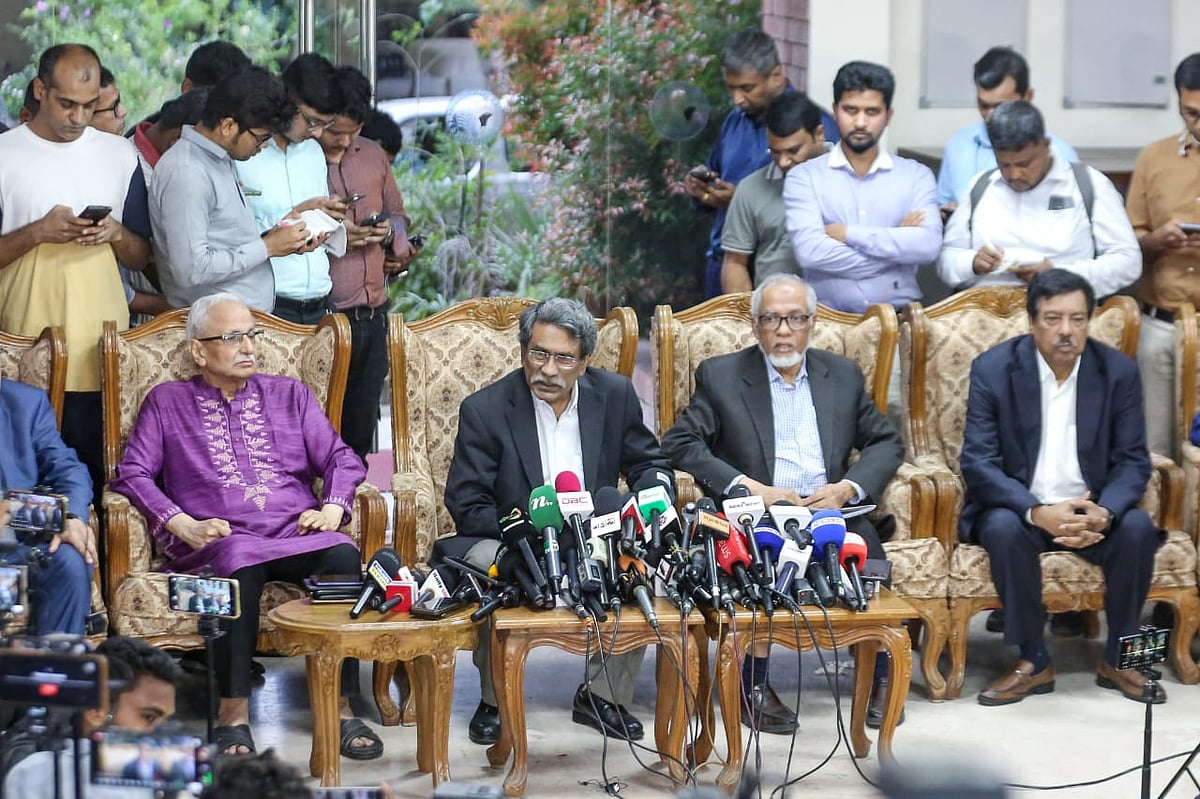
July Charter: Consensus Commission seeks guarantee for implementation
The National Consensus Commission has finalised a framework for implementing the July National Charter, but it has yet to find a way to ensure that the next parliament will actually implement the proposed constitutional reforms within the specified timeframe.
According to commission sources, the current idea is to include a provision in the forthcoming July Charter Implementation Order that would require the next parliament to implement the charter within nine months of its formation.
However, the commission has not yet decided what consequences would follow if that deadline is missed.
The July National Charter was signed on 17 October, with 25 political parties and alliances endorsing it so far. Five parties, including the National Citizen Party (NCP), have not yet signed.
Sources said that in a meeting with the commission on Saturday, the NCP stated it would not sign the charter without a clear guarantee of implementation. The commission wants all parties to be signatories, but several others may also object if such guarantees are not included. Commission members fear that without this assurance, the long effort to reach reform consensus may collapse.
The tenure of the National Consensus Commission ends on 31 October. Before that, the commission is supposed to submit a set of recommendations to the interim government outlining ways to implement the July Charter.
The commission aims to propose a legally and politically acceptable mechanism for doing so.
Yesterday, the commission held a lengthy meeting with a panel of experts, including retired judges, university professors, and lawyers. It plans to meet again on Sunday morning, possibly with experts once more if needed.
Options in commission’s consideration
Sources said the commission is considering issuing a “July Charter (Constitutional Reform) Implementation Order” based on the people’s uprising. Under this order, a referendum ordinance would be issued, and the referendum would be held accordingly. For a certain period, the next parliament would also function as a Constitutional Reform Council, working alongside its regular duties. Within nine months, the parliament would approve the proposed constitutional reforms.
However, the commission is still debating what would happen if this deadline is not met.
At Saturday’s meeting, the commission and experts discussed possible mechanisms to ensure that the next parliament follows through. Two options were raised earlier on Thursday: to include a clause stating that if the reforms are not implemented within nine months, parliament will be dissolved; or to stipulate that if parliament fails to act within the timeframe, the reform proposals will be deemed automatically enacted.
Problems with options
Participants discussed the pros and cons of both ideas in detail. Many agreed that the automatic dissolution of parliament might be legally valid but politically unacceptable, as it would require a new election within a year—raising the question of who would oversee it. Without constitutional reforms, the caretaker government system would not yet be incorporated into the constitution, meaning the election would again be held under a party government, risking renewed political turmoil. Moreover, holding another election within a year would be highly costly and complex.
Multiple sources present at the meeting said the meeting opined that automatic enactment option also lacks logic. Since the charter itself is not being introduced as a bill and some of its provisions—such as the expansion of fundamental rights—require further parliamentary discussion, automatic approval would not be realistic. Ultimately, the reforms must still be adopted by parliament; they cannot simply enter the constitution by default.
A third alternative
Another proposal discussed was to initially constitute the new parliament solely as a Constitutional Reform Council or Constituent Assembly, allowing members to take their oaths as regular MPs only after completing the reforms. This could hasten the process, but it raises the question as to who would govern the country in the meantime? Experts and commission members agreed that leaving governance entirely to the interim administration would be politically impractical.
Some members believe that the next parliament could simply be given a fixed deadline to complete the reforms. However, the NCP and some other parties are unlikely to accept that approach.
The commission has also not finalised the scope and authority of the proposed Constitutional Reform Council. Some members think the next parliament should be vested with constituent powers, allowing it to pass constitutional amendments by a simple majority, rather than the usual two-thirds requirement. The Speaker of Parliament would preside over the council.
Recommendation expected soon
The commission held a long meeting yesterday from afternoon to evening at its secretariat in the National Parliament complex, attended by several legal experts including Justice (retd) MA Matin, Professor Mohammad Ikramul Haque (Dean, Faculty of Law, University of Dhaka), and senior lawyers Sharif Bhuiyan, Barrister Imran Siddiq, and Barrister Tanim Hossain.
Commission vice-chair Professor Ali Riaz, members Badiul Alam Majumdar, Justice Md Emdadul Haque, Iftekharuzzaman, and Mohammad Ayub Mia participated on behalf of the commission. Monir Haidar, special assistant to the chief adviser leading the national consensus process, was also present.
In a statement, the commission said it hopes to submit a clear and comprehensive recommendation to the government soon on implementing the July Charter.
Earlier in the morning, the commission also met with the NCP at the Parliament’s LD Hall.
Commission vice-chair Professor Ali Riaz told Prothom Alo that NCP representatives expressed their willingness to sign the charter but sought clarification on several points. The commission has sought some explanation to them. The commission also discussed their concerns with experts.
The NCP’s proposals have both positive and negative aspects, and the commission is proceeding carefully.
Our main goal is for all parties to sign the charter, he added.