Low health risk if infected after vaccination: Study
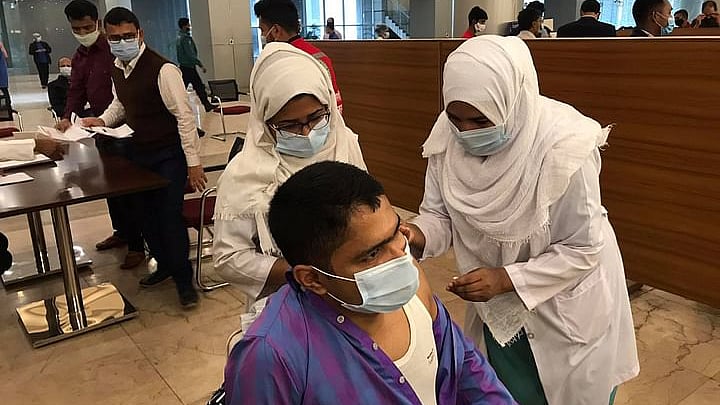
Even after taking the first dose of vaccine, many are being infected with coronavirus, but their health risk is much lower than others, according to a study.
The study conducted over 200 coronavirus infected patients has revealed that more than 88 per cent of the patients did not have any breathing problem and 92 per cent of the patients did not need oxygen.
It was conducted by a group of researchers from Chattogram Veterinary and Animal Sciences University (CVASU). It had been conducted from 7 February to 13 April. The study was conducted on the people who took the first dose of coronavirus vaccine from 7 February.
Led by CVASU vice-chancellor prof Gautam Buddha Das, the study involved prof Sharmin Chowdhury of the same university, teacher Iftekhar Ahmed and four veterinarians - Tridip Das, Pranesh Dutt, Sirajul Islam and Tanvir Ahmad Nizami.
Speaking to Prothom Alo on the study, Gautam Buddha Das said that although the people, who have taken the first dose, are being infected with coronavirus, their health risk is much lower than the people who have not taken the first dose. Risk of death is low too. So it is important to get vaccinated for ensuring safety.
Samples of some 6,146 people had been tested at the Covid-19 lab of CVASU from 15 February to 14 April. Among them, some 1,752 samples (28.5 per cent) tested positive for coronavirus. As many as 200 among them had already taken the first dose of coronavirus.
According to the assessment of the study, some 165 (82.5 per cent) of those 200 did not have to go to the hospital. Although 35 (17.5 per cent) of them had to go to the hospitals, they did not have any severe complications.
Covid-19 infected patients usually suffer from severe breathing problems. CVASU’s study, however, has revealed that some 177 (88.5 per cent) of the vaccinated coronavirus patients did not suffer from any breathing problem and 184 among them did not need oxygen.
Those who needed oxygen and suffered from breathing problems were suffering from old age complications.
The primary symptoms of coronavirus patients are fever, sneezing and cough. The study found that 89 (44.5 per cent) and 182 (91 per cent) of the vaccinated patients did not have a cough or sneeze. And those who were suffering from these problems recovered within three to seven days. There was no change in the taste of 113 people (56.5 per cent) and smell in 111 people (55.5 per cent).
The average oxygen saturation of vaccinated patients is 96.8 per cent. The breathing problem did not last more than five days among the vaccinated patients. Their lowest oxygen saturation level was 90 per cent. Most of those who did not take the vaccine had a minimum oxygen saturation of 85 per cent.
Only one of the 200 vaccinated patients had to be admitted in the intensive care unit (ICU). He died six days later. That 48-year-old patient was already suffering from kidney complications and his kidney was transplanted.
Speaking to Prothom Alo, professor Sharmin Chowdhury of the Pathology Department of CVASU, said, “We have compared the health complications of the vaccinated and non-vaccinated coronavirus patients. It has been found that people who have taken the first dose faced less health complications than the non-vaccinated patients. They were almost out of risk.”
According to the study, on the basis of age and gender, some 129 (64.5 per cent) patients had previously suffered from various health-related diseases. Of these, 36 had high blood pressure, 32 had diabetes and five had allergies. Besides, 51 people were suffering from multiple diseasess.
The study found that most of the patients got infected 32 days after the vaccination. Their average body temperature was 101 degree Fahrenheit. Based on age and gender, their highest and lowest temperatures were 99 degree and 104 degree Fahrenheit respectively.
Professor Aniruddha Ghosh of the medicine department of Chattogram Medical College Hospital told Prothom Alo that the study is definitely positive. It can also be conducted on a larger scale to make people more interested in getting vaccinated.
He said, "The patients we are getting now shows that the health risks are less among the vaccine recipients. Everyone should take the second dose of the vaccine as well.”
*This report appeared in the print and online editions of Prothom Alo and has been rewritten in English by Ashish Basu