Durga Puja: Sampriti Jatra marks 29 districts at risk of communal violence
Social platform ‘Sampriti Jatra’ has marked five districts as high-risk and 24 as moderate-risk of communal violence ahead of the upcoming Durga Puja.
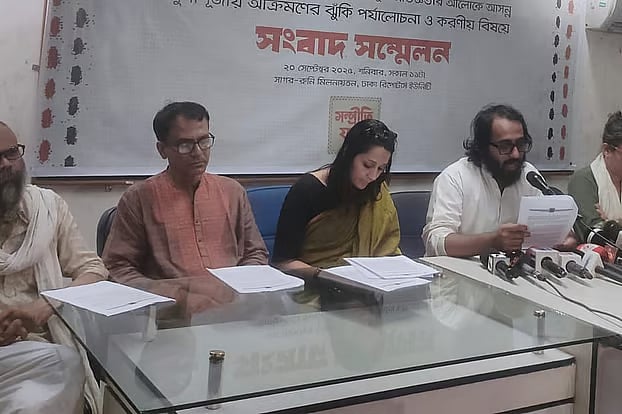
The platform made the announcements on Saturday at a press conference at the Dhaka Reporters Unity’s Sagar-Runi auditorium.
The high-risk districts are Dhaka, Rangpur, Jashore, Chandpur and Noakhali.
According to the map, the moderate-risk districts include Gazipur, Faridpur, Manikganj, Rajbari, Chattogram, Bandarban, Cumilla, Brahmanbaria, Lakshmipur, Feni, Pabna, Chapainawabganj, Natore, Lalmonirhat, Dinajpur, Gaibandha, Satkhira, Bagerhat, Khulna, Kushtia, Sunamganj, Barishal, Patuakhali and Netrokona, while the rest are categorised as low-risk.
Sampriti Jatra said the risk map was prepared by analysing reports of attacks on puja mandaps, religious processions and minority households published in various media outlets and human rights reports between 2014 and 2025.
The organisers said the platform was formed at the initiative of various writers, literatures, poets and social and cultural activists. Soon, committees will be formed in different districts and upazilas under this platform to work for the protection of temples, shrines, other religious sites, and the security of minority communities.
At the press conference, conducted by cultural activist Bithi Ghosh, the written statement was read out by writer and researcher Mir Huzaifa Al Mamduh. He said that it is the duty of the law enforcement agencies to investigate allegations against anyone. However, for more than two decades, there has been a destructive campaign to undermine communal harmony in the country, which has only expanded over time. Even after the mass uprising of 2024, driven by the aspiration for equality, no positive change has been seen in this trend.
Citing that the enjoyment of religious freedom is the constitutional right of every citizen, Mir Huzaifa Al Mamduh said, “It is the fundamental duty of the state to ensure the protection of religious, ethnic, linguistic, and cultural minority communities. If advance preparation, effective law enforcement, accountable administrative measures, and participation of the local community can be combined, then the cultural security of temples, shrines, ‘akhras’, and marginalised communities can be ensured.”
From the press conference, Sampriti Jatra announced several measures. These include forming local ‘sampriti’ (harmony) committees, monitoring and documentation, ensuring information flow to counter rumours, setting up rapid assistance mechanisms, and preparing reports and policy recommendations.
The organisers said that Sampriti Jatra is not merely an event-based immediate response, but a long-term movement for structural reforms to ensure harmony and coexistence.
Sampriti Jatra has also called on the interim government to deploy additional police and rapid response teams to ensure the safety of temples, shrines, akhras, and marginalised communities, establish mechanisms to counter rumours, maintain transparency in receiving complaints, implement technological security measures, and provide emergency assistance to those affected.
Maha Mirza, a part-time lecturer in the economics department of Jahangirnagar University, said, “The incidents we are discussing have already been reported in various media outlets. However, we have not seen strong action from the government. We believe that if the government truly wanted to, mob violence could be stopped. But it is clear that the interim government is completely turning a blind eye to these crimes.”
Referring to the “fear” among minorities after the July uprising, Maha Mirza added, “One of the core spirits of the July mass uprising was a Bangladesh built on empathy. A key aspect of that spirit was that people of all religions and ethnicities would live together. It’s a very simple idea. But the Bangladesh we see today is deeply frightening, and we are actually angered by the government’s behaviour.”
A nationwide programme under the name Sampriti Jatra was also announced from the press conference.
The organisers said they would form a fact-checking team to prevent communal incitement and misinformation. In addition, resistance networks will be built in high-risk districts involving local citizens and social organisations, minority groups, Sufi- and shrine-based organisations, ‘baul and fakir’ communities, indigenous groups, women’s organisations, cultural and professional associations, and progressive members of political parties.