Memorials
Liberation war sculptures still damaged
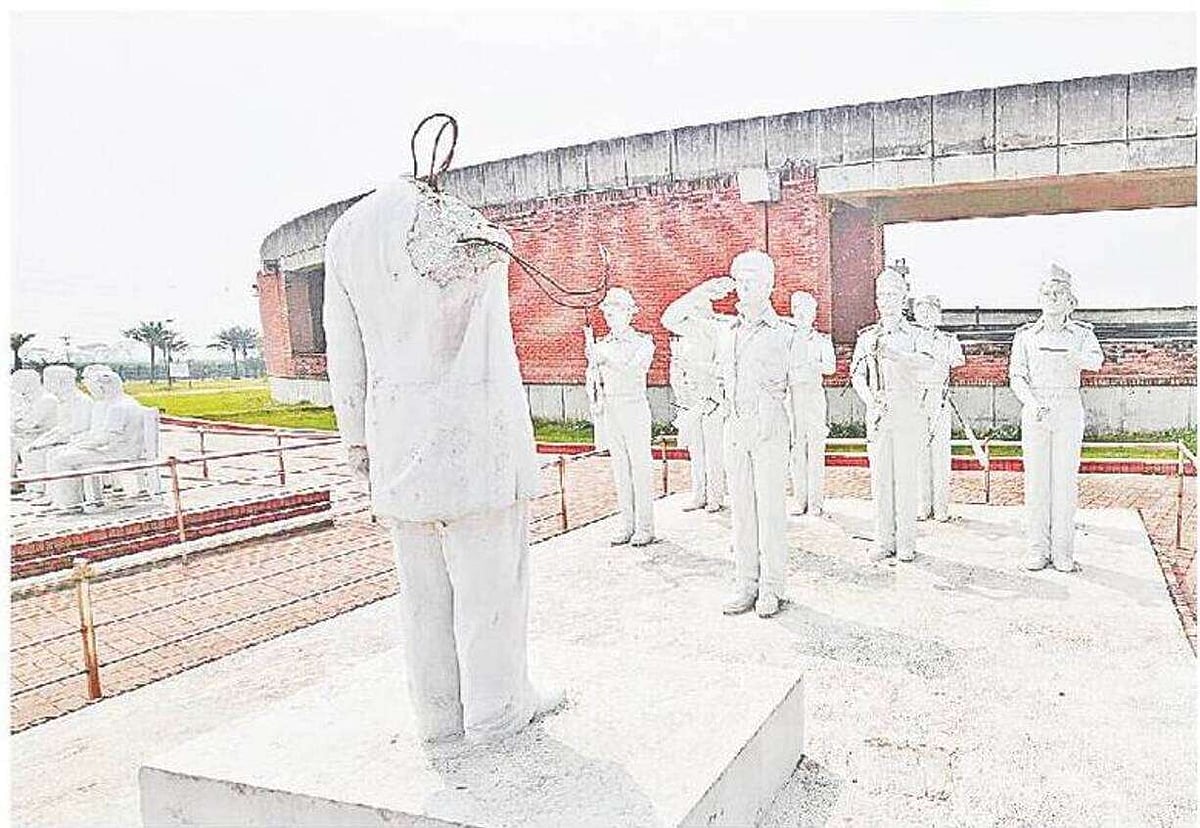
On 5 August 2024, the day the Bangladesh Awami League (AL) government fell during the July mass uprising, vandals attacked the Mujibnagar liberation war memorial complex in Meherpur in two phases. They demolished several sculptures, which remain unrepaired to this day.
Among the many sculptures at the memorial centre is one depicting the Guard of Honour given to the country’s first Acting President, Syed Nazrul Islam.
On 17 April 1971, at the oath-taking ceremony of Bangladesh’s first provisional government held in the mango grove at Mujibnagar, 12 Ansar members presented a Guard of Honour to him. The sculpture had captured that historic moment.
A visit to the memorial centre on 13 March revealed that the arm of Syed Nazrul Islam’s sculpture remains broken. The rifles held by the Ansar members have also been smashed. Almost every sculpture bears visible signs of damage.
On the day the AL government fell in the 2024 student–public uprising, and in the days that followed, attackers vandalised sculptures, murals, and various installations named after Bangabandhu Sheikh Mujibur Rahman across the country.
At the same time, they also targeted Liberation War–related sculptures, murals, memorials, museums, and sites associated with mass killings. Freedom Fighters’ complexes in districts and upazilas also came under attack.
Between 5 and 14 August 2024, correspondents of Prothom Alo documented incidents of vandalism, arson, and uprooting involving 1,494 sculptures, relief sculptures (figures carved on walls using ceramic or terracotta), murals, and memorials across 59 districts. Most of these incidents occurred on 5, 6 and 7 August.
During the tenure of the interim government formed after the July uprising, authorities did not undertake any visible initiative to repair Liberation War–related sculptures and similar structures.
At the time, several responsible officials of the Ministry of Liberation War Affairs, speaking on condition of anonymity, said that most of these sculptures had been constructed during the Awami League government according to its own preferences, and they did not accurately reflect historical reality.
Meanwhile, the BNP government, which assumed office on 17 February, is yet to take a decision on the matter.
On 16 March, the Minister for Liberation War Affairs, Ahmed Azam Khan, told Prothom Alo, “I have only just assumed responsibility. I will speak on this matter after fully understanding all aspects.”
Mujibnagar liberation war memorial complex
On 17 April 1971, Bangladesh’s first government took oath in the mango grove at Baidyanathtala in the then Meherpur subdivision. The Mujibnagar Smriti Saudha was inaugurated at the site on 17 April 1987.
In 1996, authorities initiated the establishment of the Liberation War memorial complex there.
The centre presents various sectors of the Liberation War through a map and features sculptures commemorating major events of the war.
According to police and local residents, on the afternoon of 5 August 2024, a group of more than a hundred people entered the memorial centre carrying iron rods, bamboo sticks, and hammers.
They first broke the head of the sculpture of Sheikh Mujibur Rahman. They also vandalised the ‘Guard of Honour’ sculpture, the sculpture depicting the surrender of Pakistani forces, and smaller sculptures representing the 11 sectors of the Liberation War arranged in the shape of the national map. The entire complex suffered extensive damage.
In September last year, the then Deputy Commissioner (DC) of Meherpur, Mohammad Abdus Salam, wrote to the Ministry of Liberation War Affairs, outlining the extent of damage to the installations at the Mujibnagar Liberation War memorial complex.
The letter reported losses amounting to Tk 6.1 million (61 lakh) across various structures and requested an allocation for repairs. However, the Ministry of Liberation War Affairs was unable to provide the funds.
The Secretary of the Ministry of Liberation War Affairs, Ishrat Chowdhury, told Prothom Alo that the ministry does not have sufficient funds to renovate the Mujibnagar Liberation War memorial complex.
She added that they had requested funds from the Ministry of Finance but had not received any. She further noted that authorities have now taken the initiative to implement the renovation through a development project.
Among the Liberation War memorials that suffered vandalism is the Swadhinata Chattar and Smrity Stambha built on the bank of the Chitra River in Bagharpara upazila of Jashore.
Freedom fighters and people from all walks of life used to observe Independence Day and Victory Day there. On 5 August 2024, vandals demolished both the Swadhinata Chattar and the Liberation War Smrity Stambha.
A Prothom Alo correspondent in Jashore reported that two BNP leaders, a Jubo Dal leader, and a BNP activist later erected shops at the site.
They removed the shops a few days later. Since then, people have been using the area to park battery-operated easy bikes and to store various goods.
Speaking on the matter, freedom fighter Solaiman Hossain Biswas told Prothom Alo that he felt shocked and distressed when the Swadhinata Chattar and the Liberation War Smrity Stambha were demolished.
He expressed his hope that authorities would reconstruct a proper Swadhinata Chattar and Smrity Stambha at the site.
Damage to freedom fighters complexes estimated at nearly Tk 210 million
During the tenure of the Awami League government, authorities constructed freedom fighters’ complexes in all districts and upazilas across the country.
The plan envisioned that freedom fighters would gather there to share experiences, exchange views, and spend time, while rental income from parts of the complexes would cover maintenance costs.
During the fall of the Awami League government, these complexes also came under attack.
In September last year, the Ministry of Liberation War Affairs wrote to all Deputy Commissioners (DCs) and Upazila Nirbahi Officers (UNOs) to determine how many freedom fighters’ complexes had been damaged across districts and upazilas.
The letter stated that complexes generating higher income could use 40 per cent of their earnings for building maintenance.
Those unable to finance repairs from their own income were instructed to report the extent of damage and the required funds to the ministry.
Based on information submitted by field administrations, the Ministry of Liberation War Affairs compiled a list of damages to district and upazila freedom fighters’ complexes.
The list shows that 113 complexes suffered vandalism, requiring approximately Tk 205 million (20.5 crore) for repairs.
Of these, the ministry allocated Tk 15 million (1.5 crore) during the interim government’s tenure to repair 23 complexes.
The remaining 90 complexes require approximately Tk 190 million (19 crore) for renovation, which the ministry does not currently have.
On 4 January, the Ministry of Liberation War Affairs wrote to the Ministry of Finance requesting an allocation of Tk 200 million (20 crore) for repairs.
However, the Ministry of Finance has stated that it is not possible to provide such an amount.
In this situation, the Ministry of Liberation War Affairs has prepared a project proposal and submitted it to the Planning Commission. Officials have indicated that it will take time before renovation work on these complexes can begin.
However, a senior official of the Ministry of Liberation War Affairs, speaking on condition of anonymity, told Prothom Alo, “This is essentially a matter of government decision. If the government decides, it would be possible to repair the freedom fighters complexes by allocating funds even without a new project.”