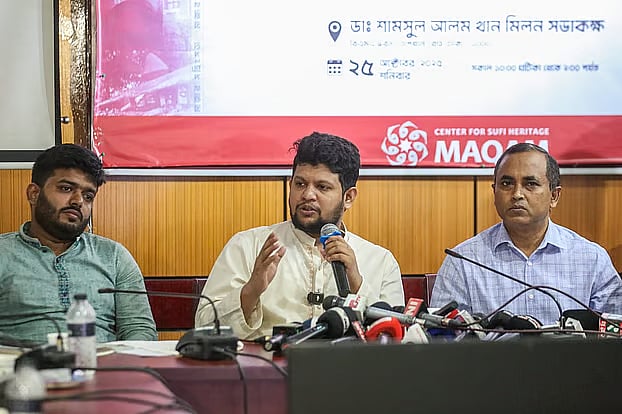
Everyone ready for conflict to unfold in few months: Information Advisor
Information advisor Mahfuj Alam has said that political parties are eager for conflict ahead of the elections.
He also believes that, so far, they have not engaged in clashes due to the stance of the Chief Advisor.
Mahfuj Alam said, “Everyone is eager for conflict, and you will definitely see this unfold within a few months. I am concerned that if a religious perspective gets involved, the situation in Bangladesh could worsen further.”
Mahfuz Alam spoke at the national dialogue titled “Mazar Culture: Violence, Crisis, and Future Perspectives” held at the BMA Building in Segunbagicha, Dhaka on Saturday morning. The dialogue was organised by Makam, a platform that conducts research on the Sufi community. Information Advisor Mahfuj Alam was the chief guest of the event.
Mahfuj Alam said that he has heard that the Awami League is trying to establish connections with the darbars (shrines). He explained that the message being conveyed to these darbars is that Professor Yunus’ government is demolishing shrines and evicting people from mosques. He emphasised that this issue is not specific to the interim government; it has been ongoing for the past 50 years. With each change of government, mosque committees and the governing body of the Islamic Foundation are replaced.
The Information Advisor further stated that while state-led fascism may have ended, social-level fascism still persists. He warned that unless opportunities for dialogue and connection are created among the various branches of Islam in the country, the state will face serious challenges. He noted that 90 to 92 per cent of the population are Muslims, with different sects and traditions. Political leaders have so far not considered how to coordinate among them; instead, they have divided groups—some aligning with the Qawmi community, others with Sunnis—and have used religious institutions as instruments of politics.
Mahfuj Alam said that over the past 15 years, the Awami League established a connection with Sufi groups from an ideological opposition standpoint. The understanding was that the Awami League would provide them protection, and in return, they would vote for the party. Religious politics has remained stuck within this framework. He also believes that the Qawmi community is no exception; they too have been used by various political parties.
Referring to the involvement of embassies of different Muslim countries in the country, Mahfuj Alam said, “Some embassies want the shrines to be destroyed. There are certain political and ideological agendas at play here.” He added that these crises need to be addressed from the perspective of the state, politics, and policy—without fearing that religious groups will fight or riot. Otherwise, the crises will continue to intensify.
The Information Advisor noted that there is frustration over the fact that nothing has been done in a year. Acting on this frustration with retaliatory measures will not produce positive outcomes. He said that after attacks on shrines, many people have been arrested, and now surveys will be conducted to implement reforms at the shrines.
Calling on the management authorities of attacked shrines to file cases, he warned that if this culture is allowed to continue, then in the future, the Islam of one political party will destroy the mosques of another party. Today it is Sufis being targeted; tomorrow it could be the Qawmi community. This cannot be allowed to continue.
At the end of his speech, a journalist asked when the advisor would resign. Since the question was unrelated to the discussion