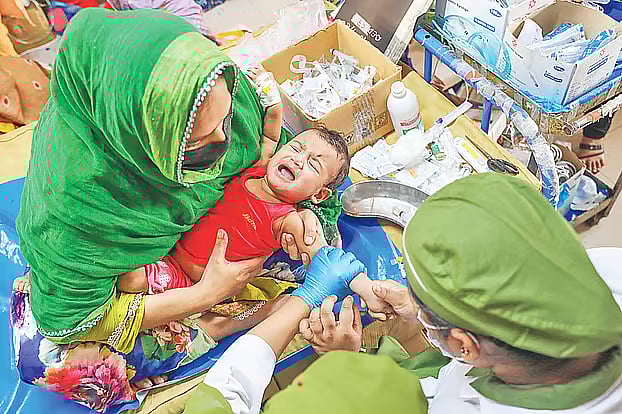
Measles treatment continues in unhygienic conditions
The environment inside and around the Infectious Diseases Hospital is unclean. In these conditions, physicians are treating measles infected children.
Hospital authorities state that they cannot maintain proper cleanliness due to the surrounding conditions and a shortage of staff.
The Infectious Diseases Hospital does not treat measles alone. As a government facility, it provides treatment for almost all types of infectious diseases in the country.
In addition to measles, the list includes HIV/AIDS, diarrhoea, smallpox, rabies, tetanus, black fever, dengue, typhoid, diphtheria, malaria, and anthrax.
The hospital also treats pneumonia and wounds. Officials report that it manages treatment for various seasonal viral diseases as well.
The hospital is located in the Sat-tola slum area of Mohakhali in the capital.
It can effectively be said that the hospital stands within a slum. Many people do not readily recognise it by its official name; rather, it is widely known as the hospital for treating dog bites.
Throughout the year, patients bitten by dogs come here for treatment. The hospital administers rabies vaccines daily; however, it does not currently provide measles vaccinations.
Three separate roads lead to the hospital and each road is lined with slum settlements. Numerous small shops operate alongside these settlements. The slum has developed on land belonging to the Institute of Public Health.
Even the corridor leading to two bathrooms contained four beds in total, two on each side. Waste disposal bins were placed close to the beds. In some areas, there were no electric fans. One guardian stated that he had purchased and was using a table fan himself. It was also observed that within the ward, the area where nurses sit and where medicines and saline are stored is directly adjacent to black, yellow, and green waste bins
Additionally, the International Centre for Diarrhoeal Disease Research, the Nursing Institute, and the Bangladesh Medical Research Council (BMRC) are all situated on land under the Institute of Public Health.
Previous governments attempted to remove the slum and implement several development projects, but those efforts were unsuccessful.
Following the spread of measles, the number of infected children at the hospital has increased. On a recent Sunday afternoon, the fourth floor was found to be overcrowded, with no space to walk.
Children suffering from measles were present in front of the lift, along the corridors, and inside the wards. Each child was accompanied by a mother, father, or another guardian.
Even the corridor leading to two bathrooms contained four beds in total, two on each side. Waste disposal bins were placed close to the beds.
In some areas, there were no electric fans. One guardian stated that he had purchased and was using a table fan himself.
It was also observed that within the ward, the area where nurses sit and where medicines and saline are stored is directly adjacent to black, yellow, and green waste bins.
Typically, medicines and waste bins are not placed side by side in this manner.
During visits to multiple floors and wards, visible waste and refuse were found throughout the hospital. Some of the waste appeared to be old, indicating that cleaning does not occur regularly.
No treatment can take place in this environment. This is merely a pretence of treatment—a farce. The government must immediately take steps to manage the additional patient burden at this hospital and increase other forms of support. It can do so without delay.Mushtuq Husain, Public health specialist and former Chief Scientific Officer at IEDCR
Three guardians reported that sweeping takes place only once a day. Discussions with hospital staff revealed that there are no additional infection prevention measures in place.
Hospital Superintendent FA Asma Khan told Prothom Alo that the hospital has only 19 cleaning staff, which is insufficient to maintain cleanliness.
FA Asma Khan has been at the hospital for less than a month. She said, “I am trying to improve the environment after arriving, but I am not managing properly. I feel bad about it myself.”
A passage through the hospital serves as a thoroughfare for slum residents, with people using it day and night. Individuals from the slum also gather within the hospital premises.
After evening, groups assemble in designated spots to consume cannabis. The hospital administration has little control over these activities.
Superintendent FA Asma Khan said, “The place is swept in the morning, but by the afternoon it returns to the same condition. We are unable to make people understand.”
“No treatment can take place in this environment”
The Infectious Diseases Hospital has a capacity of 100 beds. As of yesterday, Monday, 103 patients were admitted. Only 15 beds are allocated for measles patients; however, 63 children with measles were admitted.
In addition to measles cases, the hospital had 17 patients with AIDS, one with diarrhoea, eight with smallpox, one with rabies, eight with tetanus, two with black fever, one with malaria, and one with anthrax. There was also one patient admitted with an abnormal wound.
Every child admitted to the hospital is accompanied by more than one guardian. They eat within the hospital premises and sleep there at night.
Hospital staff allege that many guardians do not show sufficient concern for maintaining cleanliness. Some do not use waste bins and instead leave rubbish wherever convenient, including beside beds.
This year, as many as 1,196 patients sought treatment at the hospital with symptoms of measles. Of them, 807 required admission.
Among those admitted, 259 cases were confirmed as measles. A total of 32 patients presenting with measles symptoms have died at this hospital.
During a visit yesterday, Monday, the environment appeared cleaner than the previous day. The superintendent stated, “I am trying to keep the hospital clean. However, I need everyone’s cooperation.”
Public health experts state that all hospitals carry a risk of disease transmission. Patients may enter seeking treatment for one illness and leave with another.
This risk is significantly higher at the Infectious Diseases Hospital. The responsibility to reduce this risk lies with the government, and various measures are available to address it.
Public health specialist and former Chief Scientific Officer of the Institute of Epidemiology, Disease Control and Research (IEDCR), Mushtuq Husain, told Prothom Alo that no one is treating the matter with due importance.
He said, “No treatment can take place in this environment. This is merely a pretence of treatment—a farce. The government must immediately take steps to manage the additional patient burden at this hospital and increase other forms of support. It can do so without delay.”