South Korean Ambassador says
Business environment must be improved to attract Korean investment
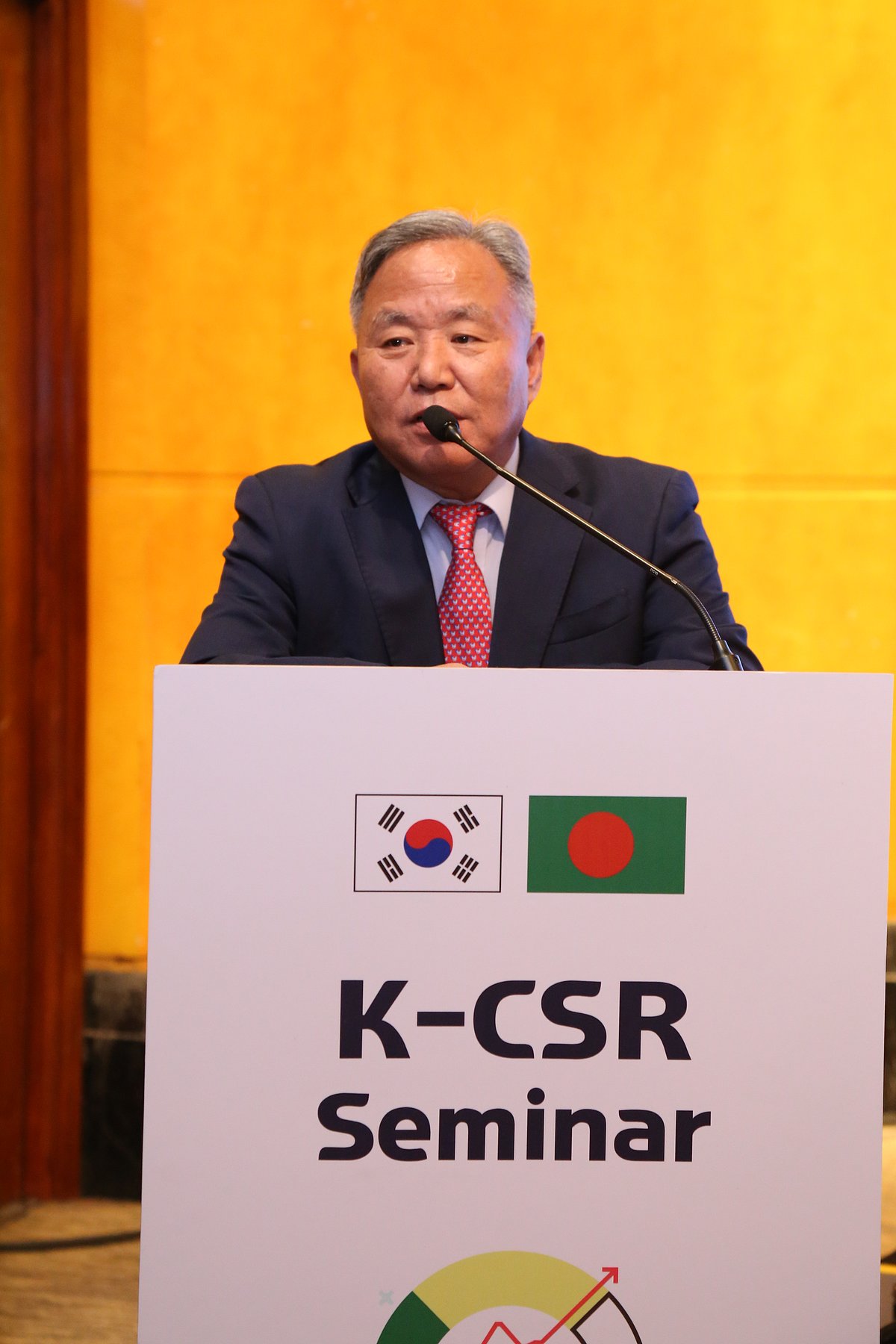
South Korean Ambassador to Dhaka, Park Young-sik, has said that Bangladesh remains a promising destination for South Korean investors due to its rapidly growing economy, strategic location, and large labour force.
Bangladesh must take several steps to improve its business environment to fully capitalise on this potential, he added.
Park Young-sik made these remarks during his welcome speech at a seminar held on Sunday afternoon at a hotel in the capital.
The seminar focused on the corporate social responsibility (CSR) of South Korean investors in Bangladesh and was organised by the South Korean Embassy in Dhaka under the theme 'CSR of Korean Investors and Moving Forward Together'.
Following Ambassador Park Young-sik’s address, Shahab Uddin Khan, President of the Korea-Bangladesh Chamber of Commerce and Industry, also delivered a speech.
Representatives from five South Korean companies—LG Electronics, Samsung, Woori Bank, Dohwa Engineering, and Youngone—then shared their contributions to corporate social responsibility in Bangladesh.
Afterward, representatives from six South Korean non-governmental organisations—Save the Children Korea, Oxfam Korea, Habitat Korea, Good Neighbours, ADRA Korea, and Global Care—highlighted their work and initiatives related to corporate social responsibility in the country.
Park Young-sik said Bangladesh and South Korea are currently negotiating the Comprehensive Economic Partnership Agreement (CEPA).
Once signed, the agreement will offer another opportunity to further deepen the already close relationship between the two countries, he hoped.
Park Young-sik said with its rapidly growing economy, strategic location, and abundant labour force, Bangladesh is a promising destination for South Korean investors. However, to fully harness this potential, Bangladesh must take several measures to improve its business environment, the Korean Ambassador stated.
These measures include timely issuance and renewal of visas, duty exemptions without administrative delays, reduction of high tariffs on imported raw materials and finished goods, resolution of issues related to payment of outstanding dues in dollars after project completion, and allowing the repatriation of profits to investors’ home countries.
Park Young-sik also noted that Bangladesh’s exports to South Korea have been increasing steadily each year. However, due to the limited range of export products, the overall growth in trade remains unsatisfactory.
He suggested that products such as footwear, ICT goods, leather items, light industrial goods, and pharmaceuticals have strong export potential in the Korean market. A CEPA agreement would enhance Bangladesh’s access to the Korean market, particularly in the ready-made garments (RMG) sector.
Park Young-sik emphasised that Bangladesh needs to build infrastructure to make its economy more sustainable and resilient.
“Just as we have partnered with Bangladesh in the garment sector, we also wish to be a key partner in its infrastructure development,” he said.
He added that South Korean initiatives are known for delivering quality, and they are ready to continue contributing to infrastructure development.
However, the Bangladeshi government must create an enabling environment for greater participation of foreign companies in infrastructure projects.
Chairman of the CSR Centre and former ambassador Farooq Sobhan remarked that corporate social responsibility (CSR) plays a vital role in fostering constructive business relationships. He highlighted how responsible corporate engagement between the two countries can build trust, encourage cooperation, and strengthen long-term partnerships.
The seminar concluded with a vote of thanks delivered by Jihoon Kim, Country Director of Korea International Cooperation Agency (KOICA) in Bangladesh.