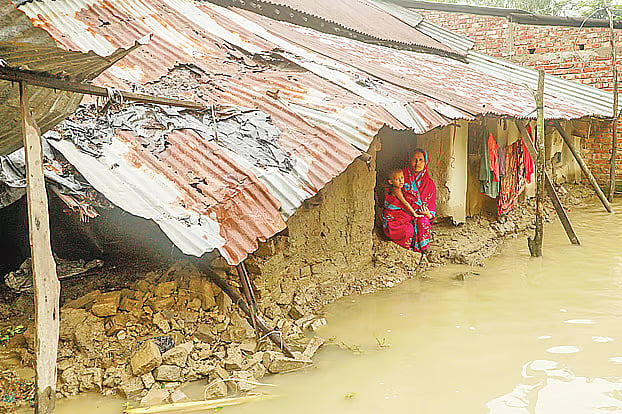
Floods submerge crops; fisheries and livestock sectors face Tk 4.88b loss
Recent heavy rainfall and subsequent flooding across several districts, including Chattogram, Cumilla and Sylhet, have claimed over 50 lives and caused extensive damage to the country's agriculture, fisheries and livestock sectors.
While floodwaters have begun to recede over the last two days as rainfall subsided, approximately 82,000 hectares of cropland remain submerged, down from 100,000 hectares recorded on Sunday.
According to sources from the respective ministries, the fisheries sector has incurred losses exceeding Tk 4.07 billion as numerous fish farms and ponds were washed away. The livestock sector reported losses of over Tk 810 million, bringing the combined preliminary loss in these two sectors to approximately Tk 4.88 billion. Officials stated that a final assessment will be completed next week.
Aush paddy has been the worst-hit crop. Data from the Department of Agricultural Extension (DAE) shows that 53,000 hectares of Aush paddy remain underwater. Additionally, 9,000 hectares of Aman seedbeds and over 20,000 hectares of vegetable fields have been damaged. A final calculation of the total financial loss in the agriculture sector is yet to be determined.
The fisheries sector has incurred losses exceeding Tk 4.07 billion as numerous fish farms and ponds were washed away. The livestock sector reported losses of over Tk 810 million, bringing the combined preliminary loss in these two sectors to approximately Tk 4.88 billion.
While 43 districts nationwide have been affected by the persistent rains, 16 have suffered the most significant damage. These include Chattogram, Cox’s Bazar, Rangamati, Khagrachhari, Noakhali, Cumilla, Barishal, Patuakhali, Bhola, Jhalakathi, Habiganj, Naogaon, Jashore, Meherpur, Bagerhat and Barguna.
Agriculturalists warned that the floods could trigger a rise in the prices of food items, fish and poultry. There are specific concerns regarding pressure on the rice market, which could complicate efforts to control inflation.
Agricultural economist Jahangir Alam Khan told Prothom Alo that approximately 10 per cent of the Aush crop has been damaged, potentially leading to a 300,000-tonne shortfall in rice production.
While it is possible to replant Aman seedbeds, there may be some pressure on the supply chain, impacting the market, he said, adding that the situation remains manageable through effective market monitoring and management.
While 43 districts nationwide have been affected by the persistent rains, 16 have suffered the most significant damage. These include Chattogram, Cox’s Bazar, Rangamati, Khagrachhari, Noakhali, Cumilla, Barishal, Patuakhali, Bhola, Jhalakathi, Habiganj, Naogaon, Jashore, Meherpur, Bagerhat and Barguna.
Tk 4.07 billion loss in fisheries
Following the agricultural sector, the fisheries industry suffered the most extensive damage from the floods. Overflowing floodwaters washed away fish from countless ponds and farms. The coastal regions, particularly Chattogram and Patuakhali, saw widespread destruction of shrimp enclosures (ghers). Similarly, fish farms in the Cumilla and Rajshahi regions were breached as water levels rose.
According to the Department of Fisheries, the total financial loss in this sector stands at over Tk 4.07 billion. Approximately 34,000 fish farms and ponds, along with 3,889 ghers, have been affected. The floods also damaged 46 fishing vessels and resulted in the deaths of five fishermen. Additionally, broken embankments caused significant infrastructural damage to ponds across the country.
Tk 810 million loss in livestock and poultry
Data from the Department of Livestock Services (DLS) reveals that 4,819 livestock farms were hit by the floods nationwide, incurring losses of approximately Tk 190 million. The poultry sector also faced a heavy blow, with over 6,000 birds affected and more than 2,500 deaths, resulting in a Tk 200 million loss.
Furthermore, approximately 12,000 tonnes of concentrated animal feed were destroyed, along with vast stretches of straw and grass fields. Cumulatively, the loss in the livestock sector has reached Tk 810.5 million.
Calls for relief and cash assistance
Experts noted that along with the human crisis, a severe shortage of animal feed has emerged in flood-affected areas. Agricultural economist Jahangir Alam Khan emphasized the need for immediate cash assistance for farmers and fishers.
We are initiating a special incentive program for the seven hardest-hit districts. We are currently conducting field visits and compiling a list of the affected farmers.Md. Abdur Rahim, Director General of the Department of Agricultural Extension
The floods are taking a toll on the rural economy and employment, Khan said, urging the government to boost the supply of animal feed. He also called on the private sector to complement government efforts in providing relief.
Md Abdur Rahim, Director General of the Department of Agricultural Extension, told Prothom Alo, “We are initiating a special incentive program for the seven hardest-hit districts. We are currently conducting field visits and compiling a list of the affected farmers.”