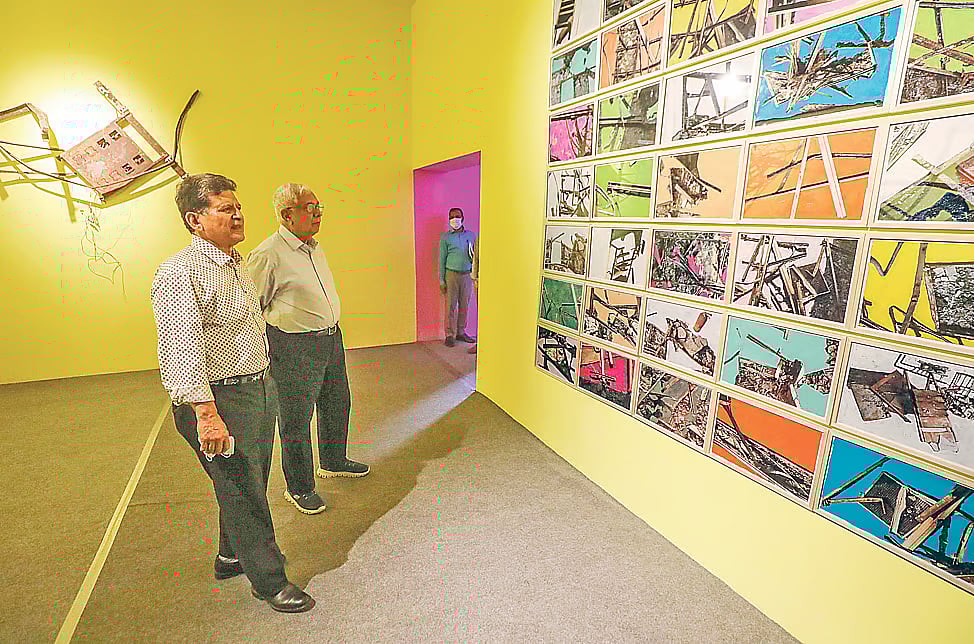
2nd day of art exhibition
Visitors astonished, saddened by the devastation at Prothom Alo building
An exceptional art exhibition titled ‘Alo’ is under way at the burned-out building of Prothom Alo, which was set ablaze in a coordinated extremist attack. On the second day, yesterday, Thursday, large numbers of visitors from various professions and age groups came to visit the exhibition in the morning and in the afternoon.
At the exhibition, visitors are encountering charred computers, machinery, tables, chairs, books and documents alongside artistic expressions symbolising resilience rising from the ashes. Confronted with the scale of destruction, many expressed both shock and sorrow. They also called on the government to ensure that such extremist attacks do not recur, to bring the perpetrators to justice, and to safeguard journalism and freedom of expression.
Former adviser to the caretaker government Hossain Zillur Rahman visited the exhibition in the afternoon. He described the attack on Prothom Alo as deeply distressing and said it had created a profound wound. Such an exhibition, he noted, is significant because it preserves memories that future generations must know. Retaining the memory of such incidents as historical material is essential for the country and the nation. The exhibition is also significant for that very reason.
Hossain Zillur Rahman said the attack involved two dimensions: first, the institution fell victim to mob violence; second, there was a surprising display of state indifference in this incident that occurred during the term of the previous interim government. “Based on these two aspects, we now seek an explanation,” he said. “The incident was not indicative of a healthy environment. To prevent any recurrence, these questions must be resolved. I hope that in the current phase of progress, the reasons behind the boundless brutality inflicted on Prothom Alo will be thoroughly investigated.”
On the night of 18 December last year, a group of extremists, driven by vengeance, attacked the Prothom Alo office. After extensive vandalism and looting, they set the building on fire. The exhibition at the damaged premises features works by noted artist Mahbubur Rahman. The exhibition, titled ‘Alo’, began on 18 February and will remain open to the public until 28 February, daily from 11:00 am to 1:00 pm and from 3:00 pm to 5:00 pm.
Professor Ahmad Kamruzzaman Majumder of the Department of Environmental Science at Stamford University Bangladesh, who came to visit the exhibition in the afternoon said it was more than just an art display. It is, he observed, a powerful artistic protest against extremist violence, attacks on freedom of expression and environmental destruction. Visitors, he said, need no explanation about the subject of this exhibition. They can grasp for themselves what has happened and what must now be done. The artist’s message has been conveyed with striking force here.
Artist Farhana Ferdousi, associate professor in the Department of Crafts at the Faculty of Fine Arts, University of Dhaka, expressed her astonishment. “It is difficult to put this feeling into words,” she said, noting that she had long been familiar with Mahbubur Rahman’s work. “Only he could undertake such a vast project in such an environment.” While differences of opinion may exist, she added, freedom of expression must be ensured for all. She expressed hope that the new government would make democracy meaningful by guaranteeing freedom of expression and safety for the press and the public.
Deutsche Welle (DW)’s Bangladesh correspondent Harun-ur Rashid came to visit the exhibition and to prepare a report on it. He described the exhibition as both painful and inspiring.
Many young students also visited, including Shuaib Tawsin of the Architecture Department at Southeast University, Humayra Tabassum of the Mass Communication and Journalism Department at Bangladesh University of Professionals, and Rahat Ehsan of Environmental Science Department at North South University. They spoke of their admiration for the exhibition and stressed the need for a firm governmental stance against extremism, mob violence and incitement to hatred in order to foster a free and open society.
Mithun Kazi, an employee of Akij Bashir Group in Banani, stopped by on his way home. Inside the building, he was struck by the scale of devastation. He described the attack as tragic and said that some individuals had used social media to incite ordinary people for their own narrow interests, leading to many destructive acts — of which this assault on a newspaper office was a stark example.
Among other visitors were former caretaker government adviser Major General (retd) Golam Kader and European Union election observer Agnes Doka.
Visitors began arriving from 11:00 am when the exhibition opened. In the morning, Paola Belfiore, wife of Antonio Alessandro, the Italian Ambassador to Dhaka, toured the exhibition. Having lived in Bangladesh for two and a half years, she photographed the distinctive architecture and the charred remains displayed in the exceptional exhibition. She told Prothom Alo that it is a beautiful way to preserve the memory of what happened last December.
Journalist Enamul Haque of ‘The Financial Express’ came to visit the art exhibition with his son. He described the attack as horrific and destructive, saying that such an incident against a newspaper had not previously occurred in the country’s history. He added that the government at the time had failed to take adequate steps to prevent it.