Jamaat-e-Islami's manifesto
Jamaat sets 26 priorities including full dismantling of fascist system
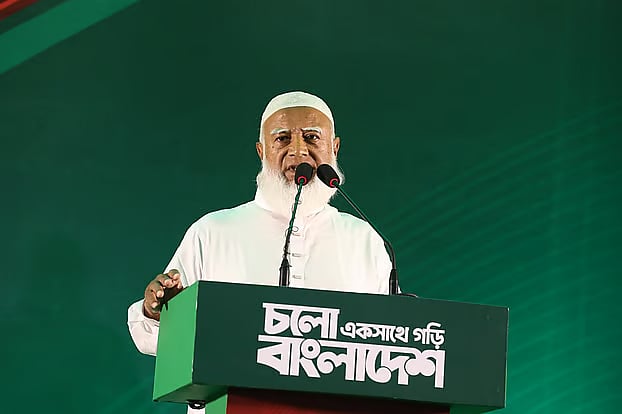
Bangladesh Jamaat-e-Islami has announced its election manifesto, giving priority to 26 issues, including the complete abolition of the fascist system and the building of a compromise-free and secure Bangladesh.
The manifesto was unveiled by Jamaat Ameer Shafiqur Rahman on Wednesday evening at a hotel in Banani in the capital.
Speaking at the launch event, the Jamaat Ameer paid tribute to the martyrs of the mass movements and revolutions of 1947, 1971 and 2024.
He said they were moving forward with the resolve to build a clean and ethical Bangladesh after 5 August 2024.
He also spoke of leaving behind the old political culture and running the country through leadership based on merit, innovation and ideals.
Referring to each point of the manifesto as the people’s right to claim and hold the party accountable day by day, week by week, month by month and year by year, Shafiqur Rahman said, “We are standing here today to hand that right over to the people.”
He said that for the past 15 and a half years, no one — opposition parties, civil society, journalists, or religious scholars — had been spared repression. “We were oppressed. But after 5 August, it seems many have forgotten the past,” he said.
He added that some people are now trying to build their own fortunes and are causing suffering to the people in various ways. “We humbly requested them: we were victims — let us never become oppressors,” he said. The Jamaat Ameer said the party’s manifesto would be people-friendly, business-friendly, peace-friendly and discipline-friendly.
The 26 priority areas
Under the slogan “An uncompromising Bangladesh in the national interest,” the manifesto prioritises:
• Building an uncompromising state based on independence, sovereignty and national interest
• Establishing a humane Bangladesh free from discrimination, founded on justice and fairness
• Empowering youth and prioritising their role in state governance
• Creating a safe, dignified and participatory state for women
• Ensuring a drug-free, extortion-free and terrorism-free society through overall improvement in law and order
• Building a modern, smart, technology-driven society
• Creating large-scale employment in technology, manufacturing, agriculture and industry
• Free applications for government jobs, merit-based recruitment and elimination of all discrimination
• Reforming the banking and financial sectors to restore confidence and build a sustainable, transparent, business-friendly economy
• Ensuring a fair electoral environment, including elections under proportional representation (PR), strengthening the caretaker government system, and consolidating effective democracy
• Bringing about an agricultural revolution through technology use and increased support for farmers
• Ensuring completely adulteration-free food security by 2030 and implementing the “Three-Zero Vision” — zero environmental degradation, zero waste and zero flood risk — to build a green, clean Bangladesh
• Promoting small and medium enterprises and ensuring investment-friendly industrialisation and job creation
• Increasing workers’ wages and living standards and ensuring safe, decent working conditions, especially for women
• Guaranteeing voting rights and all other rights of expatriates and ensuring their realistic participation in nation-building
• Establishing equal citizenship for all as Bangladeshis, not as majority or minority, and ensuring special support for disadvantaged groups
• Providing modern, universal healthcare and gradually ensuring free advanced treatment for the poor and helpless
• Fundamentally reforming the education system in line with global needs and gradually ensuring free education
• Keeping prices within people’s purchasing power and ensuring access to all basic needs
• Overhauling transport systems and reducing travel time between the capital and divisional cities to two to three hours; improving regional and urban transport
• Ensuring low-cost housing for lower- and middle-income families
• Continuing trials and reforms to fully dismantle the fascist system and prevent its return
• Introducing a universal social security system to ensure safe working lives and international-standard protection for all citizens
• Establishing good governance through transparency and accountability and building a happy, prosperous welfare state, with honest leadership and institutional reform to eliminate corruption