Energy crisis
Gas shortage adds to load-shedding misery
A sharp nationwide gas shortage has persisted for more than a week following a reduction in the supply of liquefied natural gas (LNG). The shortage has disrupted industrial production and household cooking, while electricity generation has also fallen.
As a result, consumers are now facing widespread load-shedding in addition to the gas crisis. Daily power shortages have exceeded 2,500 megawatts. It remains uncertain when gas supply will return to normal.
According to sources at the Energy and Mineral Resources Division, Excelerate Energy has requested until 10 August to fully restore operations at its fire-damaged LNG terminal.
Before then, efforts are underway to restart the terminal’s undamaged boiler. If that unit can be brought back online, it will increase gas supply by 300 million cubic feet per day, easing the crisis to some extent.
Two Petrobangla officials told Prothom Alo that several replacement parts have already been imported from abroad and delivered to the terminal. Alongside the foreign technical team, engineers from a local shipbuilding company have joined the repair work.
Intensive efforts are underway to resume gas supply through the undamaged boiler as quickly as possible. However, officials are still unable to specify when it will become operational. A clearer picture is expected today or tomorrow (Friday or Saturday).
The government has also sought Malaysia’s assistance in addressing the gas crisis. Discussions are underway on importing LNG in ISO tank containers (specialised containers). Officials involved in the process said this is an expensive and time-consuming option, offering little prospect of immediate relief. They added that the gas shortage is unlikely to ease until the LNG terminal resumes operations.
The government has repeatedly expressed regret over the situation in recent days. Petrobangla and Titas Gas, the gas distribution company serving Dhaka, have also apologised to customers through public statements.
In another notice issued yesterday (Thursday), Titas said all categories of consumers in its service area would continue to experience severe low gas pressure until the situation improves.
Amid the severe gas shortage, Petrobangla has recently sought policy approval from the Ministry of Power, Energy and Mineral Resources to propose higher gas prices for the power generation and CNG sectors.
It has proposed increasing gas prices by 67 per cent for electricity generation and 51 per cent for compressed natural gas (CNG) used in transport. It has also proposed raising distribution charges for the country’s six gas distribution companies.
If approved by the Energy Division, Petrobangla will submit a formal application to the Bangladesh Energy Regulatory Commission (BERC). The regulator will then hold public hearings before making a decision.
However, Minister for Power, Energy and Mineral Resources Iqbal Hassan Mahmood told Prothom Alo yesterday that the government has no plans at present to raise gas prices.
He said people are already suffering from the gas shortage, which was triggered by a technical accident at one LNG terminal. Therefore, the government’s priority is to restore gas supply as quickly as possible to provide relief.
He added that work is also underway on long-term plans to diversify gas supply sources. He said he was not aware of any letter proposing a gas price increase.
Bangladesh imports LNG through two floating storage and regasification terminals (FSRUs) located off Maheshkhali in Cox’s Bazar. One is operated by the US company Excelerate Energy, while the other is operated by the private company Summit.
Gas supply from Excelerate’s terminal was suspended after a fire broke out there on 21 July, worsening the country’s gas shortage.
Consumers’ hardship continues
Around 35 to 40 per cent of Bangladesh’s daily gas supply normally comes from imported LNG. LNG imports can supply up to 1.05 billion cubic feet of gas per day, but yesterday that fell to 460 million cubic feet.
As a result, total daily gas supply has now dropped below 2.11 billion cubic feet, compared with estimated daily demand of 3.8 billion cubic feet. Before the terminal shutdown, around 2.7 billion cubic feet of gas was being supplied daily, which had kept the situation relatively stable.
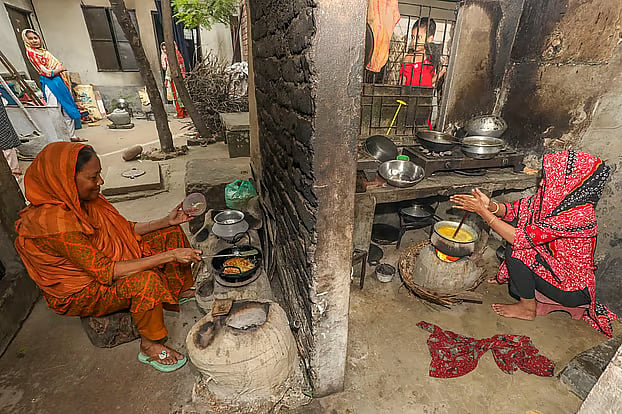
Residents in different parts of Dhaka say they are unable to cook because of the shortage. Complaints have been particularly widespread in Mohammadpur and Adabor areas.
Jesmin Akter of Mohammadpur told Prothom Alo that after failing to get gas during the day, she waited from midnight until 3:00 am but still there was no gas flow. She said, in most of the houses in the Nobodoy Housing area there was no gas for the past two weeks.
Sumaiya Khan said she could not use gas for cooking for several days. Salma Akter said residents of Tajmahal Road have been unable to light their stoves even once over the past five days.
An official at the Bangladesh Power Development Board (BPDB) said the further decline in gas supply has intensified public suffering. Many households are switching to electric stoves for cooking, increasing electricity demand.
Daily rainfall has helped keep demand somewhat under control, he said, otherwise load-shedding would have been even worse.
The situation is being managed by generating electricity from more expensive oil-fired power plants. He added that if gas prices for the power sector are increased, it will become difficult for BPDB to remain financially viable.
According to BPDB, gas supply to the power sector has fallen by more than 200 million cubic feet per day, reducing electricity generation by more than 1,500 megawatts.
Peak load-shedding exceeded 2,500 megawatts on Wednesday. During daylight hours yesterday, load-shedding still reached 2,330 megawatts. Power cuts have been more severe outside Dhaka, particularly in rural areas.
Industrialists say most factories in Narayanganj, Gazipur, and Valuka are receiving little or no gas pressure. Some factories have suspended production altogether, while others are operating at only 50 to 70 per cent of capacity.
In addition to gas shortages, factories have also been hit by load-shedding over the past several days. Some are using diesel generators as an alternative, while others are turning to renewable energy for electricity generation.
Petrobangla seeks to reduce financial deficit
According to Petrobangla sources, the company has had to purchase LNG at nearly double its previous price for the past four months since the outbreak of conflict in the Middle East. As a result, it incurred losses of Tk 178.56 billion in the 2025–26 fiscal year.
The government has provided Tk 146 billion in subsidies, but Petrobangla still faces a deficit of Tk 32.56 billion. The company has continued to incur losses during July as global LNG prices remain elevated.
A senior Petrobangla official told Prothom Alo that before the conflict, LNG cost an average of USD 11 per unit. If LNG could again be purchased at that price, the proposed gas price increases would generate an additional Tk 85 billion in revenue for Petrobangla.
Part of that income would be used to cover higher distribution charges. If the proposed increase is still implemented, Petrobangla would no longer require subsidies. If subsidies were still necessary, they would amount to no more than Tk 15 billion, the official said.
However, sector insiders caution that global LNG prices may not return to previous levels anytime soon. Instability in the Middle East is worsening, and there are concerns that conflict could spread further, driving LNG prices even higher.
LNG currently trades at more than USD 21 per unit on the international market. As a result, the government may still need to provide subsidies even if gas prices are increased.
Industrial and residential consumers point out that industrial users must pay a fixed minimum monthly gas bill, while residential customers without prepaid meters are charged fixed monthly fees.
They are required to pay these bills even when they receive no gas supply. Yet Petrobangla seeks to raise prices whenever possible, they say. During the interim government’s tenure, gas prices for industry were increased by 33 per cent.
Before that, in 2023, the Awami League government raised average gas prices by 82 per cent, citing plans to improve supply. Industrial tariffs increased by as much as 178 per cent, but gas supply did not improve.
Shamsul Alam, energy adviser to the Consumers Association of Bangladesh (CAB), told Prothom Alo that people have suffered from electricity and gas shortages for years, with the situation worsening several times annually for different reasons. Those who can afford it are switching to alternatives such as electric stoves and generators, he said.
The government, however, must take responsibility for protecting low-income households. He described Petrobangla’s proposal to raise gas prices during the current crisis as anti-consumer, arguing that the government should instead provide rebates on gas bills to customers who are not receiving gas supply.