Ecology
After rivers, salinity now reaches deep tubewells in southern region
In the southern region, salinity levels in many coastal rivers have long exceeded tolerable limits. Now, abnormal salinity has also been detected in deep tube-well water. As a result, what was once the source of life is now posing a silent threat to human health. At the same time, soil salinity in agricultural land is increasing, crop production is declining and this has emerged as a major threat to coastal livelihoods and food security.
According to experts, long-term consumption and use of highly saline water is increasing the risk of high blood pressure, kidney complications, pregnancy-related health risks and various diseases of the uterus and reproductive system among women. People working for long hours in saline water are also facing higher risks of skin diseases and infections. Researchers have warned that without effective measures to address the shortage of safe drinking water and curb the spread of salinity, the health and livelihood crisis in the southern region could deepen further.
River salinity continues to surge
Researchers at the Soil Resource Development Institute (SRDI) regional office in Barishal said that in March 2021, the salinity level in the Tetulia River near Galachipa in Patuakhali was 0.87 dS/m (decisiemens per metre). In March this year, it rose to 1.75 dS/m. In the Boleshwar river near Charduani in Patharghata, Barguna, salinity was 4.56 dS/m in April 2021. In April 2025, it increased to 5.88 dS/m. During the same period, salinity in the Paya River in the district rose from 1.8 to 3.90 dS/m.
In the Meghna river near Borhanuddin in Bhola, salinity was 0.68 dS/m in April 2022. In April 2024, it rose sharply to 25.31 dS/m. This surge of salinity has spread up to 70 to 100 kilometres upstream. However, in the Andharmanik river near Kalapara in Patuakhali, salinity was 22.20 dS/m in March 2021. In March 2026, it declined to 15.21 dS/m.
Deep aquifers no longer a safe haven
In March this year, researchers from the Soil Resource Development Institute (SRDI) tested water from several deep tube wells (at depths of 1,000 to 1,200 feet) in coastal areas and found abnormal salinity levels in groundwater.
In Badarpur of Galachipa upazila in Patuakhali, salinity in deep tube-well water was recorded at 1.27 dS/m. In Panpatti area of the same upazila, it was 1.33 dS/m. In Payrakunch area of Mirzaganj, it was 1.02 dS/m, while in the New Market area it was 0.92 dS/m. In Tiyakhali of Kalapara upazila, salinity was 1.33 dS/m. In Barguna, salinity in deep tube wells was found to be 2.35 dS/m in Charpara village of Taltali, 1.60 dS/m in Boraitola area of Sadar upazila and 2.04 dS/m in Betagi municipality area.
Md. Imran Tarafdar, Executive Engineer of the Department of Public Health Engineering (DPHE) in Barishal, told Prothom Alo that the acceptable salinity level for drinking water is 500 mg/L. However, in coastal areas, the maximum tolerable limit is considered to be 1,000 mg/L. He said that around 1,000 mg/L salinity is equivalent to 1.56 dS/m. He added that although this is considered the upper tolerable limit due to scarcity of safe drinking water in coastal areas, it is still only a ‘lesser evil’ as long-term consumption of such water poses various health risks.
AFM Mamun, Chief Scientific Officer at the SRDI regional office, told Prothom Alo that the tolerable salinity level for river water is 0.7 dS/m. However, salinity levels in all rivers in the southern region are far above this limit. Even a decade ago, river salinity was not this high, especially not so far upstream. As a result, groundwater sources are also showing intolerable salinity levels, which he warned is a serious threat to public health in the region.
The bitter price of survival
Chhoto Ankujanpara, a small village on the coast of the Bay of Bengal in Taltali upazila is gradually shrinking due to erosion by the turbulent Payra River. About 45 people were killed in this village during Cyclone Sidr in 2007.
During a visit on 10 May, it was seen that not far from the village, in the Payra River, adolescent girls and women of different ages were collecting shrimp fry using small nets while standing in waist-deep water. A woman, Kohinur Begum (30), said they collect fry from the river for six months of the year. After standing in waist-deep saline water for three to four hours, their hands and legs turn pale. With no alternative source of income, they are forced to work in the river.
From morning to evening, at least 35 women aged between 21 and 50 were spoken to in the village. All of them reported suffering from gynaecological complications, menstrual disorders and high blood pressure. At least eight of them had undergone surgery to remove their uterus. One young woman is suffering from a severe condition, but her family is afraid to risk the surgery because she is not yet married. Several were also found to be suffering from kidney-related problems.
Experts say that spending hours standing in waist-deep saline water for fishing or bathing can increase the risk of reproductive tract infections in women and affect the normal menstrual cycle.
Physician Shikha Rani Saha, a retired professor of gynaecology at Barishal’s Sher-e-Bangla Medical College, noted that women in these areas often use unsafe water for sanitation, which worsens the situation. Many believe that clean water is only necessary for drinking, not for sanitation purposes. As a result, infections develop in their bodies. Malnutrition further weakens their immunity, making them more vulnerable to uterine complications due to poor hygiene.
Dulal Hossain (55) of the same village had long been suffering from high blood pressure. After developing further complications recently, he sought medical attention and was diagnosed with kidney problems.
“I used to fish in the river. After my health deteriorated, I managed the household by running a small fish business. Now I cannot think of anything, whether to continue treatment or run the household,” he said.
His wife, Kulsum Begum, underwent surgery to remove her uterus after prolonged illness. She said the problem is now widespread in almost every household. Women are increasingly suffering from irregular menstruation, excessive bleeding, white discharge and itching. Many of these issues are not disclosed early, leading to severe complications that eventually require uterine removal.
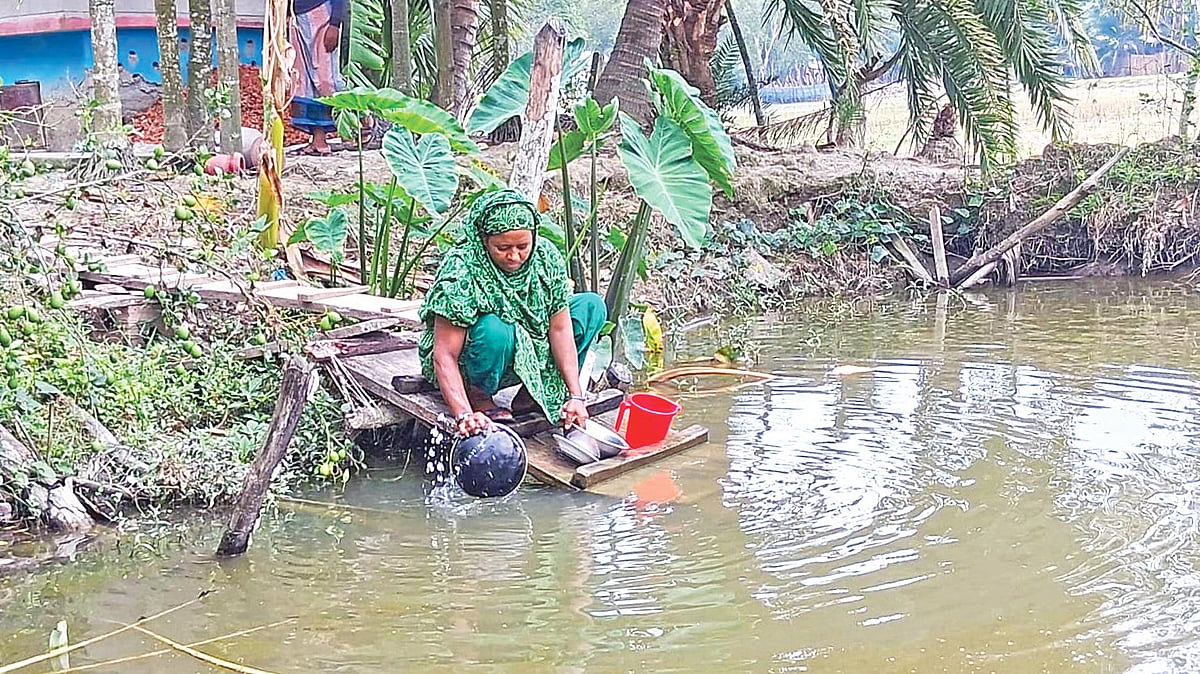
Another woman, Amena Begum (34), who has also undergone a hysterectomy, said, “We use saline water for everything, from cooking and bathing. Even during menstruation, we wash the cloth we use in saline water.”
Health problems among women becoming more severe
The serious impact of salinity on women's health in coastal areas has also been highlighted in a research study. Funded by the Ministry of Science and Technology, the Department of Community Health and Hygiene at Patuakhali Science and Technology University (PSTU) conducted the study in June 2018.
The research initially surveyed 100 women from Tiyakhali and Baliatali unions of Kalapara upazila who had children under the age of five.
Samples of water from deep tube wells, ponds and canals in the area, along with urine samples from participating women, were collected and tested in the university laboratory. The findings showed that 58 percent of the women were consuming more than two grams of sodium per day above the standard set by the World Health Organization. This had measurable effects on both their urine composition and blood pressure.
The study found that the participating women had little awareness of the health risks associated with high salinity levels. Most were familiar only with common health problems such as gastric disorders, skin diseases, rheumatic pain and high blood pressure. However, some respondents also reported symptoms including bladder irritation, painful urination, gynaecological complications, bleeding and miscarriage, cardiovascular diseases, asthma and allergies.
Professor Liton Chandra Sen of the PSTU Department of Community Health and Hygiene told Prothom Alo that the study found evidence that health problems such as high blood pressure and pre-eclampsia, among others, are becoming increasingly prevalent in coastal areas due to salinity.
Fallow land on the rise
According to a 2009 survey by SRDI Barishal regional office, excessive salinity had rendered large areas of agricultural land unsuitable for cultivation. The amount of cultivable land lost was 17,440 hectares in Barguna, 36,390 hectares in Patuakhali, 12,770 hectares in Bhola and nearly 1,000 hectares in Jhalokathi. As a result, known as the country’s southern grain basket, the total area of land unsuitable for crop production in these four districts reached 67,600 hectares.
Over the past 16 years, the extent of saline-affected land has increased further. According to the latest data published in 2024 by the Department of Agricultural Extension in Barishal, 415,000 hectares, or 52 per cent of the division’s 802,000 hectares of cultivable land are now affected by salinity.
The worst-affected district is coastal Patuakhali, where 155,180 hectares, or 39 per cent of agricultural land have been affected by salinity. In Barguna and Bhola, 24 percent of land has come under salinity stress. The figures are 9 per cent in Pirojpur, 3 per cent in Barishal and 1 per cent in Jhalakathi.
Md. Alimur Rahman, Chief Scientific Officer at the Regional Horticulture Research Centre in Patuakhali’s Lebukhali, said that until a few years ago, higher salinity levels were mainly found in the soil and water of Barguna, Patuakhali, Pirojpur and Bhola. However, over the past two years, salinity has also been detected in the soil and water of Barishal.
He told Prothom Alo that researchers recently found high levels of salinity in their research plots in Banaripara upazila of Barisal. Excessive salinity has also been detected in several areas of Jhalokathi.
‘Surviving through farming has become difficult now’
Most agricultural land in the coastal region produces only one crop of Aman rice during the monsoon season. Farmers harvest the crop in December and January. After that, rising salinity and the scarcity of irrigation water during the dry season make it impossible to cultivate any crops for nearly seven months.
To address the challenge, the Department of Agricultural Extension launched initiatives a decade ago to expand Aus rice cultivation through incentives. However, untimely heavy rainfall, cyclones and tidal surges have limited the success of those efforts.
Describing his hardship, farmer Abdul Mannan Boyati of Gabtala village in Taltali upazila, Barguna, said, “Because of salinity, rice no longer grows properly on our land. Aman yields have also declined. To make up for the losses, we now cultivate Aus rice. But if a cyclone or flood hits, we cannot even bring that harvest home. Farming is no longer profitable; surviving through it has become difficult.”
According to local agriculture office sources, Taltali upazila has a total of 16,441 hectares of cultivable land. However, due to a shortage of water during the dry season, crops cannot be grown on nearly 9,000 hectares of that land.
Farmer Idris Hawlader of Nolbunia village in the upazila’s Sharikkhali union said, “After Cyclone Sidr, no crops would grow on our land. How could they? There was nothing but salt everywhere. Three years ago, after an embankment was built, we managed to grow one crop again—Aman rice. After that, the land remains fallow. Farming no longer provides a livelihood, but we cannot leave it either.”
‘Relay cropping method’
With the aim of bringing vast stretches of saline fallow land in coastal areas under cultivation, a team of researchers began work in 2017 with support from the Australian Centre for International Agricultural Research. Under a project jointly implemented by the University of Western Australia and the Poverty Eradication initiative, researchers conducted field-level studies for seven years and developed a technology for cultivating wheat on saline land without tillage. The researchers found that wheat and similar crops can produce good yields with minimal irrigation and are naturally somewhat tolerant to salinity. They therefore focused on developing relay-cropping technologies for wheat and mung beans through intensive research. Relay cropping is a cultivation technique in which the next crop is sown before the previous crop has been fully harvested from the same field.
The research showed that groundwater at depths of 1,100 to 1,200 feet is free from salinity and suitable for irrigation. Water can be extracted from depths of 1,100 feet or more using submersible pumps. Purchasing and installing such a pump costs around Tk 150,000. A single pump can easily provide irrigation for 20 to 25 bighas of land under relay-cropping systems for wheat and other winter crops.
In 2022, several farmers in Purba Daulatpur village of Kalapara upazila in Patuakhali, were introduced to the technology and encouraged to cultivate wheat. The initial cultivation on a small area of land proved successful. Building on that success, farmers in Nolbunia village of Sharikkhali union in Taltali upazila cultivated wheat for the first time last year.
Speaking to Prothom Alo, lead researcher and agricultural scientist Mrinmoy Guha Niyogi said that the team began working on relay-cropping technology to bring saline land under cultivation and has achieved encouraging results. He said that wider adoption of the technology would allow coastal farmers to harvest an additional crop during the dry season. Around 439,000 hectares of land in coastal regions remain fallow during the dry season because of salinity. If the technology is expanded, it could make it possible to produce 1.3 million tonnes of wheat annually.
A need for sustainable water systems
Stakeholders are emphasising the need to develop sustainable water supply systems across coastal areas, including rainwater harvesting and the restoration of natural water bodies, to address the growing shortage of safe drinking water.
Rafiqul Alam, Barishal divisional member of the National Water Resources Protection Committee, told Prothom Alo that initiatives should be taken to protect local water bodies and conserve freshwater in crisis-prone areas. He said rainwater harvesting for drinking purposes, the construction of surface water treatment plants and the supply of water to rural communities through pipelines could help address the problem. He also suggested re-excavating old government reserve ponds and digging new ponds to create additional sources of safe drinking water.
Since 2024, the NGO NSS, with support from Oxfam, has been treating surface water and supplying it to 2,500 families in Patharghata, Barguna. The water supply and production system is managed by beneficiary women themselves.
Beneficiary families purchase between 5-10 litres of water per day at a cost of 30 paisa per litre. After electricity bills and other expenses are paid at the end of each month, the remaining income is distributed among the beneficiaries. As a result, around 8,000 members of these families now have access to safe drinking water.
Shahabuddin Panna, executive director of NSS, told Prothom Alo that the initiative helps protect groundwater reserves while providing a sustainable solution to the drinking water crisis.
The project is scheduled to end in December this year. However, if it is not upgraded to a second phase, the treatment plants will be handed over to a management committee formed by the beneficiary women, he said.