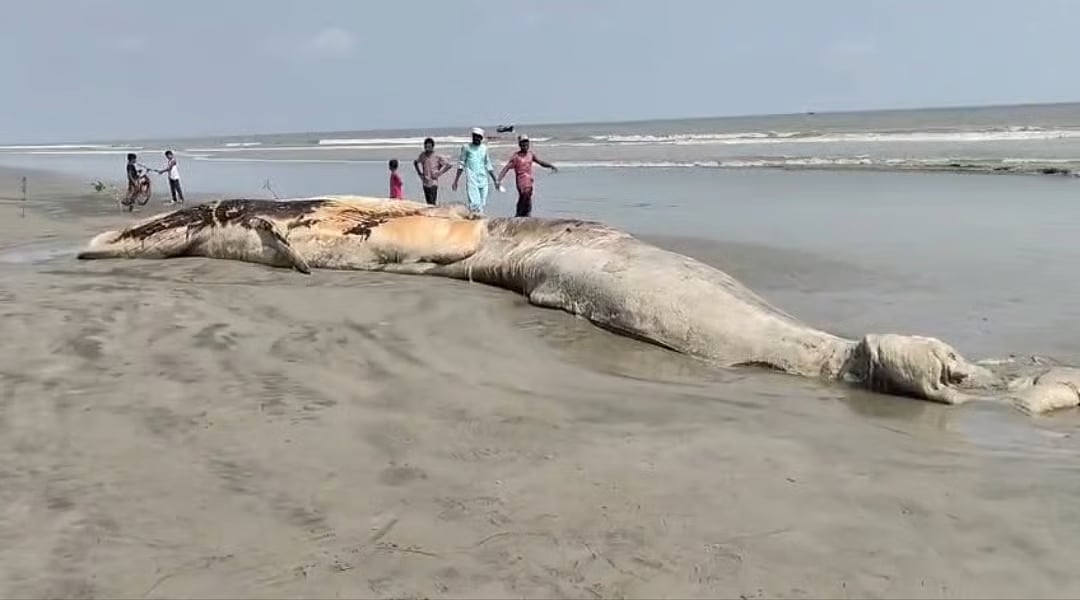
Massive 58-foot whale carcass washes ashore at Kuakata beach
The carcass of a 58-foot “baleen” whale washed ashore on Kuakata Sea Beach in Patuakhali. It drifted onto the eastern side of the beach near the Jhau Bagan area during high tide at around 2:00 pm on Wednesday (3 June).
Several local fishermen said they had previously spotted the dead whale floating in the deep sea, about 15 kilometres off the Kuakata coast. It eventually drifted to the shore with the tide and became stranded near the Jhau Bagan area.
Upon receiving the news, members of the Coastal Environmental Protection Movement rushed to the site and tried to recover the whale. However, immediate recovery was not possible as the carcass is already partially decomposed.
Meanwhile, the local administration is now trying to preserve the dead whale. If that is not possible, the upazila administration is considering burying the carcass.
KM Bachhu, convener of the Coastal Environmental Protection Movement, said, “The dead whale belongs to the Baleen species. It is suspected that the whale died about a week ago. However, the cause of death needs to be investigated.”
Mir Mohammad Ali, a researcher and teacher at the Faculty of Fisheries and Marine Science of Sher-e-Bangla Agricultural University, identified the carcass as a Baleen whale after examining photographs of the remains.
He described the stranding of the whale on the Kuakata coast as an ‘alarming signal’ for the marine ecosystem. However, determining the actual cause of death will require scientific examination or a necropsy. Dead or weakened whales may wash ashore for a variety of reasons, including entanglement in fishing nets, ship strikes, illness, plastic pollution, food shortages or strong sea currents.
Kawsar Hamid, the Upazila Nirbahi Officer (UNO) of Kalapara, told Prothom Alo, “We have also received the news. We are considering whether the dead whale can be preserved. We have already discussed the matter with the district administration, the Forest Department and the Fisheries Research Institute.”
According to experts, Baleen whales are marine mammals that lack teeth, having instead fringe-like ‘baleen’ plates in their mouths. They use these plates to filter tiny krill and plankton from the seawater. The blue whale—the largest animal on earth—belongs to this category.
These whales can range from 20 feet to 100 feet in length and are distinguished by two blowholes on top of their heads.
Baleen species, including blue whales, humpbacks and right whales, are found in almost all the world’s oceans. During summer, they typically migrate to the Arctic and Antarctic regions in search of abundant food sources such as krill, while in winter they move to relatively warmer and temperate waters.