Investigation
Farmland in Savar, Dhamrai drowning in industrial pollution
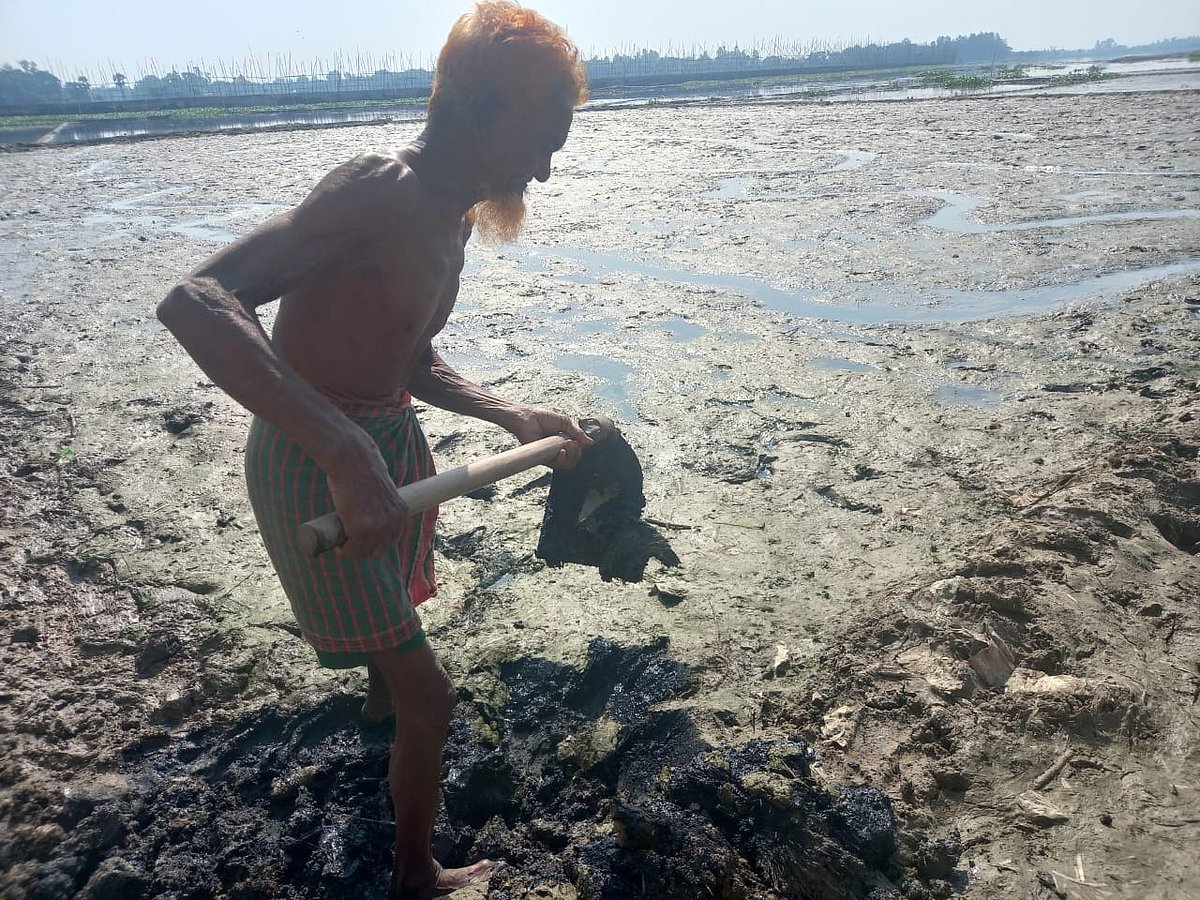
How long Md Alauddin will retain his identity as a farmer is uncertain. In 2023, he harvested about 25 maunds of paddy from his own 31 decimals of land. Last year, the yield fell to 18 maunds. This year, he could not cultivate at all.
Alauddin is from who is from Dautia village in Dhamrai upazila of Dhaka. He said in early September that water was not draining from his land. Growing paddy was out of the question; because of the stagnant polluted water, it was impossible even to step into the field. In November, the field was still found covered in dark water, with water hyacinth floating on it. Yet the land is on slightly higher ground.
Alauddin also used to work on other people’s land. Now he cannot find such work. He took a job at a garment factory; the factory has since shut down. He said, “I see darkness before my eyes. How am I going to run my family?”
Nearby, in Savar upazila’s Koltashuti mouza, this reporter met Zakir Hossain on 22 September. He had sown paddy on 28 decimals of land this season. He managed to harvest crops only from three decimals. Zakir said, “On the rest of the land, the paddy plants fell into rotten mud due to floods of factory wastewater. Even if paddy grows, most of it remains empty grains.”
Not far from the fields of Alauddin and Zakir, small and large industrial factories are being built on raised foundations. Their liquid waste is accumulating in the low-lying agricultural lands. The soil has turned into poisonous sludge. The odor of industrial waste is pungent. Many plots have turned into marshes. Small farmers are suffering the most.
From September to 16 November, this reporter visited parts of Dautia and Jaipura mouzas of Dhamrai and several areas of Koltashuti mouza in Savar. Over six days in Dautia–Jaipura, 30 farmers were interviewed, and over four days in Koltashuti, 25 farmers. Testing of soil, water, and paddy samples collected from these areas confirmed excessive levels of harmful chemicals.
According to data obtained from officials of multiple government departments, over the last 10 years, farmland has decreased while industrial establishments have increased in the two upazilas. Environmentalists and urban experts said that due to unplanned industrial expansion, pollution is damaging crops and gradually entering rivers and food sources.
Farmers’ misery
The severe impact of unregulated industrial expansion is evident in the fields adjacent to the Dautia Bridge in Dhamrai. Farmers said stagnant water has remained on approximately 200 acres in Dautia and adjoining Jaipura mouzas for 8–10 years. Liquid waste from factories mixes with this water. The foul-smelling waste is absorbing into the soil. Drainage canals are being filled and encroached upon, blocking rainwater outflow. The lands are turning into permanent wetlands.
On slightly elevated plots, farmers still grow paddy, but the rate of empty grains has increased. Farmers are also suffering from skin diseases due to exposure to the foul-smelling water.
Recently transferred Dhamrai Upazila Nirbahi Officer (UNO), Mamnun Ahmed, said that punitive measures are being taken against polluting establishments when complaints are received. He also said measures will be taken to drain water from waterlogged farmland.
However, farmer Nur Mohammad from Dautia said, “Many people said it would be solved. Even the chairman said once he would fix it. But nothing happened.”
Farmers of Koltashuti mouza in Savar also said that for more than 10 years their land has remained submerged most of the time, making cultivation impossible. Many are therefore selling their land to factory owners.
These farmers said liquid waste from some factories in Gazipur and Savar flows through a canal in their mouza and eventually reaches the Bangshi River. But parts of the canal have been filled and encroached upon. The canal has become narrow and lost depth. Now, the liquid waste overflows and accumulates in the surrounding farmland.
Waste mixed with rainwater is spreading and accumulating across vast agricultural fields. According to data from the upazila agriculture office, out of 395 hectares of farmland in Koltashuti mouza, 80 hectares have been damaged in this manner.
Mahbubur Rahman, the recently departed UNO of Savar, said that after visiting the affected areas and speaking with the affected farmers, necessary action will be taken against the polluting factories.
Afaj Uddin, a farmer from Koltashuti village, said, “There’s never a solution, we just hear that there will be one. The factory water is harming us. The water needs to be discharged into the river through pipes.”
What was found in water and soil
Prothom Alo, with the cooperation of Professor Md Mostafizur Rahman of the Environmental Science Department at Jahangirnagar University, tested the water sources, agricultural land, and surrounding areas in Dautia and Koltashuti mouzas. Soil and paddy were also tested.
Samples were collected from seven water sources, soil from four agricultural lands, and paddy from two places. At the end of September, the samples were tested in two laboratories—one at Jahangirnagar University’s Environmental Science Department and the other at a private lab in Dhaka selected by them. The latter only tested for heavy metals.
Water from various factories, including those in the BSCIC industrial zone in Dhamrai, is flowing into nearby agricultural lands in Dautia and Jaipura. Water from the end of the drains of the industrial zone and a nearby ceramic products factory, as well as stagnant water from one field, showed low dissolved oxygen (DO) levels. The ceramic factory’s water had higher-than-normal phosphate levels and excessive ammonia.
However, water from agricultural land in Koltashuti, Savar, showed almost normal DO levels, though phosphate, nitrate, and ammonia levels were high. In Dautia, three agricultural plots showed high phosphate and ammonia levels.
After reviewing the test results, Professor Md Enamul Haque of the Zoology Department at Jahangirnagar University said that water in both areas of Dhamrai and Savar has reached nearly lethal levels for aquatic life. He told Prothom Alo that when DO levels fall below 2 ppm, oxygen deficiency occurs. When phosphate levels in farmland are higher than normal, algae and other plants grow excessively. The presence of 4–5 milligrams of phosphate in farmland is much higher than normal. Excessive ammonia makes it difficult for aquatic life to survive. High nitrate levels also make it difficult for aquatic plants to survive.
Professor Md Mostafizur Rahman said, “The harmful elements found in the soil samples during the monsoon will increase by one to one-and-a-half times in the dry season. And the elements that need to be high will further decrease.”
Farmland is shrinking
According to data from the Dhamrai upazila agriculture office, in the 2015–16 fiscal year, total farmland in the upazila was 23,800 hectares. Except for about 200 hectares, all of it was cultivated. Aus, Aman, and Boro rice production exceeded 100,000 tonnes.
In the 2024–25 fiscal year, both total farmland and cultivated land have decreased significantly. Cultivated land decreased by 1,127 hectares. This year, Boro and Aus rice production stood at around 75,000 tonnes. Aman paddy is still in the field. However, the production of all three types of rice has declined. Wheat, maize, mustard, and vegetable production has increased.
According to data from the Savar upazila agriculture office, in the 2015–16 fiscal year, total farmland was 16,305 hectares, of which all but 210 hectares were under cultivation. That year, Aus, Aman, and Boro rice production totaled around 36,000 metric tons. Additionally, more than 150,000 tonnes of vegetables were produced. Mustard, wheat, jute, and maize were also grown to varying degrees.
In the 2024–25 fiscal year, both total agricultural land and cultivated land have declined significantly. Cultivated land has decreased by 2,510 hectares. This year, Aus, Aman, and Boro rice production amounted to just over 35,000 tonnes. However, vegetable and maize production has dropped somewhat.
Industries are expanding, pollution is spreading
According to data from Ashulia Industrial Police-1, in 2015 there were 1,094 factories in Savar and Dhamrai upazilas. In 2025, the number of factories has risen to 1,832.
Most of these factories are in the ready-made garment sector; of which about 40 have shut down out of 758 that existed ten years ago. Other industries include pharmaceuticals, food products, plastic goods, ceramic products, leather goods and processing, and battery manufacturing.
Gazipur Agricultural University Vice-Chancellor GKM Mustafizur Rahman said tannery industries spread the most harmful pollution. He told Prothom Alo that the tannery industrial zone is now in Savar. Chromium and cadmium from tannery waste are entering Savar’s soil. Nickel and lead from dyeing and pharmaceutical factories are entering the land. From the soil, these harmful heavy metals are passing into crops.
Pollution in rivers as well
In 2018, a team of 10 experts conducted a study on the presence of heavy metals and changes in land use. The study was titled “Monitoring of heavy metal pollution and GIS derived land use changes in the major economic zone of Bangladesh.”
The researchers tested water samples from 20 locations in the Dhaka Export Processing Zone (DEPZ) in Savar’s Ashulia, from the adjacent Turag River, and from the Bangshi River that flows through Savar and Dhamrai. Tests detected lead and nickel in Turag River water beyond the limits set by the World Health Organization (WHO). In 18 samples, the amount of cadmium was also high. The highest level recorded was 16.2 ppb, whereas the WHO standard is 3 ppb. Levels of all three metals were found to be high in the Bangshi River as well.
One of the researchers, Sharmine Akter, assistant professor at the Department of Environmental Science at Jahangirnagar University, said that the heavy metals found in the Turag and Bangshi rivers spread to agricultural land during the monsoon. Crops absorb these from the soil. She said, “As a result, the quality of crops is changing, production is falling, and these heavy metals are accumulating in crops.”
The state is silent, farmers are helpless
According to environmentalists and urban planners, the problem stems from factories being set up at will and from failure to follow pollution control regulations. Without installing effluent treatment plants (ETPs), factories are dumping liquid waste freely into drains, canals, and rivers, which then flow into agricultural land. Experts blame factory owners’ non-compliance with the law and the lack of effective initiatives by relevant administrative departments to protect agricultural land.
Environmental expert Professor Mustafizur Rahman stressed regular monitoring and testing of water and soil in both the monsoon and dry seasons.
Jahangirnagar University’s Professor of Urban and Regional Planning, Adil Mohammed Khan, said that Savar is already polluted, and Dhamrai is following the same path. He said that according to laws and policies, industries are supposed to be set up in designated areas, but that is not happening. The government is preparing an agricultural land protection law. Even under existing land-use laws, industries cannot be established on agricultural land.
Professor Adil Muhammad Khan further said Prothom Alo that everything that’s happening is through sheer muscle power and by exploiting weaknesses in the administration. By managing upazila and district administrations and the Department of Environment, industrial owners are getting the opportunity to destroy the environment for their own benefit. Meanwhile, helpless farmers protest, but the state remains silent.
Saidur Rahman in Koltashuti has sold his half-acre of land and is looking for a buyer for the remaining 18 decimals. He told Prothom Alo, “Because of the factory’s dirty water, crops don’t grow, but I still have to pay land tax. I am being forced to sell at a low price. If farming were possible, there would be no need to sell.”