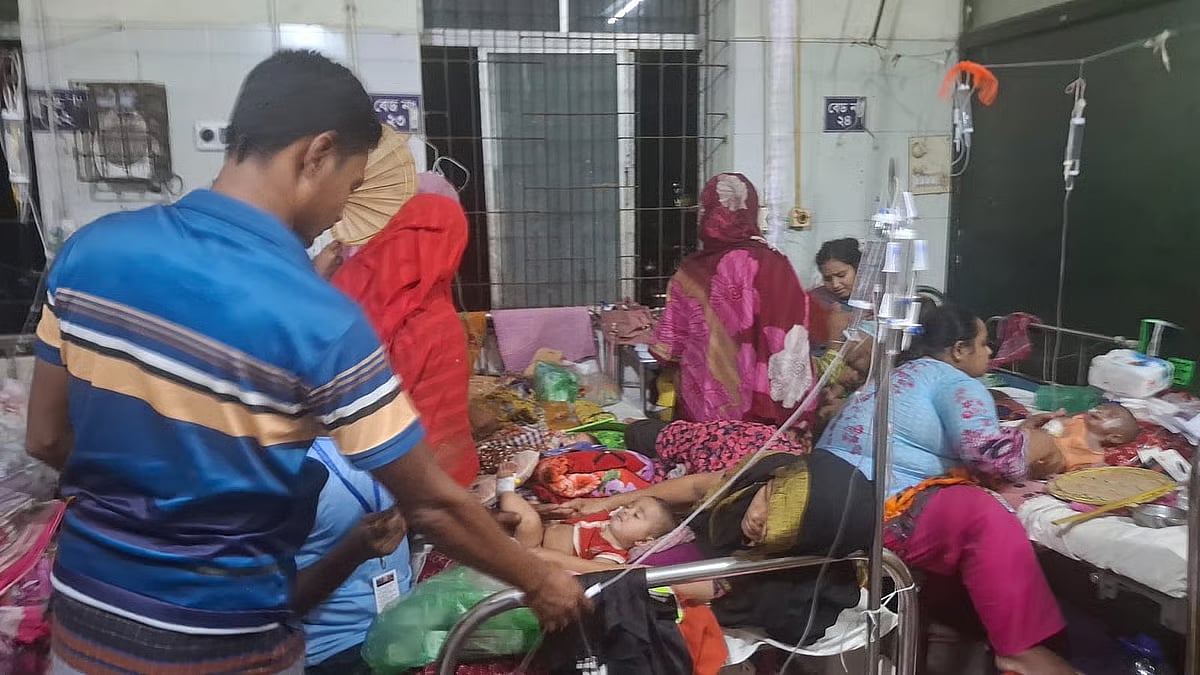
Rajshahi Medical College Hospital
33 children die in 11 days while waiting for ICU
Two-and-a-half-year-old Nusaiba was admitted to Rajshahi Medical College Hospital (RMCH) with critical injuries from a road accident. She needed to be placed in the Intensive Care Unit (ICU). Her name was 22nd on the waiting list for an ICU bed. But before her turn came, she died on 12 March. Four days later, ICU staff called to inform that her turn had arrived.
Nusaiba was the daughter of Sabuj Ali from Kathenga village in Chatmohar upazila of Pabna. Like her, 33 children waiting for ICU beds at RMCH died between 11 and 22 March. As of Wednesday morning, 38 children were still on the waiting list for ICU beds.
Nahid, the child of Sahid, a resident of Terokhadia area in Rajshahi city, died at the hospital on 13 March. His father said his son died three days after physicians advised ICU care. Despite efforts during those three days, he could not get his son admitted to the ICU.
Abu Hena Mostafa Kamal, in charge of the ICU at RMCH, believes that the 33 children might have survived if ICU support had been available.
He told Prothom Alo that a child who died on the morning of 19 March had been 37th on the waiting list. The child’s mother, crying, said over the phone, “I sought help from so many places, yet you did not give my child an ICU bed—if he had got a bed, he would have survived.”
Kamal said he frequently receives such “curses” from guardians over the phone.
A physician associated with its ICU services, speaking anonymously last month, said that out of around 150 applications for ICU admission, only 20–30 patients can be admitted daily on average.
He added that among government hospitals in Rajshahi, Rangpur, and Khulna divisions, this is the only dedicated 12-bed pediatric ICU in Rajshahi, and even that is running under special arrangements. As of 19 March, the last patient on the waiting list was from Rajbari, indicating that even patients from Dhaka division are coming here for ICU beds.
Critically ill and dying patients require ICU care. Although the cost of ICU services in government institutions is relatively low, private ICU care is beyond the reach of low- and middle-income families. Yet ICU beds, both public and private hospitals, are often unavailable.
According to the “Health Bulletin 2023” published by the Directorate General of Health Services (DGHS) in June 2024, a total of 728 new ICU beds were established in government initiatives between 2014 and 2023.
However, the bulletin did not specify the total number of ICU beds in government hospitals and health facilities nationwide.
A Prothom Alo report on 28 April, 2023, titled “No government ICU services in 22 districts,” stated that there are 1,126 ICU beds in government hospitals across the country, with around 1,000 more in the private sector. Even when needed, hospitals often cannot provide ICU care.
For example, Dhaka Medical College Hospital (DMCH), the country’s largest hospital, faces the same crisis.
A physician associated with its ICU services, speaking anonymously last month, said that out of around 150 applications for ICU admission, only 20–30 patients can be admitted daily on average.
Under special arrangements, of the 40 adult ICU beds, 12 are being used for young patients, 16 for older patients, and 12 for children. The remaining 20 pediatric ICU beds cannot be made operational due to lack of necessary equipment and human resources, even though demand for pediatric ICU care is very high.
According to the physician, not only admitted patients but also many outside patients, often with recommendations from influential figures, including ministers, seek ICU admission.
Stating that there are also shortages of human resources and malfunctioning equipment, the physician said hospitals should ideally have ICU facilities for 10 per cent of admitted patients, but even half of that requirement is not being met.
‘What is needed is goodwill’
A 60-bed ICU complex, the largest in the country, has been constructed at Rajshahi Medical College Hospital.
According to hospital sources, it includes 40 beds for adults and 20 for children. However, it has not yet received government approval and is being run under the hospital’s own management.
Under special arrangements, of the 40 adult ICU beds, 12 are being used for young patients, 16 for older patients, and 12 for children. The remaining 20 pediatric ICU beds cannot be made operational due to lack of necessary equipment and human resources, even though demand for pediatric ICU care is very high.
Hospital director Brigadier General PKM Masud Ul Islam said the currently operating 40-bed ICU at Rajshahi Medical College is not government-approved and is being run entirely under the hospital’s own arrangements, with no staff appointed by the government.
Meanwhile, a 200-bed children’s hospital has been constructed in Lakshmipur area of the city, including a 10-bed pediatric ICU. Although construction was completed in 2023, the facility has not yet been handed over, and its staffing structure has not been approved.
ICU in-charge Abu Hena Mostafa Kamal said, “The infrastructure for a children’s hospital and pediatric ICU in Rajshahi is already in place. What is needed now is proper management of government resources and goodwill.”