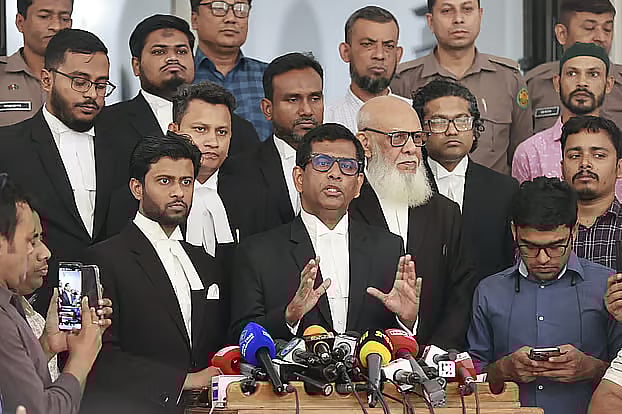
Student leader accuses Tajul Islam of irregularities
Mohammad Tajul Islam, the recently removed chief prosecutor of the International Crimes Tribunal (ICT), has been accused of irregularities by Mohammad Samrat Robayet, central coordinator of the private university unit of the Anti-Discrimination Student Movement.
He alleges that, there had been attempts to shield former member of parliament ABM Fazle Karim Chowdhury, an accused in a case involving crimes against humanity committed in Chattogram during the July mass uprising. Allegedly, Tajul Islam did not allow an arrest warrant to be issued against Fazle Karim’s son, Faraaz Karim Chowdhury, in that case.
Samrat Robayet submitted the complaint to the current chief prosecutor of the tribunal Md Aminul Islam. He is also the complainant in the case filed at the tribunal against Fazle Karim Chowdhury. Previously, he served as the chief coordinator of the private university wing of the Anti-Discrimination Student Movement in Chattogram.
Speaking to Prothom Alo, Samrat Robayet said he submitted the complaint to Aminul Islam at the chief prosecutor’s office on 25 February.
Former Awami League MP Fazle Karim Chowdhury, who represented the Chattogram-6 (Raozan) constituency, is currently in prison after being arrested in the crimes against humanity case. Monday had been scheduled for the submission of the investigation report to the tribunal, but it was not submitted. A new date, 12 April, has been set instead.
Meanwhile, former prosecutor Md Saimum Reza Talukder, who was assigned to the case, has been accused of demanding Tk10 million to secure bail for Fazle Karim Chowdhury. The allegation came to light after a joint investigative report by Prothom Alo and Netra News, published on 10 March under the headline ‘Prosecutor sought Tk 10m for bail in ICT case, recordings show’, sparking widespread discussion. The investigation reported that Saimum Reza Talukder had demanded the money from Fazle Karim’s family.
On the day the report was published, a five-member fact-finding committee led by the chief prosecutor was formed. The committee, established by the chief prosecutor’s office, has already held two meetings. Saimum Reza Talukder has since resigned from the position of prosecutor.
Regarding the allegations made by Samrat Robayet against Tajul Islam, Chief Prosecutor Aminul Islam told Prothom Alo on Tuesday that the investigation into the Chattogram case is ongoing. Therefore, they are not in a position to disclose further details about the allegations or the complainant at this stage. He said the committee is working on the matter and all issues will be reflected in its report.
Samrat’s allegation
In his written complaint, Samrat Robayet alleged that former chief prosecutor Tajul Islam, along with prosecutors Gazi Monawar Hossain Tamim, Md Mizanul Islam and Tarek Abdullah, formed a group that attempted to shield identified offenders.
The complaint states that although more than 55 witnesses in the tribunal’s investigation directly named Faraaz Karim in connection with the Chattogram incident, Tajul Islam used special legal authority to exclude Faraaz’s name from the arrest warrant. It also alleged that Tajul Islam maintained regular communication with Faraaz’s mother due to family ties.
Faraaz’s mother, Rizwana Yusuf, is the former wife of ex-MP Fazle Karim Chowdhury and is representing her former husband in the tribunal case.
Robayet also alleged that a conspiracy was hatched to secure bail for Fazle Karim despite his physical condition being normal and the Inspector General of Prisons describing his illness as “seasonal”.
Responding to the allegations, former chief prosecutor Tajul Islam told Prothom Alo that he is no longer in office and therefore is not aware of where or by whom such allegations are being made. However, he said he believes such “baseless and false propaganda” is being spread deliberately to question the judicial process.
Tajul Islam said the tribunal’s investigation agency and prosecution worked independently in their respective roles, and only those whose involvement was found during preliminary investigations were named as accused. No one was made an accused with ulterior motives, nor was anyone involved in crimes excluded. He added that, to his knowledge, the investigation report in the Chattogram case had not yet been accepted and that further investigation was under consideration during his tenure.
Tajul Islam said, “The claim about a conspiracy to secure bail is a grave falsehood. During my tenure, no bail petition for the individual concerned was filed or presented before the court for hearing. These false, baseless and motivated allegations are being raised as part of a deeper conspiracy to create hype over a non-existent issue and to cast doubt on the trials of those accused of crimes against humanity.”
Responding to the allegations, former chief prosecutor Tajul Islam told Prothom Alo that he is no longer in office and therefore is not aware of where or by whom such allegations are being made. However, he said he believes such “baseless and false propaganda” is being spread deliberately to question the judicial process.
Claiming that he had carried out his duties as chief prosecutor with integrity, Tajul Islam said, “I took an uncompromising stance on the trial of the July killings, enforced disappearances and other crimes, as the entire nation knows. I can state firmly that no one will be able to show even the slightest evidence of corruption against me. These media trials, based on irrelevant and false allegations, are attempts to mislead the public and ultimately to cast doubt on the trials of those accused of mass killings and crimes against humanity. I urge all concerned to refrain from such mean-spirited attempts.”
The interim government reconstituted the International Crimes Tribunal to try crimes against humanity committed during the July mass uprising and appointed Tajul Islam as chief prosecutor on 5 September 2024. After the BNP formed the government following the 13th parliamentary election, Tajul Islam’s appointment was cancelled on 23 February and Aminul Islam was appointed to the post.
Earlier, tribunal prosecutor BM Sultan Mahmud had also accused Tajul Islam of corruption and irregularities. He alleged that a “syndicate” led by Tajul Islam had turned the chief prosecutor’s office into a means of making money. Tajul Islam, however, rejected those allegations as well.
Allegations against others
In his written complaint against prosecutors Gazi Monawar Hossain Tamim and Mizanul Islam, Samrat Robayet said, “We have learned that in exchange for a large sum of money, Tamim and Mizan have vowed to protect Faraaz and Fazle Karim at any cost. Such disgraceful episodes are destroying the credibility of the tribunal.”
Denying the allegation, prosecutor Gazi Monawar Hossain told Prothom Alo, “I have not been involved with the Chattogram case from the beginning. I have no knowledge about the scene of the incident or the accused in this case.”
Prosecutor Mizanul Islam also claimed that he does not know the complainant, Samrat Robayet. Saying he had never been associated with the Chattogram case, he told Prothom Alo, “Everyone has the right to make allegations. But I can say that no one has ever discussed this matter with me. I have never earned a single penny through illegal means in my life.”
The complaint also mentions prosecutor Tarek Abdullah, alleging that although the investigation officer wanted to submit the report, “this group” repeatedly delayed the process. It further alleges that when Robayet and others went to the investigation office to discuss the matter, prosecutor Tarek Abdullah behaved very rudely towards them.
Tarek Abdullah, however, said he was not involved with the case, though he acknowledged meeting Samrat Robayet once.
Speaking to Prothom Alo, Tarek Abdullah said that one day towards the end of 2025 Samrat and a group of four to five others came to the tribunal and sat in the conference room of the chief prosecutor’s office. Several prosecutors and investigation officials were present there, including prosecutor Mizanul Islam, Md Shahidul Islam Sardar and the investigation agency’s coordinator Mohammad Shahidullah Chowdhury.
According to Tarek Abdullah, Samrat told the investigation officer, “We asked for arrest warrants against 15 people, why did you issue warrants against only 14?”
Observing what he described as Robayet’s disrespectful behaviour towards senior officials, Tarek said that although he did not know the full details of the case, at one point he told him that the tribunal would decide how many arrest warrants to issue and that it was not something they could dictate. He said he raised his voice while making that remark and had no further knowledge of the matter.