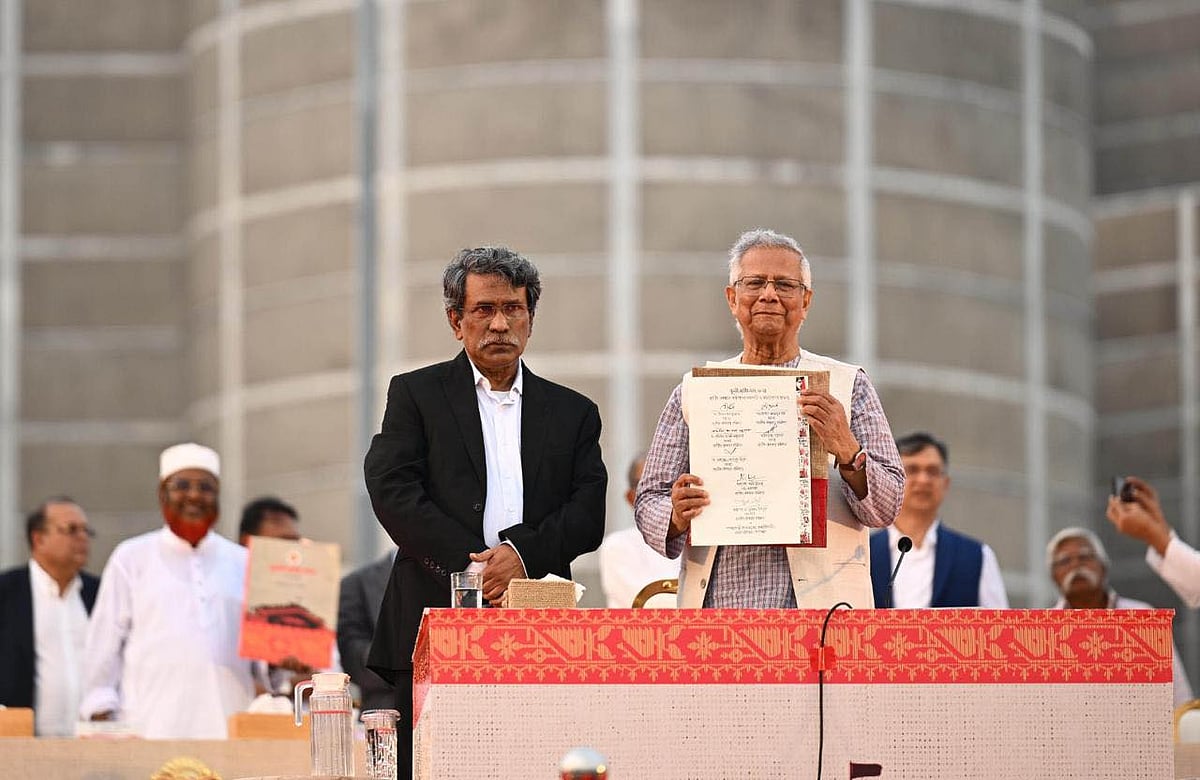
July Charter
Reform implementation process faces complications at the outset
Although those elected from the Bangladesh Nationalist Party (BNP) have taken oath as members of parliament (MPs), they did not take oath as members of the constitution reform council.
MPs elected from the party’s allied groups and independent MPs followed the same path. As more than two-thirds of members did not take the oath, the council could not be fully constituted.
People concerned say the outgoing interim government, through the formulation of the July National Charter, initiated efforts to reform various sectors of the state, particularly fundamental constitutional reforms, which were expected to be implemented by the elected government.
But with the council not formed, the reform implementation process has faced complications right at the beginning of the new government’s journey. There are concerns that this could trigger political tensions in the future.
Oath held on Tuesday
Chief Election Commissioner (CEC) AMM Nasir Uddin administered the oath to newly elected MPs in phases at the oath room of the National Parliament building yesterday, Tuesday.
Those elected from Jamaat-e-Islami and the National Citizen Party (NCP) took two separate oaths—one as MPs and another as members of the Constitutional Reform Council. Both oaths were administered by the CEC.
Following the victory of the “Yes” vote in the referendum, the July National Charter (Constitutional Reform) Implementation Order stipulates that a Constitutional Reform Council should be formed comprising representatives elected in the 13th parliamentary elections.
The referendum endorsed the order and the 48 constitutional reform proposals contained in the July Charter. The responsibility for implementing these proposals rests with the council.
According to the order, elected representatives are to take oath as council members at the same ceremony after being sworn in as MPs. They would simultaneously serve in both roles.
From the date of its first sitting, the council would have 180 working days to complete constitutional reforms in line with the charter and referendum results.
Through prolonged discussions between political parties and the former National Consensus Commission, agreement and decisions were reached on a total of 84 reform proposals spanning various sectors. These proposals formed the basis of the July National Charter.
However, the BNP did not join the council yesterday, leaving the reform implementation process in limbo. After taking oath, BNP Standing Committee member Salahuddin Ahmed told journalists that the party remained committed to upholding the July Charter “to the letter” as a document of political consensus.
In the election held on 12 February, the BNP won 209 of the 297 seats and its allies secured 3. Jamaat-e-Islami won 68 seats, while partners in its 11-party alliance secured 8. Seven independents were elected.
Uncertainty had existed beforehand about whether BNP MPs would take oath as council members. During the oath ceremony yesterday morning, Salahuddin Ahmed instructed party MPs that they had been elected under the Constitution as MPs, not as council members. He said oath-taking could proceed once procedures were set out in the Constitution’s Third Schedule following reforms and clarity emerged on who would administer it.
CEC Nasir Uddin then administered the oath to BNP members, including party chair Tarique Rahman, as MPs.
Jamaat and NCP take dual oaths at noon
There had also been uncertainty about whether Jamaat-e-Islami and NCP MPs would take the parliamentary oath if the BNP declined to join the council. Jamaat nayeb-e-ameer Syed Abdullah Mohammad Taher had said in the morning that they might refrain from taking either oath. NCP leaders similarly indicated their six elected MPs might abstain. Ultimately, however, 68 Jamaat MPs and 6 NCP MPs took both oaths.
Around 12:30 pm, Jamaat chief Shafiqur Rahman and the party’s MPs were sworn in, joined by independent MP Rumeen Farhana and BNP’s Ishraq Hossain. After taking oath as MPs, the latter two left the chamber, and Jamaat members then took oath as council members. After 1:00 pm, NCP convener Nahid Islam and the party’s six MPs also took their oaths.
Under the existing Constitution, newly elected MPs are sworn in by the outgoing Speaker or a nominee. If that does not occur within three days, the CEC administers the oath within the following three days.
Procedural rules also require MPs to sign prescribed forms before the Speaker or nominee. Since former speaker Shirin Sharmin Chaudhury has not appeared publicly since resigning in September 2024, and former deputy speaker Shamsul Haque Tuku is in jail following arrest in a murder case, the CEC administered the oath yesterday after the publication of the election gazette.
What was the reform implementation process?
Through prolonged discussions between political parties and the former National Consensus Commission, agreement and decisions were reached on a total of 84 reform proposals spanning various sectors. These proposals formed the basis of the July National Charter.
Of these, 48 proposals were related to the constitution. A referendum was subsequently held to implement those constitutional proposals, and the ‘Yes’ vote prevailed.
The July Charter contains several significant reform proposals, including a partial reduction of the prime minister’s authority, an expansion of the president’s authority in certain appointments, the introduction of a bicameral legislature, and the incorporation of appointment procedures for constitutional bodies directly into the constitution.
However, the Bangladesh Nationalist Party (BNP) submitted notes of dissent on several key issues, including the method of forming the proposed upper house. The party also incorporated its own constitutional reform proposals in its election manifesto.
3 stages of implementation
The implementation of the constitutional proposals was structured in three stages, two of which have already been completed.
First, to provide a legal basis, the ‘July National Charter (constitutional reform) Implementation Order’ was issued.
Second, a referendum was held to endorse the implementation of that Order. With the victory of the ‘Yes’ vote, the process moved towards the third stage.
Under the third stage, the implementation order stipulates the formation of a constitutional reform council comprising MPs to give effect to the constitutional proposals contained in the July Charter.
Why a constitutional reform council?
Under the existing constitution, amendments may be enacted with the support of two-thirds of the MPs. However, the July Charter Implementation Order provides that, rather than the regular parliament, a dedicated constitutional reform council would undertake the task of constitutional reform on this occasion.
During discussions with political parties, the proposal to establish such a council was raised. In particular, Jamaat-e-Islami and the NCP argued that the constitutional proposals contained in the July Charter would, if implemented, introduce substantial changes to the fundamental structure of the constitution.
They contended that there could be legal questions as to whether a regular parliament is empowered to alter the constitution’s basic structure. If amendments were adopted through the ordinary parliamentary process, they might subsequently be challenged before the courts. By contrast, granting the incoming parliament a specific and extraordinary mandate to carry out constitutional reform would preclude such legal challenges.
The BNP, however, expressed the view during those discussions that the formation of a separate council was unnecessary, maintaining that the existing constitutional amendment procedure was sufficient.
Furthermore, Jamaat-e-Islami, the NCP and several other parties proposed that the charter should be implemented through the issuance of a special order rather than by ordinance. The BNP opposed this approach, arguing that there is no constitutional provision for such an order and that the president may only promulgate an ordinance under the constitution.
The National Consensus Commission subsequently sought expert opinions on these matters. Ultimately, on 13 November last year, the president promulgated the ‘July Charter (Constitutional Reform) Order’, which included provisions for the establishment of a constitutional reform council.
Nevertheless, uncertainty remains as to the extent to which this order will be effective in practice and whether it will withstand legal scrutiny in the future.