Why interim govt was so restless in agreements with US: Anu Muhammad
Economist and lecturer Anu Muhammad has raised the question as to why the interim government was so restless in signing trade agreements with the United States.
He said, “By concluding these agreements in this manner, they (the interim government) have tied Bangladesh’s hands and feet. They could have easily said, the elected government is coming, you will be able to negotiate with the elected government.”
Regarding this, Anu Muhammad further said, “Their (interim government’s) enthusiasm has been extremely high since the budget period.”
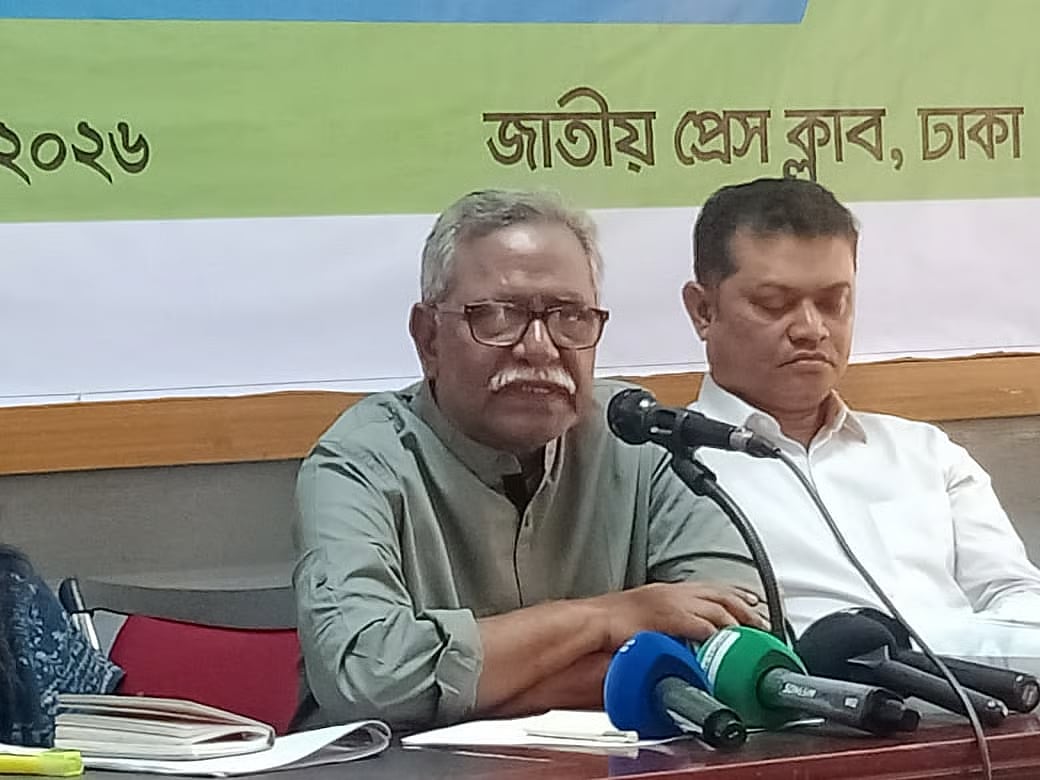
Anu Muhammad, former economics professor at Jahangirnagar University, made these remarks at a discussion titled “Bilateral Free Trade Agreements and Bangladesh’s Gains and Losses” organised by Bangladesh LDC Graduation Watch at the Tofazzal Hossain Manik Mia Hall of the National Press Club, Dhaka on Thursday.
Raising the question of what changes Bangladesh’s communication system has undergone as a result of the agreement with US-based internet service provider Starlink, Anu Muhammad said, “Judging by their (interim government’s) unusual enthusiasm in signing these agreements, it seems that even if they were advisers or special assistants, they effectively acted as lobbyists for various companies.”
Calling on the new government to reconsider the trade agreements, Anu Muhammad said that these agreements could push Bangladesh’s economic future toward a major crisis.
He emphasised on opening a national-level discussion and, if necessary, reconsideration of the agreements is crucial.
Addressing the BNP government, Anu Muhammad said, “Sobar Agey Bangladesh (First and foremost, Bangladesh)—if Tarique Rahman’s slogan is to be taken seriously, then the first task is to clear the path for how Bangladesh can be freed from these agreements. Those who executed these agreements must be held accountable and brought under justice.”
Describing the trade agreements with the US as ‘horrific’ and ‘against Bangladesh’s interests,’ the economist said, “There was no rationale for signing the agreements on 9 February, just a few days before the election. Most countries in the world have still not signed such agreements. Those that have, have far better terms than Bangladesh.”
Referring to the terms of the agreement, Anu Muhammad further said, “The government claims that importing cotton from the US will allow the ready-made garments sector to enjoy duty-free benefits. But businesspeople say there are so many conditions and uncertainties that it is unclear whether any actual benefit will be received. Cotton prices will be high. Export quantities are also unspecified.”
Anu Muhammad criticised the interim government led by Professor Yunus. He said, “What was Yunus’s motivation… He has established many institutions under Grameen, received tax exemptions. Haven’t his projects already benefited him… or did he need to do all this to become UN Secretary-General, as claimed?”
Demand for cancellation or reconsideration of the agreement
In the discussion, Associate Professor Mosahida Sultana of the Accounting Department at Dhaka University described the trade agreement with the US as “inadequate and harmful.” She said, “This agreement, signed at the very end of the interim government’s term, could put the country’s energy security, industrial policy, and economic interests at risk.” According to her, the agreement imposes mandatory conditions that weaken Bangladesh’s bargaining capacity.
Expressing concern over conditions limiting subsidies for state-owned enterprises and the agricultural-industrial sector, Mosahida Sultana said that developing countries like Bangladesh need subsidies to support industry. She called for cancellation or reconsideration of the agreement, stating that parliamentary discussion and decisions based on public opinion should have preceded it.
Example of an inadequate agreement
Supreme Court lawyer Jyotirmoy Barua raised questions about the legal and ethical validity of international agreements signed by the interim government with Japan and the US. He said in the discussion, “The clauses of these agreements are examples of unfair contract terms. They require fresh legal review and analysis.”
He also noted that these agreements are risky for Bangladesh not only economically but also politically and legally. He stressed that it is now necessary to review them through full parliamentary discussion.
The discussion session was moderated by Zakir Hossain, CEO of Nagarik Uddyag, with main remarks presented by Barkat Ullah Maruf, coordinator of Bangladesh LDC Graduation Watch. Development economics researcher Maha Mirza also attended the discussion.