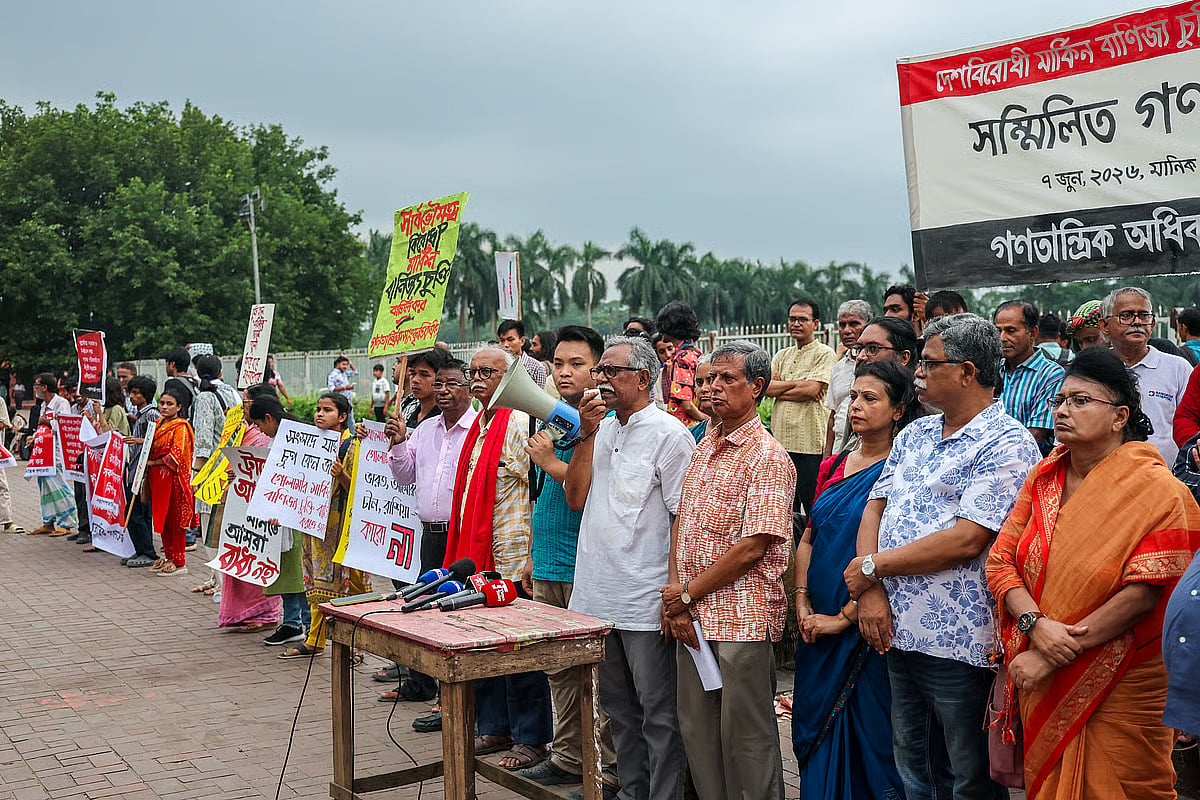
Govt must be held accountable over US trade agreement: Anu Muhammad
Economist and academic Professor Anu Muhammad has said that the government must be held accountable for the trade agreement signed with the United States, arguing that responsibility ultimately lies with those elected by the people of Bangladesh.
“This government is accountable; it must answer,” he said.
Professor Anu Muhammad made the remarks at a mass protest programme organised by the Ganatantrik Odhikar Committee (Democratic Rights Committee) at Manik Mia Avenue in the capital on Sunday afternoon.
The demonstration was held under the banner of demanding the cancellation of what organisers described as an anti-national trade agreement with the United States. Representatives of various left-wing political, social and cultural organisations took part in the event.
“This is an elected government. The people elected Tarique Rahman’s government. The people elected Tarique Rahman, yet the country will be run by the United States and the Trump administration? The country will be run by the IMF and by various corporate interests? That cannot be allowed,” Professor Anu Muhammad said.
Describing the trade agreement with the United States as an issue affecting the country’s very existence, sovereignty and security, he said that the document contained more than a hundred provisions detailing the obligations Bangladesh would be required to fulfil.
“From the very first clause onwards, the agreement specifies what Bangladesh will be compelled to do. As for what the United States will do, the document mainly outlines the measures Washington may take against Bangladesh should the latter fail to implement the agreement’s provisions,” he said.
According to Professor Anu Muhammad, a close reading of the agreement reveals that it amounts to a set of instructions issued by the United States.
“Anyone who reads the entire document will understand that it is essentially an American directive. Those who signed on behalf of Bangladesh are, in effect, representatives of the US administration. They have no backbone, no sense of responsibility, and no hesitation in bringing ruin upon the country. A group of traitors signed this agreement,” he stated.
Professor Anu Muhammad also demanded that those associated with the signing of the agreement, including incumbent Foreign Minister Khalilur Rahman and others linked to the interim government led by Professor Muhammad Yunus, be brought to justice.
He further expressed concern over what he described as the current government’s conduct.
“The role the government has played so far is deeply alarming,” he said. “We have yet to see any evidence that this is an elected and independent government. What we have witnessed instead is a government that has capitulated to the United States and other international powers and, despite being elected by the people, is pursuing policies contrary to the public interest.”
‘A treaty of subjugation’
Harun Ur Rashid, a member of the Ganatantrik Odhikar Committee, characterised the trade agreement as a “treaty of subjugation”.
“If the country is to be protected, political differences must be set aside and people must unite against this disastrous agreement,” he said. “Opposing this agreement is a moral obligation for every citizen.”
Moshrefa Mishu, general secretary of the Ganatantrik Biplobi Party (Democratic Revolutionary Party), warned that the agreement would have adverse consequences for major sectors of the economy, including the garment industry, pharmaceuticals and energy.
“In the interest of the country and its people, this agreement must be cancelled,” she said.
Others present at the protest included Dhaka University professor Tanzimuddin Khan, public health expert Mushtuq Husain, development economist Maha Mirza, Nari Mukti Kendra (Women’s Liberation Centre) President Seema Dutt, writer and researcher Pavel Partha, Akram Khan, poet Hasan Fakir, and lawyer Manjur-Al-Matin, among others.
The programme was moderated by Mahatab Uddin Ahmed, a member of the Ganatantrik Odhikar Committee.
Open letter
At the event, Dhaka University academic Moshahida Sultana read out an open letter addressed to the prime minister, the speaker of parliament and all members of parliament.
The letter stated, “The conduct of both government and opposition MPs gives the impression that no such agreement — one capable of placing long-term shackles on the nation — has even been signed. As citizens of Bangladesh, we demand a proper explanation for this dangerous silence on matters of national interest, with the exception of a single independent member of parliament.”
Addressing the MPs directly, the letter continued, “As elected representatives, do not continue to neglect your grave responsibilities. During the current parliamentary session, hold a detailed debate on this trade agreement — this American directive — and take the decision to annul it, thereby freeing Bangladesh from the snare created by this agreement.”