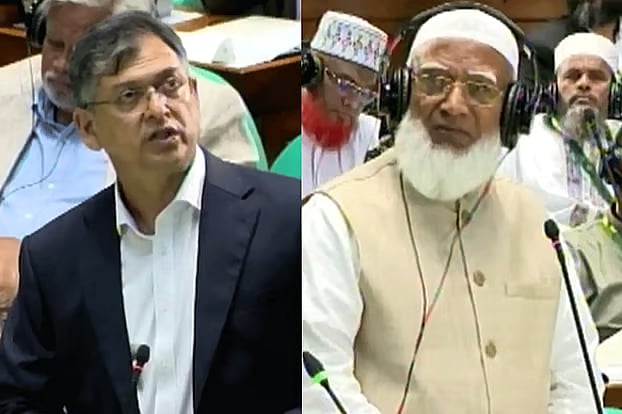
Home minister, Jamaat ameer debate constitution reform council in parliament
A debate has taken place in the Jatiya Sangsad (national parliament) over the formation of a constitution reform council to implement the proposals of the July National Charter.
Opposition leader and Jamaat-e-Islami ameer Shafiqur Rahman expressed concern in parliament over the failure to convene the session of the constitution reform council within the stipulated time under the July National Charter (Constitutional Reform) Implementation Order.
In response, home minister Salahuddin Ahmed said the prime minister cannot advise the president on the matter because the constitution does not recognise the existence of a constitution reform council.
He further said the president also cannot convene such a session and therefore has not done so. He proposed that the opposition leader discuss the issue of constitution reform at the business advisory committee of parliament.
The unscheduled debate over the constitution reform council took place during an unscheduled discussion in parliament today, Sunday.
The parliament session began at 11:00 am. At the start, opposition leader and Jamaat-e-Islami ameer Shafiqur Rahman stood up seeking time for an unscheduled discussion.
Speaker Hafiz Uddin Ahmad then said the opposition leader would be given the floor after the question-answer session.
After the question-answer session, the speaker allowed Shafiqur Rahman to speak. The opposition leader said the parliament, formed in the context of the July mass uprising, did not come through the usual electoral process. It came into being through an order issued by the president on 13 November 2025.
The opposition leader read out the entire July National Charter (Constitution Reform) Implementation Order in parliament. He said the order requires that the session of the constitution reform council be convened within 30 days of the declaration of the election results.
The opposition leader further said, “However, this session has not been convened within that time. That is my concern.”
Referring to various clauses of the July Charter order, Shafiqur Rahman said the order states that if “Yes” wins in the referendum, a constitution reform council will be formed with the representatives elected in the national parliament election. But such a council has not been formed.
Referring to the MPs of the current parliament being elected through two separate votes in two different capacities, Shafiqur Rahman said that under the July order, 77 members from the opposition had taken oath as members of the constitutional reform council. Under the order, they want the opportunity to serve simultaneously as MPs and as members of the constitutional reform council.
After the opposition leader’s remarks, speaker Hafiz Uddin Ahmad said he expected a response from the treasury bench.
Home minister Salahuddin Ahmed then responded to the opposition leader.
At the outset, he asked the speaker under which rule the opposition leader had been given the floor. He said that if an adjournment motion on a matter of urgent public importance was to be raised, there were rules for that, and questioned whether the opposition leader had submitted any notice under those provisions.
He also asked whether any notice had been submitted under Provision 68 for a short discussion on a matter of urgent public importance.
Salahuddin Ahmed said the president can promulgate an ordinance when parliament is not in session. However, any matter involving an amendment to the constitution or a change to the constitution cannot be brought through an ordinance. That would not be valid.
Home minister Salahuddin Ahmed said, “But this order—the July national ordinance implementation order—is neither an ordinance nor an act. It’s something in between. I had said at the time that it might be considered neutral in character.”
Referring to the order as an “imposed” directive, Salahuddin Ahmed stated that under the constitution, the president acts on the advice of the prime minister in all matters except two. Similarly, the calling of this parliament was done on the prime minister’s advice. However, as the constitution does not provide for the existence of a constitutional reform council, the prime minister cannot advise the president on it. Since the president cannot convene that council either, no session has been called.
Salahuddin Ahmed added that if the president’s issued order were considered constitutional as per the opposition’s question, it could be discussed here.
He said that the courts have issued rulings stating why the constitutional reform implementation order and the relevant parts of the referendum ordinance cannot be declared unconstitutional. The judiciary may offer opinions, but their views are never binding on the sovereign parliament. At the same time, the sovereign parliament cannot enact any law that could later be challenged in the judiciary and annulled or considered a violation of the constitution. Therefore, both aspects must be kept in mind to proceed legally and constitutionally in the broader interest of the nation.
Home minister Salahuddin Ahmed said, “Now, if it is said that a constitution reform council must be formed to implement the referendum result, we accept that. We were elected through a constitutional vote. The election commission has two mandates: one is to conduct the national parliament election, and the other is to conduct the presidential election. This is a constitutional mandate that the election commission is obliged to uphold.”
He added that another law exists specifically for the referendum, which BNP had also proposed. However, in the meantime, the order was issued and the referendum was held with four questions. Among these, one major question had no prior agreement in the July national ordinance. It was a forcefully imposed order, and a question from that order was included in the referendum. Even though there were four questions, people had no alternative to vote yes or no on each specific question.
Salahuddin Ahmed said that even if the referendum result is to be implemented, constitutional reform must come first.
He added that there is considerable doubt whether a constitution amendment bill can be introduced in this session, as 133 ordinances were presented on the first day.
He noted that if a decision is made in the parliamentary advisory committee, and the parliament approves, then the constitutional amendment bill could be introduced in the budget session.
Home minister Salahuddin Ahmed said, “I am not denying anything. The public must be respected, but that has to be done constitutionally, legally. There is no place for emotion here. The state does not run on emotions. The state runs on the constitution, law, and rules.”
The home minister proposed to the opposition leader that the matter be discussed in the parliamentary advisory committee.
Salahuddin Ahmed, a member of BNP’s policy-making body, standing committee, added that they have pledged to the nation that they respect every word of the July national ordinance as a document of political consensus. However, whether the constitution can be amended through any order imposed outside the July national ordinance or through any illegal order remains a major legal and constitutional question. He called for debate and discussion on this issue as well.
Later, addressing opposition leader Shafiqur Rahman, speaker Hafiz Uddin Ahmad said, “You have raised an extremely important public matter. Such significant issues cannot be resolved on the spot. You will submit a notice, and once the notice is received, I will make a decision.”