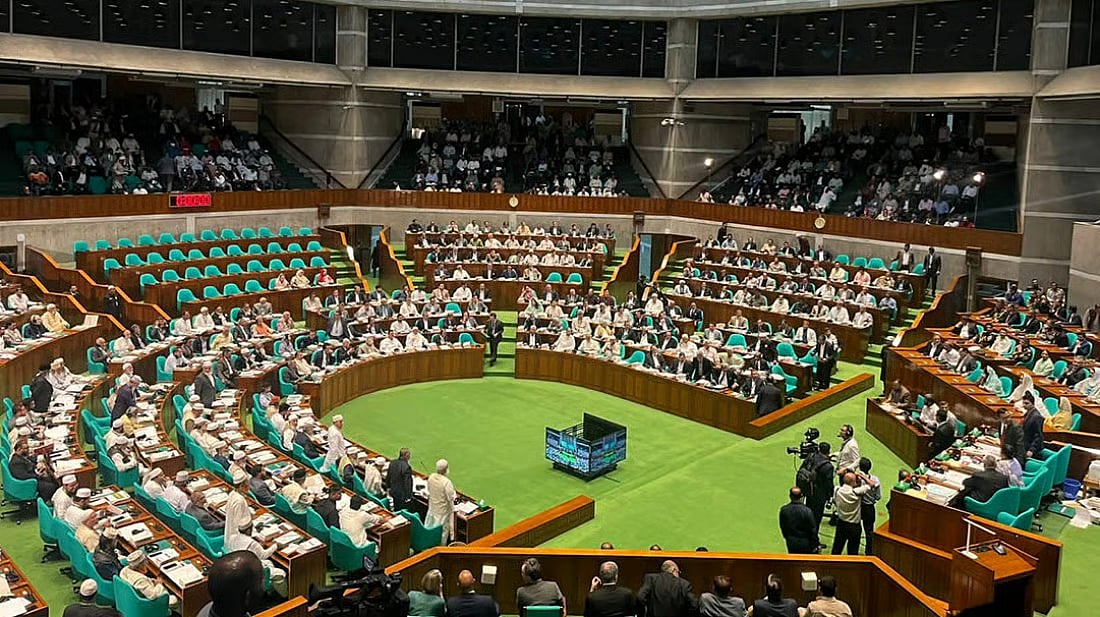
Parliament Session
No consensus in parliament on how to implement July charter
Although a discussion was held yesterday, Sunday, in the National Parliament on an adjournment motion regarding how the July National Charter would be implemented, the ruling party and the opposition failed to reach any consensus on the issue. On this question, the ruling party BNP and the opposition parties Jamaat-e-Islami and NCP remained firm in their previous positions.
The BNP said it would adhere strictly to the July National Charter as it was signed, including the notes of dissent. Accordingly, it proposed amending the Constitution through the regular parliamentary process.
On the other hand, the opposition said it wants reform of the existing Constitution. It seeks changes to those parts of the Constitution that have repeatedly given rise to fascism over the past 54 years. For this reason, it supports full implementation of all the core proposals of the July Charter—without the notes of dissent. It believes a meeting of the Constitution Reform Council is necessary for this.
Yesterday, ruling party MP Zainul Abdin Farroque raised an adjournment motion in Parliament to discuss how the July National Charter should be implemented. Nine members from both the ruling and opposition parties took part in the discussion. Speaker Hafiz Uddin Ahmed presided over the session.
Earlier, on Wednesday, a discussion had been held on another adjournment motion by the opposition regarding convening a meeting of the Constitution Reform Council to implement the constitutional-related proposals of the July Charter. No decision was reached that day either.
Position of the Ruling Party
Home Minister Salahuddin Ahmed took part in the discussion on the adjournment motion in Parliament on behalf of the Leader of the House, Tarique Rahman. He presented the party’s arguments, referring to the key proposals of the July National Charter on which the BNP had notes of dissent.
Salahuddin Ahmed said the provision that a person cannot hold the office of prime minister for more than 10 years had been proposed by the BNP under the direction of Tarique Rahman. This is because they do not want the emergence of personal or parliamentary autocracy.
He said the BNP is committed to fully implementing all clauses and pledges of the July Charter as it was signed, including the notes of dissent. At the same time, he described the July National Charter Implementation Order as “colourable legislation.”
He alleged that there had been consensus on abolishing the Fifth, Sixth, and Seventh Schedules of the Constitution. However, later the Seventh Schedule was not included in the Charter. There had also been agreement on inserting “full faith and belief in Allah” and removing the provision requiring the display of Sheikh Mujibur Rahman’s portrait—but these were not included in the Charter either.
He said the BNP is committed to ensuring full independence of the judiciary, but does not support a “sovereign judiciary,” because sovereignty lies with the people, parliament, and the state—no other entity can hold sovereign authority. He added that laws regarding the judiciary’s secretariat and judicial appointments would be passed in this Parliament.
The home minister said the Constitution is not “reformed”; rather, it is annulled, suspended, amended, or repealed. Changes can be made through amendments. He said the opposition wants reform, not amendments. Some had wanted a rewritten Constitution—those who, he claimed, had come from abroad with reform proposals. He added that a rewritten Constitution, a new Constitution, and a constituent assembly essentially mean the same thing; whatever is to be adopted can be brought through amendments.
Referring to the spirit of the July mass uprising, he said it would be reflected in the Constitution, but nothing can be compared with the independence of 1971. He argued that some people do not like the 1972 Constitution because it includes the declaration of independence, the Liberation War, victory, and the role of President Ziaur Rahman—all forming part of the country’s history of victory, which may represent defeat for others.
He added that the first schedule of the 1972 Constitution legalised several orders, including the Bangladesh Collaborators Order, under which collaborators such as Razakars and Al-Badr members were tried.
Calling the July Charter Implementation Order illegal, the home minister said that after the first Parliament began on 7 April, 1973, there was no longer any authority to issue presidential orders. He alleged it had been imposed as a document of national deception and that a referendum had been forced through manipulation.
Earlier, Law Minister Md Asaduzzaman said the method of implementing the July Charter is already explained within the Charter itself and would be reflected transparently as a “debt of blood.” No alternative method is needed. He said the Charter reflects the will of the people, with 33 parties agreeing on a Constitution that would be revised through additions, deletions, and refinements based on the current one. All amendments are reforms, but not all reforms are amendments—reforms must ultimately be formalised through amendments.
Participating in the discussion, Bangladesh Jatiya Party (BJP) Chairman Andaleeve Rahman Partho said the provisions of the July Charter should be incorporated into the Constitution through parliamentary procedures. He warned that the nation is being misled and that there is an attempt to position them against the spirit of July.
Position of the Opposition
Opposition Leader and Jamaat-e-Islami Ameer Shafiqur Rahman, referring to the Constitutional Reform Council, said that even though the deadline has passed, a solution is still possible if there is openness. They want to move forward by finding that path. Necessary reforms and amendments can be carried out, and they are not opposed to amendments. They will fully cooperate in constitutional amendments and lawmaking.
He said they want changes to the Constitution to establish a just society and a country free from fascism. They are not against the Constitution, but against those aspects that have repeatedly enabled authoritarianism over the past 54 years.
Urging acceptance of a referendum without controversy, he said the Constitution and laws exist for people, and the current Parliament was not formed under perfect conditions. Compromises were made in the interest of the country and its people. Even though the deadline has passed, a solution is still possible with an open mind.
Earlier, National Citizen Party (NCP) Member Secretary Akhtar Hossain said the implementation method of the July Charter had already been discussed in the National Consensus Commission, but the BNP is now unwilling to accept its outcome. He alleged that reform has progressed significantly, but the government is now trying to rein it in.
He said the initial draft of the July Charter given to parties did not include notes of dissent; these were later inserted by a party or an individual at Parliament Plaza, and he called for an investigation into the matter.
Responding to questions about the legality of the July Charter Implementation Order, he said that BNP Chairperson Khaleda Zia was not released under any specific law after the uprising—it was done based on the will of the people.
Similarly, the order was issued based on public will, as stated in its background. He added that although the Constitution requires portraits of Sheikh Mujibur Rahman to be displayed in all ministers’ offices, this is not being followed—again reflecting the will of the people.
Explaining why a Constitution Reform Council is needed, Akhtar Hossain said some proposals in the July Charter would change the fundamental structure of the Constitution. If incorporated merely through amendments, they would not be sustainable. That is why a constituent assembly had been proposed in the consensus commission.
While the BNP preferred parliamentary amendments, the idea of a Constitution Reform Council emerged through discussion, supported by leaders like Zonayed Saki and Nurul Haque Nur. Jamaat MP Nazibur Rahman said the ruling party is disregarding the public mandate by invoking the Constitution. Ignoring the people’s verdict and revolutionary movement amounts to disregarding the Constitution itself.
Among others, BNP MPs Zainul Abdin Farroque and Mir Helal Uddin, and Jamaat MP Gazi Enamul Haque also took part in the discussion. Later, the Speaker adjourned the session until 3:30 pm today, Monday.