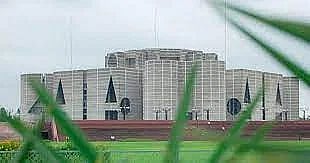
The first session of the 13th Jatiya Sangsad (National Parliament) begins today, Thursday. Indications suggest that tensions may emerge from the very start of the session.
Formed through elections held after the student–public uprising, this parliament may see growing debate and friction over the implementation of several key constitutional proposals included in the July National Charter.
The session will begin at 11:00 am in the parliament chamber at the Jatiya Sangsad Bhaban. Under the constitution, President Mohammed Shahabuddin will address the first session of a newly elected parliament.
However, he was elected during the tenure of the government of the Bangladesh Awami League (AL), whose activities are now banned.
Opposition parties Jamaat-e-Islami and the NCP have raised objections to his address to parliament. Multiple sources from the two parties indicated that the issue could spark tensions during the very first sitting.
When asked about Jamaat’s stance on the president’s address, the party’s ameer and leader of the opposition Shafiqur Rahman told journalists yesterday, Wednesday, at the LD Hall of parliament, “We have had extensive discussions on the matter. Tomorrow (today) you will see our role clearly. Just as the sun will rise, you will hear the speech—and you will also see our response.”
There are also differences between the BNP and other parties regarding several constitutional reform proposals included in the July National Charter. The BNP supports implementing those proposals according to its own interpretation, while Jamaat and the NCP want the charter to be implemented in full. Opposition parties have hinted that they will take a firm stance on the issue in parliament.
Relevant stakeholders say the 13th parliament is convening in a new political reality. There is widespread expectation that the Jatiya Sangsad will be established as a centre of effective debate, accountability and democratic practice.
The previous three parliaments—the 10th, 11th and 12th (which lasted six months and eight days)—were formed through controversial elections. All three were effectively one-sided.
During those periods, the Jatiya Party (JaPa) served as the main opposition to the then ruling Awami League, often being labelled in political circles as a “tame opposition.” Allegations were frequently made that the ruling party and opposition in those parliaments acted in concert in many instances.
The Awami League government fell following a mass uprising on 5 August, 2024. An interim government led by Professor Muhammad Yunus took oath on 8 August.
A year and a half later, the 13th parliamentary election was held on 12 February. The election commission published the official gazette of the results on the night of 13 February, and newly elected MPs took oath on 17 February.
According to the constitution, the first meeting of parliament must be convened within 30 days of the announcement of election results. The first session is being held today, exactly one month after the results were declared.
Speaking at a press conference yesterday at the LD Hall of parliament, Chief Whip Nurul Islam said the national parliament is not merely a constitutional institution; it represents the rights, dignity and democratic aspirations of the people.
He further said the new session is beginning with the hope of reflecting the people’s expectations, trust and aspirations.
The chief whip also said their goal is to run an effective, vibrant and responsible parliament and to make it the centre for resolving the country’s problems.
Nurul Islam also expressed hope that the opposition would play a constructive role and extend cooperation.
What will happen with the reforms
After the fall of the Awami League government, the interim government initiated reforms in various sectors of the state. Among them was a referendum on implementing 48 constitutional reform proposals.
As the “Yes” vote won in the referendum, the July National Charter (Constitutional Reform Implementation Order) stipulated the formation of a Constitutional Reform Council comprising elected representatives of the 13th parliament.
While members elected from Jamaat and the NCP have taken oath as members of the council, BNP lawmakers have not. As a result, the council has not been formed, creating an early setback for the constitutional reform initiative undertaken during the interim government’s tenure.
However, the BNP says it embraces every word and letter of the July National Charter and remains committed to implementing it. The party has also said it will implement the commitments included in its election manifesto for which it received the people’s mandate.
The charter contains several major proposals, including reducing the prime minister’s unilateral powers, increasing certain powers of the president, forming an upper house based on the vote share of the lower house, requiring approval from the upper house for constitutional amendments, and incorporating constitutional provisions for appointments to institutions such as the ombudsman, the Public Service Commission and the Anti-Corruption Commission. The BNP has expressed differing views on some of these proposals.
With a two-thirds majority in parliament, the BNP can amend the constitution according to its own position. Observers believe attempts to implement these proposals may create political tensions both inside and outside parliament.
Opposition leader Shafiqur Rahman said yesterday that 69 per cent of voters supported the “Yes” vote in the referendum.
“There is no scope to ignore that. We will continue to play our role in support of it, and we want all four issues included in the referendum to be accepted and implemented exactly as they are,” he told reporters at the parliament’s LD Hall.
He noted that opposition MPs have taken both the oath as members of parliament and as members of the Constitutional Reform Council. “Unfortunately, the ruling party has not yet taken the first oath,” he said.
When asked about the future of the Constitutional Reform Council mentioned in the July Charter, Chief Whip Nurul Islam said yesterday that the government had not taken the oath because the provision is not yet part of the constitution. A decision will be taken once it is incorporated into the constitution, he added.
In addition to constitutional reforms, legal reforms may also generate tensions in parliament. During the interim government’s tenure, 133 ordinances were issued as part of reform initiatives. The BNP has objections to some of them.
Speaking at an event in the capital yesterday, BNP Standing Committee member and Home Minister Salahuddin Ahmed said the government could accept most of the 133 ordinances issued during the interim government period. However, several ordinances require further discussion, he said, adding that the government and opposition will discuss them together.
Deputy speaker issue
According to the July National Charter, parliament will be bicameral, with an upper house formed proportionally based on the vote share of the lower house. One deputy speaker will be nominated from the opposition in each chamber. While the BNP agrees with the proposal in principle, it has reservations about the method of forming the upper house. The party has nevertheless proposed giving the deputy speaker’s post to the opposition in the current parliament.
However, it remained unclear until yesterday whether the opposition party Jamaat-e-Islami would accept the deputy speaker’s post.
After a meeting of opposition lawmakers at the parliament complex yesterday, opposition leader Shafiqur Rahman told journalists, “The July Charter clearly states that one deputy speaker will come from the opposition. We do not want this in isolation—we want the whole package, we want piecemeal. We want the entire charter to be accepted and implemented so that we can perform our rightful duties based on it.”
An unusual start
Typically, the first sitting of a new parliament begins under the chairmanship of the speaker or deputy speaker of the outgoing parliament, who then presides over the election of the new speaker and deputy speaker. This time, however, the process will be different.
Former speaker Shirin Sharmin Chaudhury resigned in September 2024 and has not appeared publicly since. Outgoing deputy speaker Shamsul Haque Tuku is currently in prison after being arrested in a murder case.
At yesterday’s press conference at the parliament’s LD Hall, Chief Whip Nurul Islam outlined the first day’s proceedings. He said the session will begin with the speaker’s chair left vacant due to the absence of the former speaker and deputy speaker. The proceedings will start with a recitation from the Holy Quran. The leader of the house will then propose the name of a senior member to preside over the sitting, which will be seconded by another MP.
The nominated member will then preside over the session.
Following that, the new speaker and deputy speaker will be elected. A condolence motion will then be presented. The motion will include discussion about former prime minister Khaleda Zia and the “July fighters.”
The chief whip said that after the condolence motion is adopted, the law minister will place the 133 ordinances issued during the interim government’s tenure before parliament. A “special committee” will be formed during the first meeting to review these ordinances. Comprising members from both the ruling party and the opposition, the committee will determine which ordinances will remain in force and which will be repealed.
The first day’s proceedings will conclude with the president’s address, the chief whip said.
Representation of 9 parties in parliament
The Jatiya Sangsad has a total of 350 seats, including 50 reserved seats for women. Elections for the reserved seats have not yet been held. Of the 300 general seats, voting took place in 299 on 12 February. The election commission has withheld the results of two constituencies following orders from the High Court.
The BNP formed the government with a two-thirds majority, winning 209 seats.
The main challenger in the election was the 11-party electoral alliance led by Jamaat-e-Islami. Jamaat won 68 seats, while the NCP secured six seats.
The Awami League did not participate in the election due to the ban on its activities and therefore has no representation in the current parliament.
A total of 50 registered political parties took part in the election. Ultimately, nine parties—including the BNP, Jamaat and the NCP—have representation in parliament. Among the others, two MPs were elected from Bangladesh Khelafat Majlis, while one each was elected from Islami Andolan Bangladesh, BJP, Ganosamhati Andolon, Gono Odhikar Parishad and Khelafat Majlis. There are also seven independent MPs.
Speaking at an event at the National Press Club yesterday, Local Government, Rural Development and Cooperatives Minister and BNP Secretary General Mirza Fakhrul Islam Alamgir said the first session of parliament would create a new history.
“The people of the country are hoping for a new democracy, and that democracy will take institutional form in tomorrow’s parliament,” he said.