Obituary
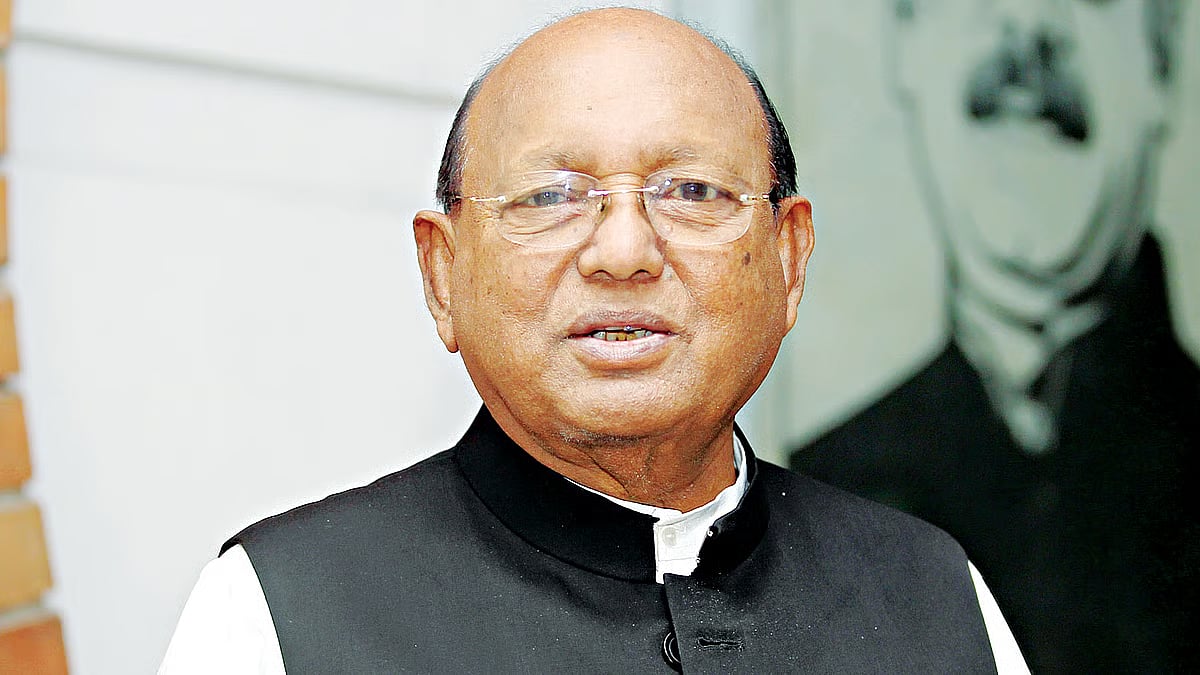
Demise of Tofail Ahmed: A veteran sidelined within his party in his final years
Tofail Ahmed, a monumental figure across critical epochs of Bangladesh’s political history, has passed away. For nearly a decade and a half, he remained marginalised within party politics; ironically, at the time of his demise, the activities of the Awami League stand banned.
Yet, it was this very Tofail Ahmed who attained immense popularity as a student leader and Vice President (VP) of the Dhaka University Central Students’ Union (DUCSU) in the previous century.
He became a Member of Parliament (MP) at the tender age of 27, enjoying the close companionship of Bangabandhu. Subsequently, he served as a crucial leader within the Awami League and held ministerial portfolios on multiple occasions.
Following a prolonged illness, Tofail Ahmed passed away on Monday while undergoing treatment at a hospital. He was 82. Family members and close associates revealed that he had been gravely ill since the beginning of 2024. At one stage, he was virtually confined to his home. His final days were spent under strict hospital and medical supervision.
Tofail Ahmed was born on 22 October 1943 in Koralia village under the Dakkhin Dighaldi union of Bhola Sadar upazila. He stepped into politics during his student years, joining the Bangladesh Chhatra League (currently banned). In 1969, he was elected President of the Chhatra League. During the 1969 Mass Upsurge, he served as the VP of DUCSU.
On 7 June 1970, he formally joined the Awami League (whose activities are now banned). Over his political career, he discharged various responsibilities, including serving as a member of the Awami League’s presidium.
Most recently, he was a member of the party’s advisory council. He was elected to parliament nine times and served as a cabinet minister on several occasions.
During the 1/11 political changeover (the 2007–2008 military-backed caretaker regime), Tofail Ahmed, along with several senior leaders, came to be known as ‘reformists’ within Awami League.
Having incurred the displeasure of party president Sheikh Hasina, he was removed from the presidium and relegated to the largely ceremonial advisory council. Consequently, he never regained his political stature within the party.
From DUCSU VP to leading the mass upsurge
Tofail Ahmed graduated with a Bachelor of Science (BSc) degree in 1964 and later obtained his Master of Science (MSc) from the Department of Soil Science at the University of Dhaka. His involvement in BCL politics began during his college years. While studying at Brojomohun (BM) College in Barishal, he was elected Sports Secretary of the student union and Vice President of the Ashwini Kumar Hall hostel in 1962.
During his university years, he became the Sports Secretary of the Iqbal Hall (now Shahid Sergeant Zahurul Huq Hall) council in 1964, and served as its VP from 1966 to 1967. Incorporating the ‘Six-Point’ charter of Sheikh Mujibur Rahman—the architect of Bangladesh’s independence struggle—with the students’ ‘11-Point’ demands, four student organisations (including the Chhatra League and two factions of the Chhatra Union) formed an action committee to launch a mass movement. As the VP of DUCSU, Tofail Ahmed served as the convenor of the All-Party Student Action Committee.
The consecutive programmes launched by the All-Party Student Action Committee culminated in a historic mass upsurge in January 1969. Tofail Ahmed emerged as one of the principal leaders of that mass uprising, gaining nationwide recognition.
Against the backdrop of the 1969 Mass Upsurge, the Pakistani government was compelled to release all accused in the Agartala Conspiracy Case, including Sheikh Mujibur Rahman. On 23 February of that year, the Student Action Committee organised a massive public rally at the then Racecourse Maidan (now Suhrawardy Udyan) in Dhaka. It was at this rally that Sheikh Mujibur Rahman was bestowed with the title ‘Bangabandhu’, and it was Tofail Ahmed who made the historic proclamation.
From Liberation War organiser to Bangabandhu’s secretary
Tofail Ahmed joined the Awami League in 1970. In the general election of that year, at just 27 years of age, he was elected as a member of the National Assembly of Pakistan. When the Liberation War broke out in 1971, he assumed the role of an organiser. He was one of the four regional commanders of the ‘Mujib Bahini’. The western region of the Mujib Bahini—comprising Barishal, Patuakhali, Khulna, Faridpur, Jashore, Kushtia, and Pabna—was under his command.
On 14 January 1972, Sheikh Mujibur Rahman appointed Tofail Ahmed as his Political Secretary with the rank and status of a Minister of State. Following the formation of the Bangladesh Krishak Sramik Awami League (BAKSAL) in 1975, he became the General Secretary of its youth wing, the ‘Jatiya Jubo League’.
Immediately following the assassination of Sheiikh Mujibur Rahman on 15 August 1975, Tofail Ahmed was placed under house arrest. Arrested in September of that year, he endured 33 months of continuous imprisonment. In 1978, while interned in Kushtia Jail, he was elected Organising Secretary of the Bangladesh Awami League. However, for his perceived ‘inaction’ following the assassination of Bangabandhu on 15 August 1975, Tofail Ahmed later faced sharp criticism from Sheikh Hasina.
Upon his release from prison, Tofail Ahmed dedicated himself to reorganising the Awami League.
When the Awami League formed the government under Sheikh Hasina’s leadership in June 1996, Tofail Ahmed was initially given charge of the Ministry of Industries and Commerce. Later, he looked after the Ministry of Commerce exclusively. In January 2014, he was once again appointed Commerce Minister in the government formed through a controversial, unilateral election.
Over a span of 53 years from 1970 to 2024, Tofail Ahmed was elected to parliament nine times. He was last elected as an MP in the boycotted national election of January 2024. Following the fall of the Awami League government in a mass uprising in August of that year, parliament was dissolved, bringing an end to his tenure as an MP.
Frustration and unfulfilled ambitions
Following the assassination of Sheikh Mujibur Rahman, his daughter Sheikh Hasina was elected President of the Awami League in 1981 while she was still abroad. Tofail Ahmed played a pivotal role in facilitating her return to the country and handing over the party’s leadership. Since then, Sheikh Hasina has remained the party president for over four decades.
The prevailing consensus within the party has always been that the presidency would not leave the Bangabandhu family. Consequently, the competition among other top leaders was centred entirely around the post of general secretary. Tofail Ahmed was one of the chief aspirants for this position, but he was repeatedly passed over. Fellow party leaders believed this left him harboring a deep-seated sense of frustration.
Nevertheless, in 1992, Tofail Ahmed was inducted into the presidium, the highest decision-making forum of the party, a position he held consecutively for 16 years. However, after being branded a ‘reformist’ during the 2007–2008 military-backed interim government, he found himself systematically sidelined.
Subsequently, at the 2008 party council, a significant section of senior leaders, including Tofail Ahmed, were dropped from the policymaking presidium. They were relocated to the relatively toothless advisory council.
Furthermore, when the Awami League formed the government with an overwhelming majority in 2009, Tofail Ahmed was denied a cabinet berth. He was, however, brought back as a minister in the election-time government of 2013 amidst fierce opposition protests. Following the uncontested election of 2014, he served in the cabinet for five years. Thereafter, he was excluded from Sheikh Hasina’s cabinets formed in 2018 and 2024.