Covert attacks, shootings, killings, explosions, mob violence, and the use of illegal weapons—one incident after another has raised serious concerns about election-related security.
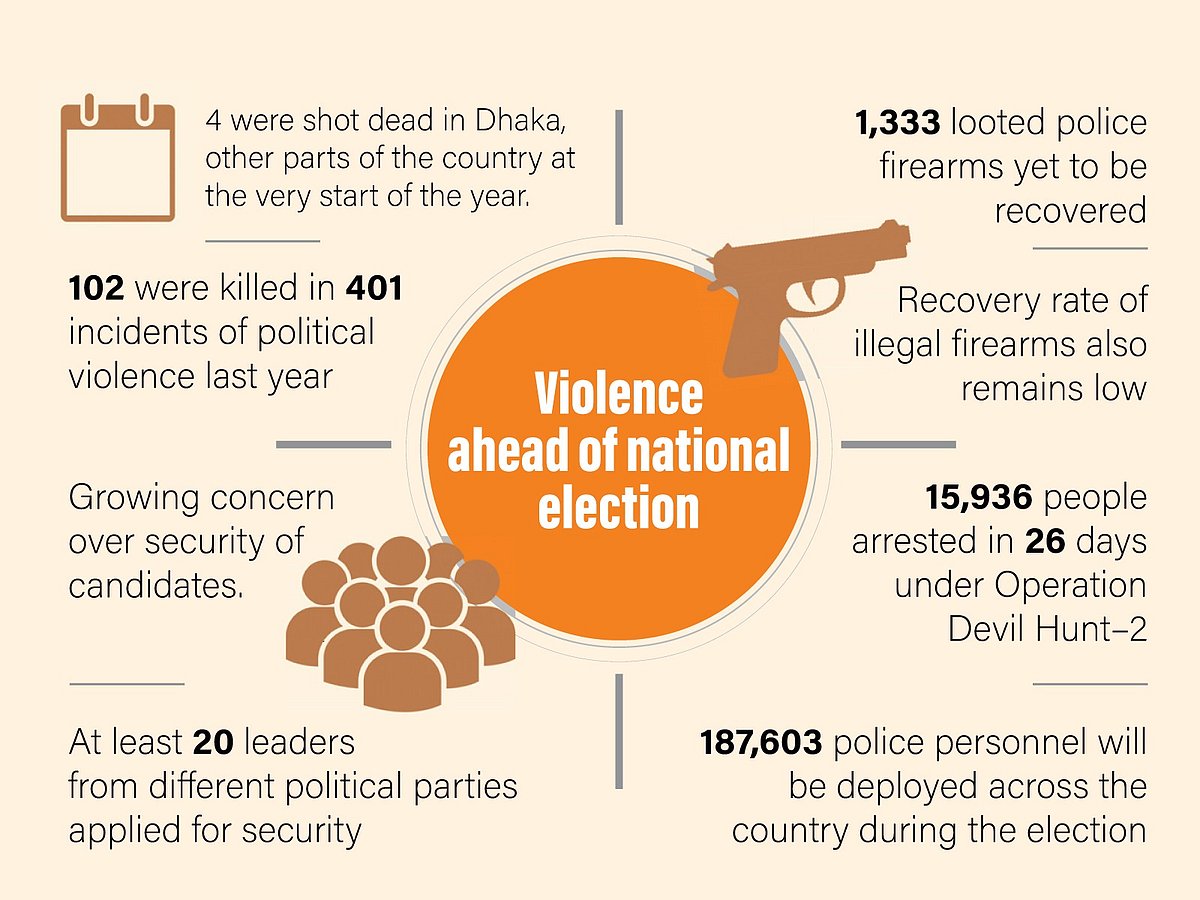
In the very first week of the new year alone, at least four people were killed in separate shooting incidents. Earlier, attacks and shootings took place during the campaigns by candidates.
Taken together, the country’s law and order situation is becoming increasingly complex ahead of the national parliamentary election.
On Wednesday night, a leader of the Jubo Dal was shot dead at Tejturi Bazar, near the busy Farmgate and Karwan Bazar areas of the capital. Yesterday, Thursday afternoon, miscreants shot at an National Citizen Party (NCP) activist in Gazipur and fled with his motorcycle; he narrowly escaped death.
Earlier, on Thursday morning, two young men were killed in an explosion inside a house in Zajira, Shariatpur. Police said the explosion occurred while making cocktails. There is also suspicion that the cocktails were being prepared for attacks or sabotage during election campaigning.
Earlier, on 26 December, a powerful explosion occurred at a house in South Keraniganj, Dhaka. The blast blew off the walls of two rooms of a single-storey building, causing extensive damage.
Police recovered cocktails, chemical substances, and bomb-making materials from the site, and several people were arrested.
Police sources said the arrestees stated during interrogation that several bombs manufactured at the rented house, operated under the guise of a madrasah, had already been sent to different locations.
Even where incidents were not directly political killings or attacks, mob violence has created a sense of insecurity among the public. For instance, on the night of 31 December, lawyer Nayeem Kibria was beaten to death by a mob in the Bashundhara Residential Area of Dhaka following a collision between a motorcycle and a car.
On the same day, businessman Khokon Chandra Das was hacked and burned to death in Damudya, Shariatpur. Earlier, on 18 December, a young man named Dipu Chandra Das was beaten to death in Bhaluka, Mymensingh, over allegations of religious defamation.
On the night of 19 December, assailants locked the door and poured petrol before setting fire to the house of a local BNP leader in Lakshmipur. His seven-year-old daughter died in the fire, while the BNP leader and his two other daughters were severely burned.
On Monday night, miscreants shot dead a Jubo Dal leader in Raozan, Chattogram. On the same day, a businessman was shot in Monirampur, Jashore, and at 9:00pm another businessman was shot dead at the gate of his home in Palash upazila of Narsingdi.
These incidents have created a renewed climate of fear in the election environment. Analysts believe that the biggest challenge before the vote is bringing the situation under control quickly and restoring a sense of security among the people.
Despite repeated statements by the government against mob violence, such incidents continue to occur across the country. Human rights organisation Ain o Salish Kendra (ASK) reported that 197 people were killed last year in lynchings or mob violence.
In 2024, at least 128 people were killed in similar incidents.
Earlier, a day after the election schedule was announced, Inqilab Moncho convener Osman Hadi was shot in broad daylight in the capital, triggering widespread reactions nationwide.
Using the incident involving Shaheed Osman Hadi and the accompanying emotions as a backdrop, attacks, arson, and looting took place at the offices of Prothom Alo and The Daily Star, alongside attacks on Chhayanaut and Udichi.
Fear over illegal and looted weapons
The gravest fear regarding illegal weapons emerged following the shooting of Shaheed Sharif Osman Hadi, spokesperson of Inqilab Moncho and a potential parliamentary candidate from Dhaka-8.
On 12 December, shortly after Friday prayers, Osman Hadi was shot in the head while riding a rickshaw on Culvert Road in Purana Paltan, Dhaka. Since that incident, at least eight more shooting-related killings have taken place across the capital and other parts of the country.
Following the shooting of Osman Hadi, ‘Operation Devil Hunt Phase-2’ began on 13 December. By 7 January, a total of 15,936 people had been arrested in the operation.
However, the number of identified, professional, and major criminals arrested remained very low. Weapon recovery figures were also limited—only 236 weapons were recovered during this period.
Notably, very few weapons were recovered from major criminals of Dhaka’s underworld or their associates. Similarly, recoveries from those who rent out weapons for criminal activities were minimal.
Following the mass uprising on 5 August 2024, 1,333 weapons looted from various police stations are yet to be recovered. Concerned individuals believe that illegal weapons could pose a serious risk to the election.
Earlier, after a terrorist attack on students and members of the public in Gazipur, a nationwide joint forces operation named ‘Operation Devil Hunt’ was launched on 8 February. However, even that operation saw a very low rate of arrests of professional criminals. As a result, concerns about election security persist despite the announcement of the latest special operation.
On 21 December, the Election Commission stated that no one would be allowed to engage in terrorist activities and that joint operations would be launched swiftly. Election commissioner (retd) Brigadier General Abdul Fazal Md Sanaullah also said security would be tightened.
Candidates express concern
There is growing concern among candidates regarding election-related law and order. This was evident in a video of BNP candidate for Gopalganj-3 and central president of the Swechchhasebak Dal, SM Jilani. During a meeting with supporters on 7 January, he was seen displaying the bulletproof vest he was wearing.
Pulling aside his shawl and unbuttoning his kurta to reveal the vest, SM Jilani said, “There is a threat to our lives—this is true. You can see, I am still wearing a bulletproof vest. I don’t know what may happen at any time, so I remain cautious.”
Earlier, on 5 November last year, shots were fired during election campaign activities of the BNP-nominated candidate in Chattogram-8 (Boalkhali–Chandgaon), killing one person. So far, the attackers have not been arrested, nor has the weapon been recovered.
Given the current reality, at least 20 leaders from different political parties have already applied to the government seeking security due to concerns over law and order.
Election-centric institutions at risk
Beyond attacks, clashes, and violence, there is concern over what steps the Awami League might take to obstruct the election scheduled for 12 February. Law enforcement and intelligence agencies fear that election-related institutions could come under attack ahead of the vote, which requires heightened security.
Such indications have already emerged. On 13 December, petrol was poured and set alight at the Lakshmipur district election office. The previous night, an attempt was made to set fire to the Mathbaria upazila election office in Pirojpur. During the same period, buses were set on fire in Dhaka and cocktails were thrown at various locations.
Election Commission (EC) sources said many field-level election officials are also concerned about security. Taking these issues into account, on 13 December the EC instructed police to ensure security at all EC field offices nationwide.
The EC also sent letters requesting special security for Chief Election Commissioner AMM Nasir Uddin, four election commissioners, and the senior secretary of the Election Commission Secretariat.
Inspector General of Police Baharul Alam told Prothom Alo that police are working on election security in two ways. Before the election, special focus is being placed on arresting professional criminals, recovering weapons, and taking action against individuals who could engage in sabotage.
At the same time, security is being ensured for candidates and important individuals. Special security plans are also being prepared for high-risk polling centres on election day.
Political violence raises alarm among parties
Another major concern during the election period is political violence. A report published in November by the Manabadhikar Shongskriti Foundation (MSF) stated that political violence increased compared to the previous month. From early December, indicators of such attacks and clashes showed an upward trend.
According to ASK, political violence in Bangladesh has taken on an extreme and continuous form since 5 August 2024 and has expanded further in 2025. From January to December 2025, at least 401 incidents of political violence were recorded, leaving around 4,744 people injured and 102 killed.
Another human rights organisation, Human Rights Support Society (HRSS), said these incidents involved clashes within the same party at times and confrontations between rival party activists at others.
Alongside violence among active political parties, a major concern has arisen over threats by the Awami League to obstruct the election. Law enforcement sources say Awami League supporters are issuing calls and plans for sabotage on social media and cyberspace.
Many people are receiving killing threats, and the use of illegal weapons has become increasingly visible, creating an atmosphere of fear around the election. Political parties have also conveyed these concerns in public events and to the government.
Following the shooting death of Swechchhasebak Dal leader Azizur Rahman Musabbir in Dhaka on Wednesday night, BNP secretary general Mirza Fakhrul Islam Alamgir issued a statement yesterday.
He said such horrific incidents were being repeated to put the government in a difficult position and that there was a deliberate attempt to destabilise the country, with the killing being a brutal manifestation of that effort.
He further said such violence is placing the country’s law and order situation at extreme risk and increasing public insecurity.
Earlier, at an event in Dhaka on 21 December, Jamaat-e-Islami secretary general Mia Golam Porwar said that after the shooting of Osman Hadi, candidates in all 300 constituencies were concerned about their personal safety.
According to the Jamaat leader shooting a candidate the day after the election schedule announcement was not an isolated incident but part of a “package programme”.
More attacks might already be planned, he apprehended.
Maintaining stability is the challenge
Law enforcement agencies say they are taking maximum preparation for the election. Police headquarters said 187,603 police personnel are being readied for election duty.
Chief Adviser Professor Muhammad Yunus has said the interim government will organise the “best election” in the country’s history. Yet, people remain unconvinced about the law and order situation surrounding the election.
Election expert Md Abdul Alim told Prothom Alo that the shooting of Osman Hadi initially created fear among voters, candidates, and political parties, but that fear has since eased somewhat. Although some incidents have occurred recently, he said nothing has happened that could derail the election.
“Maintaining this environment is now the challenge,” he said, adding that the situation could deteriorate at any time and security preparations must be made accordingly.