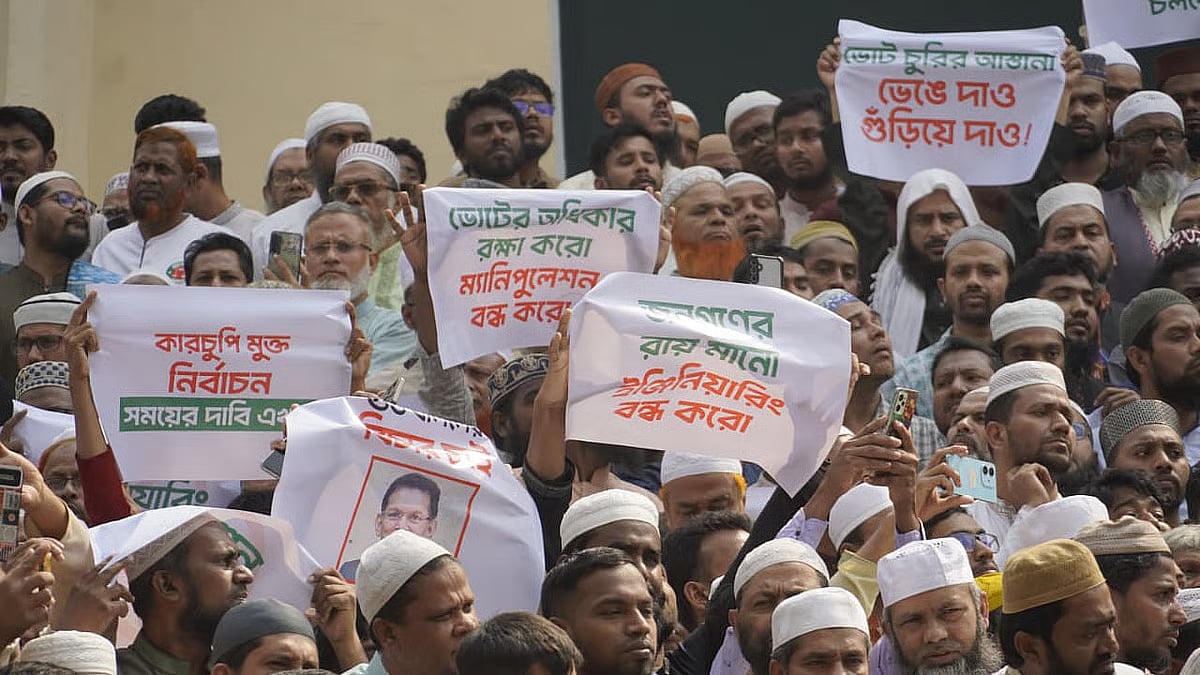
Jamaat moves to keep election disputes alive to put pressure on BNP
In the post-election political landscape, Bangladesh Jamaat-e-Islami has adopted several strategies to keep the Bangladesh Nationalist Party (BNP) government under pressure.
Leading an 11-party electoral alliance, the party has petitioned the election commission (EC) for a vote recount in 32 constituencies. Candidates from the alliance have also challenged results in court in at least 13 of these seats.
Jamaat has additionally raised questions over the roles of Syeda Rizwana Hasan and Khalilur Rahman, two former advisers to the interim government led by Professor Muhammad Yunus. The party has also called for their questioning and legal accountability.
Jamaat aims to keep these issues in public debate and plans to maintain a vocal stance in parliament.
Election results and recount demands
In the 13th national parliamentary elections held on 12 February, the BNP secured an absolute majority, winning 209 seats on its own and 212 in coalition. Jamaat won 68 seats independently and 77 in alliance.
Two days after the elections, on 15 February, the 11-party alliance applied to the EC for recounts in 32 constituencies, where vote margins ranged from 1,026 to 13,632 votes.
Of those seats, 25 were candidates from the Jamaat, three from National Citizen Party (NCP), two from Khelafat Majlis, and one each for Bangladesh Khelafat Majlis and the Liberal Democratic Party (LDP).
Leading an 11-party electoral alliance, the party has petitioned the election commission (EC) for a vote recount in 32 constituencies. Candidates from the alliance have also challenged results in court in at least 13 of these seats.
Jamaat alleges that their alliance candidates were narrowly defeated due to irregularities in the electoral process, including delayed results, publication without polling agent signatures, forged polling agent endorsements, and in some cases, pencil-marked tallies.
Following complaints to the EC, so far 12 candidates began legal challenges in courts from late February through last week, including Jamaat Secretary General Mia Golam Porwar in Khulna-5.
Other seats with ongoing court challenges include Dhaka-6, Dhaka-7, Dhaka-10, Gaibandha-4, Narayanganj-2, Narayanganj-3, Lalmonirhat-1, Lalmonirhat-2, Barguna-2, Pirojpur-2, Cox’s Bazar-4, and Dhaka-13 (Bangladesh Khelafat Majlis candidate Md. Mamunul Haque).
Notably, the original 32-seat recount request excluded Dhaka-6, Narayanganj-2, and Narayanganj-3, where the vote margins were significantly higher (more than 23,000 in Dhaka-6; over 42,000 in Narayanganj-2; and over 20,500 in Narayanganj-3).
There is ongoing discussion about whether complaints of irregularities could expand beyond the initial 32 constituencies.
Legal action as a political message
Jamaat leaders indicate that the recount petitions are primarily intended as a political signal—to keep the election results in question and to maintain pressure on the government.
We are indeed demanding a proper inquiry. This is necessary for the investigation of the allegations. Whether the government will carry out this process directly or it will be conducted through a judicial inquiry is a decision for the government to make.Jamaat Secretary General Mia Golam Porwar
They are also positioning themselves strongly on various issues inside and outside parliament.
Central executive members and election committee officials of the party told Prothom Alo that legal challenges will continue to ensure the election issue remains active.
Assistant Secretary General Ahsanul Mahboob Zubair confirmed that additional constituencies could be added to court challenges if sufficient evidence emerges.
2 former interim govt advisers under scrutiny
To amplify election controversies, Jamaat has questioned the roles of former interim government advisers Syeda Rizwana Hasan and Khalilur Rahman.
The party alleges that Syeda Rizwana Hasan’s televised remarks hinted at election manipulation, while Khalilur Rahman’s appointment as Foreign Minister in the BNP government is framed as a ‘reward’ for favouring the BNP during the interim government’s tenure.
On 5 March, Jamaat held a press conference demanding legal inquiry and questioning of the two advisors for “election engineering.” Party leaders have reiterated the demand multiple times.
Jamaat ameer Shafiqur Rahman first spoke on the matter on 9 March. Speaking at an iftar party in the capital that day, he stated “Prior to the election, we declared loudly and unequivocally that we do not wish for the victory of any particular party. Invoking my party’s name, I said, we do not desire the success of this party alone. What we seek is the triumph of the 180 million people. That victory has not been realised. The right to vote has been infringed. Everything is now manifestly clear in broad daylight, and witnesses are coming forward. Justice now rests with the people’s tribunal, and the verdict of that tribunal will be in favour of the people, God willing.”
Prothom Alo talked to at least three central leaders of the party about this.
Secretary General Mia Golam Porwar on 6 March clarified to Prothom Alo that their immediate focus is on the two former advisers. Other figures of the caretaker government whose impartiality may be questioned will be addressed in due course.
“We are indeed demanding a proper inquiry. This is necessary for the investigation of the allegations. Whether the government will carry out this process directly or it will be conducted through a judicial inquiry is a decision for the government to make. Nonetheless, we are insisting on this demand. For the time being, this is the stage at which we stand,” Mia Golam Porwar stated.
The party maintains that they are pursuing electoral irregularities through formal legal channels, but they are not planning to mobilise strong field actions at this stage.