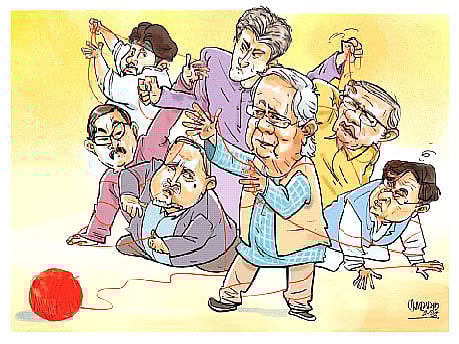
The government is moving towards a decision to hold both the Jatiya Sangsad (national parliament) election and the referendum for implementing the July National Charter on the same day. This is because it is considered almost impossible to organise the two votes on separate days. In addition, the government wishes to take into consideration the formation of an upper house of parliament through a proportional representation (PR) system.
The government, in this way, is attempting to reach a settlement by partially accommodating the demands of the political parties. It is expected that the two major parties will make some concessions on their respective positions, multiple responsible government sources said this.
According to those sources, everything will be finalised at a meeting of the advisory council on 13 November. By 15 November, the government will issue the order for implementing the July Charter and promulgate the ordinance required to conduct the referendum.
Meanwhile, informal discussions between the government and political parties are ongoing. Several advisers are maintaining communication with the parties. They are seeking to explain the government’s position and the practical realities to the political parties.
The positions of the Bangladesh Nationalist Party (BNP), Jamaat-e-Islami and their like-minded parties are in direct opposition to each other on the question of the referendum.
Jamaat demands that the referendum must be held before the national election. The BNP, however, wants the national election and referendum to be held on the same day. The government also supports holding both votes on the same day, and hopes Jamaat will concede on this point.
Meanwhile, the PR-based upper house of parliament is included in the July Charter, to which the BNP has objections. The government hopes that the BNP will make a concession on this issue.
Wishing not to be named, one member of the advisory council, who has been maintaining contact with the parties, told Prothom Alo that the government is attempting to resolve the matter by gradually aligning the demands of all parties, particularly the two major political parties. The government is making this decision independently.
Beyond the BNP and Jamaat, the government considers the National Citizen Party (NCP) to be significant in electoral calculations. The party has not yet signed the July Charter. However, government sources say that the NCP is relatively flexible on the timing of the referendum. The party will accept the referendum being held on the same day as the national election or beforehand. But the NCP demands that the order to implement the July National Charter (constitutional reform) be issued directly by the chief adviser of the interim government, professor Muhammad Yunus.
The government believes this is constitutionally impossible. This has been explained to the NCP. Meanwhile, the NCP has accepted the Shapla Kali (water-lily bud) as its electoral symbol. The government believes the NCP will no longer oppose the implementation process of the July Charter.
7-day time limit expires today
In the face of intense disagreements among political parties concerning the implementation of the July Charter, the advisory council expressed concern at an emergency meeting on 3 November. The council urged the parties to hold discussions on their own initiative and provide a unified direction to the government as soon as possible. A seven-day window was given for this. Otherwise, the government stated that it would itself make the decision.
The government’s deadline ends today, Monday. However, the political parties have not held any meetings or discussions among themselves. As a result, the responsibility for making the decision now lies with the government.
Yet, concerns remain as to whether all political parties are in a position to accept the government’s decision.
Speaking at a meeting to exchange views in Thakurgaon on Sunday, BNP secretary general Mirza Fakhrul Islam Alamgir alleged that a group of educated elites returning from the United States are imposing matters, such as the referendum and the charter, upon the people. He reiterated that the referendum must be held on the same day as the election.
When asked about this, BNP standing committee member Salahuddin Ahmed told Prothom Alo that all parties signed the July Charter, and that the charter contains both agreements and disagreements among parties.
“Why has deviation occurred afterwards?” he asked. The problem, he said, originated from the consensus commission and the government. According to the leader, if the July Charter is implemented exactly as signed, then no one should have reason to be pleased or displeased.
Why referendum and election must be held together
Government sources say that holding the election and referendum on separate days would create several practical problems. Like the political parties, the government also considers implementation of the reform proposals to be a priority. It neither wants reform implementation to be jeopardised, nor does it want negative effects on the national election.
In any election, the presence of party and independent candidates and their workers is crucial for mobilising voters. There is no direct political candidature involved in a referendum. So who would mobilise voters to attend the referendum?
Furthermore, if the referendum is held before the national election, and in defiance of the position of the BNP and several other parties, then those parties’ leaders and activists would have little motivation to encourage public participation. In some areas, they might even campaign against it. Negative campaigning has already begun on social media.
Although the activities of Bangladesh Awami League are currently banned, its voters remain. If they vote in a coordinated manner against the referendum, the reform process could collapse entirely.
Moreover, the national election is scheduled for February, with the election schedule likely to be announced in early December—less than three weeks away. Within such a short time, preparing for a referendum and informing the public about the issues and ballot questions would be extremely difficult.
Additionally, the same officials who would conduct the referendum would have to conduct the national election a few months later. Concerns exist about the administrative capacity to conduct two major votes in close succession. If any controversy arises during the referendum, it may influence the national election. Organising two separate votes would also cost an additional 20-30 billion (2,000-3,000 crores) taka, which the government must consider.
Order and ordinance
Government sources also state that an order will be issued regarding the implementation of the July National Charter (constitutional reform). Under this, a separate ordinance must be issued to hold the referendum as the current Constitution contains no provision for a referendum. The existing 1991 referendum law cannot be used, as that law applied only to specific constitutional matters.
The proposed referendum concerns two matters: approval of the July National Charter (constitutional reform) implementation order, and approval of the 48 constitutional reform proposals listed in its schedule.
The order and ordinance may be issued across two consecutive days. Thereafter, the referendum ballot paper with questions will be prepared and published.
Government also supports PR in the upper house
The July Charter specifies that the upper house of parliament will be formed under a PR system. That means, seats will be allocated according to the percentage of votes each party receives in the national election. This is the demand of Jamaat and its like-minded parties. However, the BNP wants seats in the upper house to be allocated proportionate to the number of seats each party wins in the lower house.
Multiple government sources say that many within the government believe that forming the upper house based on seat count in the lower house would yield very little benefit. This is because it would resemble the system used for allocating women’s reserved seats. Instead, forming the upper house based on vote share would create balance in parliament.
It would exert pressure on the ruling party. It could bring parliament closer to the aspirations of the July mass uprising by increasing accountability and restraining the ruling party from monopolising power.
An adviser to the government, speaking anonymously, said that if the BNP accepts a PR-based upper house, Jamaat and other parties are likely to accept holding the election and referendum together. Several advisers are currently discussing this with the parties. The adviser believes no party will take a position that risks obstructing or derailing the February election.
The government has already announced that the national election will take place in the first half of February next year. The BNP and Jamaat have already announced preliminary lists of candidates. Other parties have begun selecting candidates.
Now, the remaining step is implementing the reform process according to the July Charter. Once the government issues the order, political parties are expected to shift fully into election mode. The government too is proceeding with this expectation in mind.