Analysis
4 paths lie ahead for Awami League, which one will it choose?
The 77th founding anniversary of the Awami League has arrived at a time when the party finds itself plunged into a deep crisis. Having held state power for a prolonged duration, the party is now out of power, organisationally devastated, banned from political activities, and facing acute political uncertainty. Many of its top leaders are currently incarcerated, or in hiding, or outside the country.
Having remained in power consecutively for over a decade and a half, the paramount question now confronting the party is, can Awami League ever return to Bangladeshi politics?
Awami League is one of the oldest political parties in the country, founded on 23 June 1949. The party led the Liberation War and has enjoyed the longest tenure in power in the nation's history. The party's chief, Sheikh Hasina, served as the longest-reigning Prime Minister of Bangladesh. Yet, all those tales of success were completely overshadowed by the student-led mass uprising of 2024.
In this uprising, Awami League did not merely lose power; its decade-and-a-half-long misrule, three controversial elections, and deep-seated organisational weaknesses were all laid bare.
Consequently, Awami League now faces a twin challenge: survival on one hand, and reclaiming public support on the other. Thus, on its 77th founding anniversary, the discourse surrounding the party focuses far more on its future than its past glory. How this old and influential political party will navigate this crisis remains one of the biggest questions in the political arena.
How effective its current strategy?
Following its ousting from power, the interim government led by Professor Muhammad Yunus banned the activities of the Awami League in May 2025. The party's student wing, Bangladesh Chhatra League (BCL), has also been banned. Consequently, the party’s operations have become entirely confined to virtual platforms.
Occasionally, flash processions popped up and strikes were called. However, these have not been substantial enough to challenge the government. Bangladesh Nationalist Party (BNP) came to power through elections, and the ban on the Awami League's activities remains in place.
In this uprising, the Awami League did not merely lose power; its decade-and-a-half-long misrule, three controversial elections, and deep-seated organisational weaknesses were all laid bare.
On the occasion of its 77th founding anniversary, the Awami League had been organising sporadic flash processions in various locations over the past few days. Today, Tuesday, leaders operating from hiding announced plans to hold these processions nationwide.
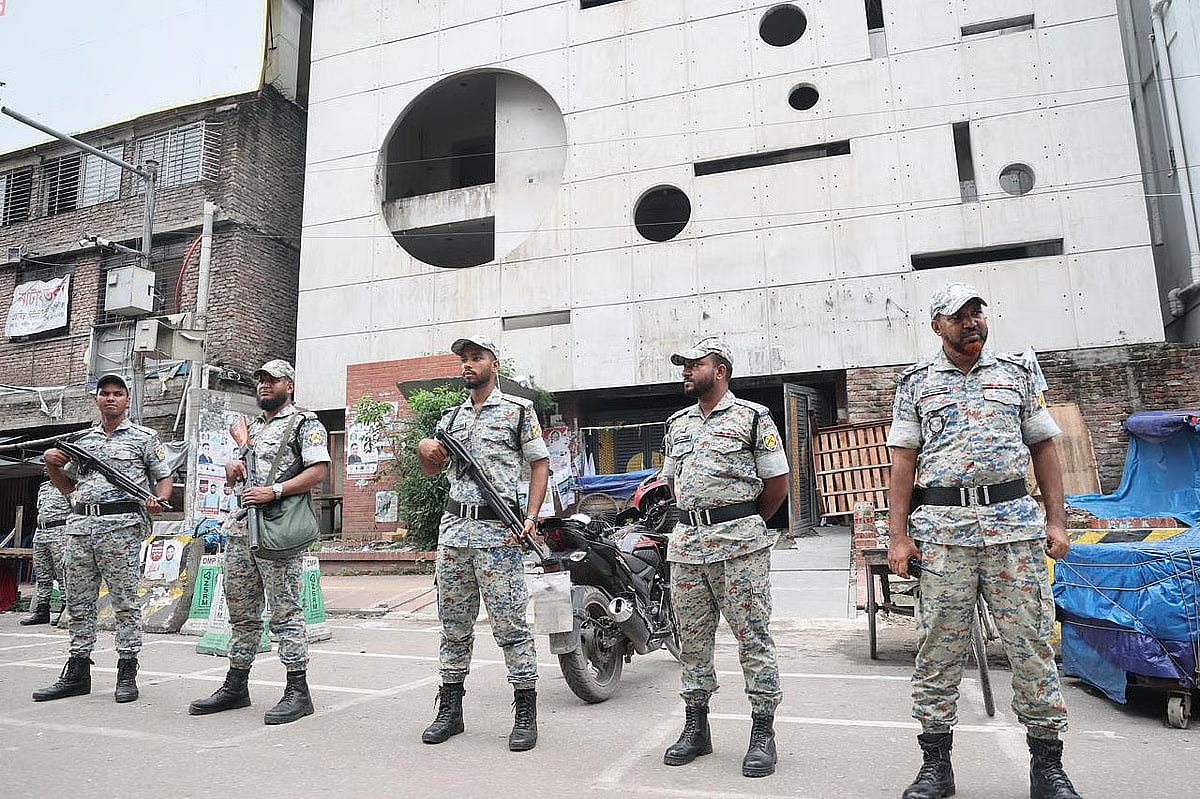
In light of this situation, the Dhaka Metropolitan Police (DMP) has implemented extensive security measures across the capital. The police stated that more than 18,000 personnel will be deployed to maintain law and order and to avert any untoward incidents.
Furthermore, the Ministry of Home Affairs sent a letter requesting military deployment. The government reached this decision out of apprehension regarding potential sabotage and disorder.
Party sources within the Awami League claim that the very security preparations undertaken by the government represent a success for them. They acknowledge that flash processions alone cannot destabilise the government, but the primary objective of the Awami League is to generate domestic and international discourse around their presence.
However, a senior Awami League leader, speaking to Prothom Alo on the condition of anonymity, remarked that these programmes would yield little result. Instead, party activists and leaders within the country who had secured bail might face re-arrest.
The leader added that attempting to exert pressure on a government that has only been in office for six months would backfire. Instead, the party should focus on legally challenging the ban on its activities, preparing to contest the lawsuits filed against them, and initiating internal party reforms.
Strength in history, weakness at present
The party began its journey on 23 June 1949 at the Rose Garden in Tikatuli, Dhaka, as the East Pakistan Awami Muslim League. Later, the word 'Muslim' was dropped to transform the organisation into a non-communal entity, expanding its reach.
The greatest strength of the Awami League has historically been its pivotal role during various defining epochs of the nation. Under Pakistani rule, the party stood as the central force during every major political turning point, including the Language Movement, the United Front elections, the Six-Point Movement, the mass uprising of 1969, and the Liberation War.
Sheikh Hasina remains the first Prime Minister and leader in the history of Bangladesh who was forced to flee the country upon losing power. The vast majority of ministers, MPs, top party leaders, and even leaders of affiliate organisations fled the country alongside her, a phenomenon unprecedented in Bangladesh.
The party matured through the Six-Point-based Swadhikar Andolan (self-determination movement) of 1966 and the mass uprising of 1969. In 1971, the Liberation War commenced under the leadership of the Awami League. Following a nine-month armed struggle, the sovereign independent state of Bangladesh emerged on 16 December that year. These historic achievements established the Awami League as the most formidable political force in the country.
In the 1970 elections, the Awami League winning 160 out of 162 seats in the then-East Pakistan was an unprecedented event in Bengali political history. Following independence, the party secured a landslide victory in the 1973 elections as well, though that election was not free from controversy.
The national political landscape shifted dramatically following the assassination of Bangabandhu and his family on 15 August 1975. After 21 years of relentless struggle and political movements, the Awami League returned to power on 23 June 1996. Despite a defeat in the elections of 1 October 2001 and another severe setback following the events of 11 January 2007, the party rebounded to win a three-quarters majority in the elections of 29 December 2008.
From that point onwards, the Awami League remained in power until its collapse in the 2024 mass uprising.
However, the Awami League seemed to forget that history is not a permanent asset, nor does it guarantee perpetual favour. While history enriched the Awami League, its governance over the past decade created the party’s greatest crisis.
From 2009 to August 2024, the Awami League enjoyed the longest uninterrupted tenure in power in the history of Bangladesh. During this period, major infrastructure projects such as the Padma Bridge, Dhaka Metro Rail, and the Karnaphuli Tunnel were executed. The party also claimed substantial progress across various economic growth and social development indices. However, prolonged power paired with the ruthless suppression of opposition forces transformed the Awami League into an aggressive political entity.
A senior Awami League leader, speaking to Prothom Alo on the condition of anonymity, remarked that these programmes would yield little result. Instead, party activists and leaders within the country who had secured bail might face re-arrest.
Domestically and internationally, it earned the label of an authoritarian regime. Years of enforced disappearances and extrajudicial killings culminated in indiscriminate firing upon citizens during the mass uprising—dragging the Awami League’s misrule to its absolute extreme.
The controversies surrounding the 2014, 2018, and 2024 parliamentary elections severely eroded the political legitimacy of the Awami League. The boycott by opposition parties and widespread domestic and international criticism of the electoral processes fostered a total crisis of confidence among voters.
Competitiveness even vanished from local government elections. A party that had once built its reputation on grassroots democratic movements ended up governing through explicitly undemocratic means.
Rise and fall under Sheikh Hasina
In independent Bangladesh, Bangabandhu Sheikh Mujibur Rahman’s administration held state power for a mere three and a half years. In contrast, under the leadership of Sheikh Hasina, the Awami League governed the country for five terms, spanning over 20 years.
Sheikh Hasina has held the position of party president for nearly four decades—the longest tenure in the history of the Awami League.
Consequently, the recent history of the Awami League is essentially the biography of Sheikh Hasina. She was handed the presidency of the Awami League in 1981 while living abroad. Since then, no rival for the position ever emerged within the party.
When Sheikh Hasina returned to the country to take charge, the Awami League was fragmented and suffering from a severe leadership vacuum, having broken into numerous factions after the assassination of Bangabandhu. Under those conditions, Sheikh Hasina reorganised the party and gradually became its absolute leader.
Returning the Awami League to power in 1996 after 21 years, securing a massive victory in the 2008 elections, and maintaining power for the subsequent decade and a half were all achieved under Sheikh Hasina’s absolute command. As a result, the development of alternative leadership within the party ground to a halt.
This dynamic lies at the very root of the Awami League’s current crisis. Over time, the party transitioned from an institutionalised political organisation into a highly leader-centric one.
Policy-making, organisational decisions, and political stances all revolved solely around Sheikh Hasina. Consequently, in her absence, the party's decision-making apparatus and leadership capabilities have proved visibly incapacitated.
In 1991, the military dictator HM Ershad fell from power due to a mass movement. He went to prison, but he remained in the country until his death and stayed active in politics. Sheikh Hasina remains the first Prime Minister and leader in the history of Bangladesh who was forced to flee the country upon losing power.
The vast majority of ministers, MPs, top party leaders, and even leaders of affiliate organisations fled the country alongside her, a phenomenon unprecedented in Bangladesh.
During the student-led mass uprising of 2024, widespread public outrage against Sheikh Hasina was palpable. Consequently, many leaders and well-wishers within the Awami League believe that the ultimate responsibility for the party's tragic fate rests squarely on Sheikh Hasina herself.
Organisational strength lost?
The Awami League has traditionally claimed to possess millions of staunch supporters. However, during its long tenure in power, a vast section of the party became deeply entwined with state and administrative patronage structures. As a result, the distinction between the party and state power grew increasingly blurred. Once power was lost, it became apparent that the bulk of its organisational strength was practically defunct.
According to several Awami League leaders, the party did not face such a severe vacuum even after the assassination of Bangabandhu. Despite the jail killings and the imprisonment of numerous leaders at the time, many prominent figures remained within the country. Following the 2024 mass uprising, however, the central committee and the top leadership of all affiliate organisations fled abroad into hiding. Others were sent to prison, leaving the party entirely leaderless on the ground.
The party is now wholly dependent on virtual communication with leaders stationed abroad—a mechanism completely inadequate for surviving the rigours of street politics or power-centric governance.
Political analysts believe that under current realities, four potential paths lie ahead for the Awami League:
First: The party could remain politically marginalised for an extended duration. Due to a barrage of lawsuits against the leadership, organisational inertia, and a severe deficit in public support, the process of rebuilding the party could face protracted delays.
Second: The emergence of new leadership from within the Awami League. If the party can break away from its Sheikh Hasina-dependent structure, bring forward a new generation of leaders, and engage in genuine self-criticism regarding past errors, an opportunity for restructuring may present itself.
Third: The party faces a serious risk of fragmentation. History demonstrates that the Awami League has fractured multiple times in the past. If the current crisis prolongs, the possibility of new divisions arising over questions of leadership and strategy cannot be ruled out.
Fourth: Re-emerging by demonstrating strength on the streets. This strategy relies on the assumption that the incumbent BNP government will commit critical errors, causing opposition groups like Jamaat-e-Islami and the NCP to turn hostile towards the administration, and leading to a breakdown in administrative control.
Awami League hopes to exploit such a vacuum to stage its political comeback. Party sources indicate that the Awami League is visibly pursuing this exact path. However, many political observers view this as a fundamentally flawed policy.
On its 77th founding anniversary, the Awami League stands at a historic crossroads. The definitive question remains: will the party opt for self-criticism and reform to reconstruct itself within a new political reality, or will it continue to grope in prolonged political darkness, relying solely on the memories of its past glory?