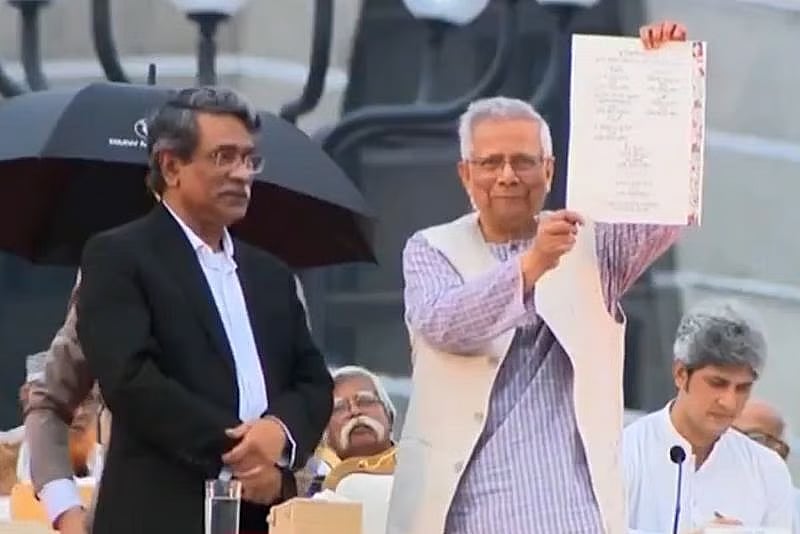
Consensus commission considers referendum under special order to implement July Charter
The National Consensus Commission plans to submit its recommendations to the interim government as soon as possible on how to implement the July National Charter. The commission is considering recommending the issuance of a special order based on which a referendum will be held, and the next parliament will be empowered with a dual role, acting both as a Constitutional Reform Council and as the National Parliament, to implement the Charter.
According to relevant sources, the Consensus Commission is currently weighing two options. One is to recommend that the entire July Charter be placed for a referendum under a special order. The other is to suggest that certain proposals of the Charter be implemented through a special order, while others be placed for a referendum.
Although the July National Charter was signed last Friday, recommendations on how it will be implemented have not yet been finalised. The Commission is expected to submit a comprehensive recommendation to the government within this month. Political parties agree on holding a referendum to implement the Charter. However, there are differences over what the basis of the referendum will be, when it should be held, and how the referendum questions will be framed.
Sources within the National Consensus Commission said that, based on opinions from political parties and experts, a draft recommendation has already been prepared. The Commission held a meeting yesterday, Saturday, to discuss parts of the draft.
Based on that discussion, it now plans to move forward with finalising the recommendations. Some sections of the proposal need to be made clearer and more detailed. A meeting with legal experts is scheduled for today, Sunday, to further refine it. Informal discussions with political parties will also continue.
According to sources, the Commission believes that before a referendum can take place, a formal order must first be issued regarding the July Charter. The contents of that order have not yet been decided. The specific questions to be asked in the referendum also remain undecided. Whether the referendum will be held on the same day as the national election or earlier will be left to the government’s discretion.
The Commission is of the view that to make the reforms sustainable, the next parliament must be given constituent powers along with holding the referendum. This is because the July Charter proposes several changes to the fundamental structure of the Constitution. Without granting the next parliament special authority, such reforms could face legal challenges in the future.
Professor Ali Riaz, Vice-President of the National Consensus Commission, told Prothom Alo yesterday that the Commission intends to submit a comprehensive recommendation for implementing the July Charter as soon as possible. He said a draft has already been prepared and that it will be finalised quickly through consultations with experts.
Discussions with political parties on reform proposals across various sectors of the state concluded on 31 July. The two-phase dialogue, which began in February, reached consensus and decisions on 84 proposals.
Twenty-four political parties and alliances signed the July National Charter last Friday. Gono Forum is set to sign it today. However, the National Citizens’ Party (NCP), Communist Party of Bangladesh (CPB), Bangladesh Samajtantrik Dal (BSD), BSD (Marxist), and Bangladesh Jasad have not signed the Charter.
Sources within the Commission said it is maintaining informal contact and dialogue with the NCP. The Commission is also engaging with the CPB, BSD, BSD (Marxist), and Bangladesh Jasad. Informal meetings with these four parties may take place today, Sunday, as the Commission seeks to understand their concerns.
Differences over Implementation Method
Determining the method of implementing the Charter was not originally within the mandate of the National Consensus Commission. However, following demands from several political parties, the Commission began formal and informal discussions with parties and experts after 31 July to find a way forward. These discussions concluded on 9 October. While there was consensus on implementing the Charter through a referendum, disagreements remain regarding its basis, timing, and process.
The BNP believes that a gazette notification can be issued on the July Charter, followed by an ordinance under which the referendum will be held. The party supports holding the referendum on the same day as the national election. According to the BNP, in that case, there would be no need to grant special powers to the next parliament, and implementation of the Charter would become mandatory.
Sources said the BNP believes that the July Charter already specifies which proposals have differing opinions among parties. It also states that if any political party or alliance secures the people’s mandate by including its differing stance in its election manifesto, it may proceed accordingly. Therefore, if the “Yes” vote wins in the referendum, the parties winning the national election may implement the Charter based on their respective interpretations.
On the other hand, Jamaat-e-Islami and the NCP want a “July Implementation Order” to be issued — even if it is not a constitutional order — to serve as the basis for the referendum. They propose holding the referendum before the national election. The differing proposals should remain within both the Charter and the referendum. If the referendum outcome favours implementation of the Charter, it should then be executed exactly as decided within the Consensus Commission. The next parliament, they argue, must be granted dual authority to perform both legislative and constituent functions.
The NCP has stated that the Chief Adviser will issue and execute this order to consolidate the aspirations the people expressed through the uprising.