Analysis
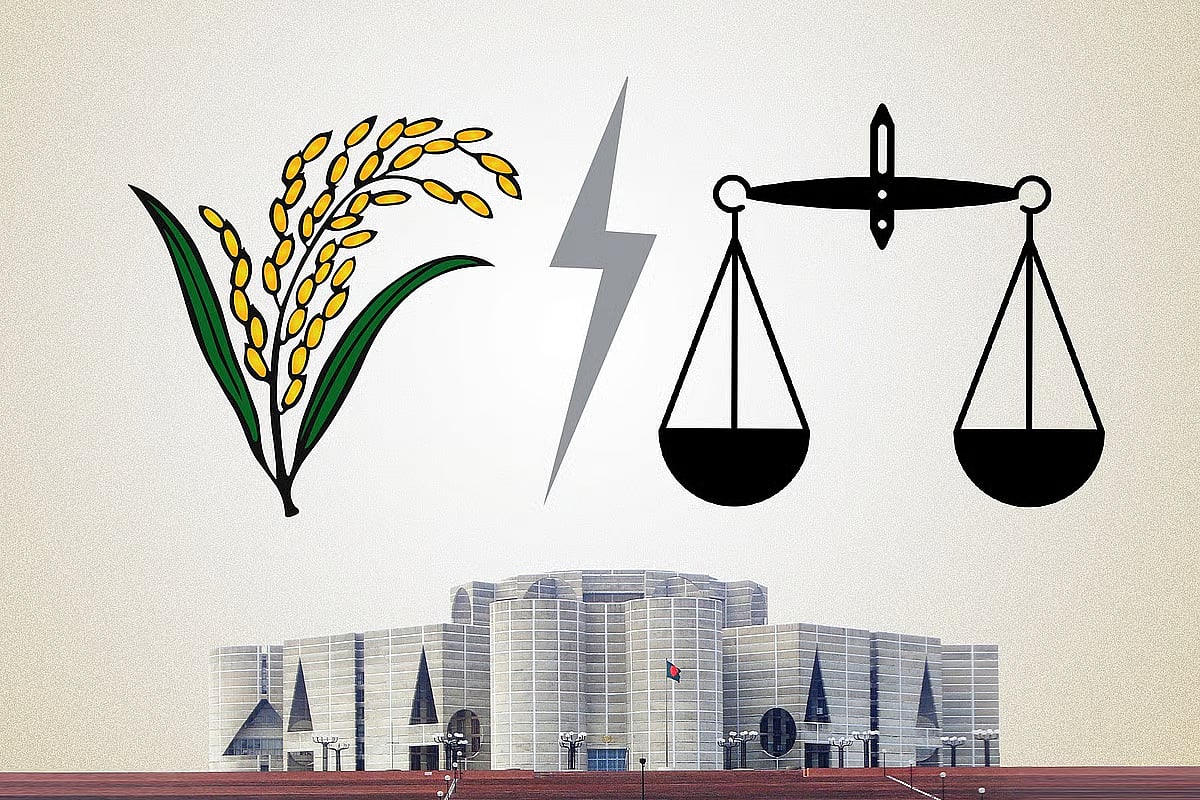
Will it become harder to win polls without ‘Sheaf of Paddy’ or ‘Scale’ symbols?
Candidates will have to contest under their own party symbols in the next general election even if alliances are formed. This is the new rule after the amendment to the Representation of the People Order (RPO).
As a result, questions have arisen about whether only two or three political parties will dominate the next national parliament. At the same time, with the ruling party’s “boat” symbol absent, the prominence of the BNP’s ‘sheaf of paddy’ and Jamaat-e-Islami’s ‘scale’ symbols appears increasingly evident.
Previously, if parties formed an alliance, smaller partner parties could contest using the symbol of the major party. That opportunity no longer exists. According to the amended law, no registered political party can participate in the next national election using another party’s symbol.
In the present political landscape, BNP, Jamaat-e-Islami, and the National Citizen Party (NCP), among others, are the most active in the electoral field.
Although BNP has announced its preliminary candidate list, it has left 37 seats vacant—reportedly to accommodate allies. Jamaat has announced candidates nationwide but is also working to form a coalition of seven Islamic parties. Meanwhile, there is ongoing discussion about whether NCP, Gono Odhikar Parishad, and other political parties will join a coalition.
From 2001 to 2024, the major parties contested all five parliamentary elections as alliances. In most of these elections, many candidates from alliance partners won using the boat or sheaf of paddy symbols. This happened primarily because they felt winning with their own party symbols would be difficult.
Ahead of the 13th parliamentary election, expected in early February, the interim government has amended the RPO. Regarding the allocation of symbols for allied parties, the amendment states that if two or more registered political parties agree to nominate joint candidates, they must inform the Election Commission. However, candidates must contest using their own party’s registered symbol.
On 23 October, the Advisory Council gave preliminary approval to the amended RPO ordinance. Jamaat and NCP welcomed the rule requiring candidates to contest under their own symbols, while BNP objected. Ignoring BNP’s objections, the ordinance was issued on 3 November.
The decision that allied parties can no longer contest using another party’s symbol effectively dismantles a long-standing feature of Bangladeshi coalition politics. Until now, the symbol of a major party had been the main tool of survival for smaller parties. Without this advantage, questions arise that will alliances continue in practice or only on paper? And even if alliances persist, can smaller partners still win seats?
Possible dominance of ‘Sheaf of Paddy’ and ‘Scale’
After losing power to the July uprising, the Awami League—after 16 years in office—was barred from political activities by the interim government. The Election Commission also suspended its registration, preventing it from participating in the upcoming election. The main opposition party of the past three elections, the Jatiya Party, is also in a weakened state.
Between 1991 and 2008, the main electoral contest was always between Awami League’s boat and BNP’s sheaf of paddy. Either BNP or Awami League formed the government. Apart from them, Ershad’s Jatiya Party and Jamaat also had representation in parliament. The three most recent elections (2014, 2018, 2024) were largely one-sided, although the Awami League brought its alliance partners into parliament.
Today, BNP is undeniably the largest political force. With the Awami League absent, the Jatiya Party sidelined, and Jamaat showing strength through major victories by its student wing in four public university student union elections, the political environment appears favorable to them. Meanwhile, the relatively new NCP—formed by leaders of the July mass uprising—is also gaining traction.
BNP’s sheaf of paddy and Jamaat’s scale are long-established symbols. After prolonged negotiations, NCP has secured the shapla koli (water lily) as its symbol. The Jatiya Party retains the plough symbol.
BNP has long been leading movements alongside allied parties. It has announced that it will contest the election as a coalition with its allies and partners, including LDP, Gonotantra Mancha, Gono Odhikar Parishad, Ganaforum, Ganosamhati Andolon, the Labour Party, the 12-Party Alliance, the like-minded alliance, Bangladesh Jatiya Party (BJP), and others.
In the 2018 election, many Jamaat candidates contested using BNP’s sheaf of paddy because they had lost their party registration. Jamaat is now working jointly with seven Islamic parties. Although not officially declared, it is expected that they will contest the election jointly or through negotiated seat-sharing.
There were discussions about NCP joining BNP’s alliance, but the party reportedly prefers not to formally join any coalition. Meanwhile, the Jatiya Party has yet to enter the field. Many top leaders of the Awami League–led 14-party alliance are either in jail or in hiding. The leftist parties are also discussing joint participation.
Given the history of elections since 2001 and recent survey analysis, it appears that the main contest this time will be between the sheaf of paddy and the scale. Other parties will try to win by leveraging their support bases. This means that unless the main alliance parties sincerely support their partners, it will be difficult for smaller parties to win.
Smaller parties’ fate depends on larger partners
In the 2001 election, the BNP-led four-party alliance won a huge majority. In that election, Maulana Fazlul Haque Amini of Islami Oikya Jote became an MP for the first time, contesting with BNP’s sheaf of paddy symbol because he had struggled to win earlier using his own symbol. Shahinur Pasha Chowdhury also became an MP using the sheaf of paddy. In these seats, BNP did not field independent or rebel candidates. Bangladesh Jatiya Party (BJP) won four seats using the sheaf of paddy symbol.
In that election, Jamaat was a BNP alliance partner and contested using its own symbol, the scale, while BNP did not field candidates in those seats.
Political analysts note that smaller partners were able to win in 2001 because BNP’s activists fully backed them.
The 2018 election became known as the “midnight election” election, with allegations that ballot boxes were filled the night before voting. In that election, BNP and its allies participated under the Jatiya Oikya Front banner.
Gonoforum’s Sultan Mansur Ahmed won from Kulaura under the sheaf of paddy symbol. Another Gonoforum candidate, Mokabbir Khan, won from Sylhet-2 using the rising sun symbol. In that constituency, BNP’s missing leader Elias Ali’s wife, Tahmina Rushdir Luna, had been the BNP candidate before her candidacy was cancelled by the court. Awami League also left the seat for the Jatiya Party, meaning there was no boat candidate. For the first time since its formation, Gonoforum had two MPs—largely thanks to BNP votes.
Alliance played a role even in negotiated elections of 2014–2024
The first election after the abolition of the caretaker government system was held on 5 January 2014. In 153 seats, Awami League and its partners won uncontested. The remaining 147 seats saw violence, fraud, and irregularities.
In that election, the Jatiya Party contested with its own symbol. Other partners of the Awami League contested some seats with their own symbols and some with the boat symbol. Analysis shows that those who contested with the boat won; those who contested with their own symbols mostly lost.
In 2024, known as the “Dummy election,” the Awami League again left six seats for allies. Most of the allies contested with the boat symbol. But except for Rashed Khan Menon and JSD’s Rezual Karim Tansen, all others were defeated—mainly because the Awami League did not fully commit to ensuring their victory, unlike in 2014 and 2018.
In 2024, although allies received the boat symbol, the Awami League encouraged its leaders and activists to contest independently in those seats to make the election appear competitive in the absence of BNP, Jamaat, and other opposition parties. As a result, the allies lost even with the boat symbol.
Similarly, in 2024, the Jatiya Party was allotted 26 seats but won only 11; in the rest, Awami League–backed independents won.
Possible scenario in the upcoming election
Analysis of past elections shows three major reasons why smaller alliance partners were able to win. 1: Being allowed to contest using the major partner’s symbol. 2. Preventing rebels or independents from the major party. 3: Mobilising the major party’s activists to campaign for allied candidates.
When these conditions were met, allied candidates won. In 2024, these conditions were not met in many constituencies, leading to losses for allies even after negotiated seat-sharing.
BNP has left 37 seats vacant in its initial list, likely to be given to allies. But the major problem is that BNP cannot allocate its symbol, the sheaf of paddy, to them. This raises doubts about whether BNP’s activists will fully support alliance candidates. If BNP leaders contest independently in those seats, the problem deepens. The same concerns apply to Jamaat and others.
In the past three elections, the Awami League ensured parliamentary representation for its smaller allies. It remains to be seen whether BNP or Jamaat can do the same.
Many small parties that benefited from alliances will now face major risks. Their symbols and organisational strength are too weak compared to the bigger parties. Some parties, however, believe this is an opportunity to rebuild their identities. Otherwise, the next parliament may become dominated by just a few large parties.