Panchagarh-1
"Will decide who to vote for on the night before the election"
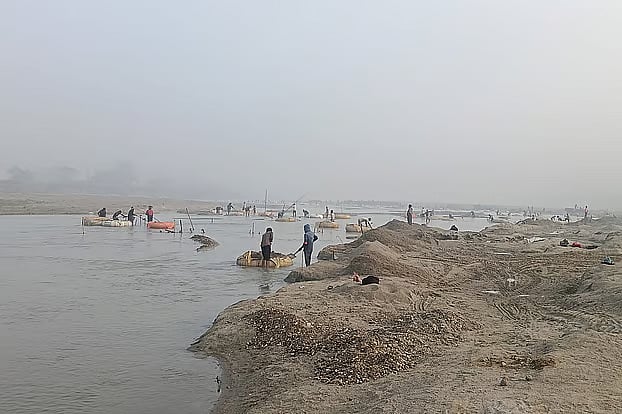
Tetulia is enveloped in dense fog, bone-chilling cold. Even in this winter, people crowd the river. Right after the early morning Fajr prayers, they wade into the water. It is not for a festival. They have come driven by hunger, to extract sand. The river is the Mahananda.
Here, the Mahananda separates Bangladesh from India. On the eastern bank lies Tetulia; on the opposite bank are the Indian localities of Murikhoya and Bandarjhuli, according to local residents and members of the Border Guard Bangladesh (BGB) stationed in the area.
Though it may lack influence, Tetulia is politically a place of great significance. The phrase “from Teknaf to Tetulia” is used to denote the whole of Bangladesh and its people. That is why, the name of this border area in Panchagarh district is being invoked in this election as well.
Azizur Rahman of Sardarpara in Tetulia is over sixty. As on any other day, he waded into the Mahananda River early Sunday morning to extract sand. His son, a Class 10 student, brought him roti and tea from home. It was eight in the morning. After chatting for some time, when the topic of the election came up, Azizur Rahman said he would definitely cast his vote in this election. He would choose a candidate from either Jamaat or the BNP. However, he has not yet made up his mind, there is still time.
Law and order is also not an election issue for the people of Tetulia. Incidents of theft and mugging are rare here. There is no history of political violence either. The common people believe there is little risk that the election will disrupt peace in the area.
Tetulia falls within the Panchagarh-1 constituency, which comprises Panchagarh Sadar, Tetulia and Atwari upazilas. There are 458,807 voters in this seat, with seven candidates in the race. Voters believe the main contest will be between BNP candidate Naushad Jami and NCP candidate Sarjis Alam. However, to some voters, the JSD candidate and former MP Nazmul Haque Pradhan is also a significant contender. What one would normally describe as a lively election campaign, is conspicuously absent along this border.
India is not an issue
There are very few affluent people in Tetulia. Roughly half the population belongs to the middle class and can get by year-round without borrowing. The other half survives on physical labour. Their livelihoods are mainly of three kinds: agricultural day labour, work in tea gardens, and extracting sand and stones from the Mahananda River.
In some stretches, the entire Mahananda River lies within India; elsewhere, half of it is in Bangladesh and the other half in India. By nine in the morning, the river is to be cleared. Such are the instructions from the Border Guard Bangladesh (BGB). A sand trader said he has been in the business for 12 years and has never faced any obstruction from the Indian side regarding sand extraction.
At Tetulia market, a vegetable trader said that in the past people would come from India and steal cattle. In one night, 12 buffaloes from their family were stolen. Now the thefts have stopped because India itself has erected barbed-wire fencing along the border. These days, people of Tetulia have no trouble with Indian citizens.
A journalist at the Tetulia Press Club said that in some places in Tetulia, India surrounds the area on three sides. Just a few yards off the Panchagarh–Tetulia road lie Indian tea gardens. Many people cannot even tell which part is Bangladesh and which part is India. So what, really, is the election issue here?
At the Tetulia Press Club, a journalist spoke about the election. He said the election has arrived and it will be held. There are no issues here. Voters will not cast their ballots based on issues; they consider the party or the candidate.
Milk is sold daily at Tetulia market. Vendors bring milk in large plastic bottles or small cans and sell it at designated spots. On Saturday night around eight o’clock, two such vendors were selling milk at Tk 60 per litre, and some milk still remained unsold. The two are friends, both around thirty years old. Both said they would vote in the upcoming election.
One of them said that whoever wins, no one will do anything for the poor. The other had previously worked for two pharmaceutical companies and is now a small entrepreneur with a cattle farm. He said this time the issue is different, it is not like before. Roads, electricity or bridges are not the issues in this election. The issue this time is insaf (justice).
Taxi driver Imran Hossain spent 15 years in Saudi Arabia. After returning home, instead of sitting idle, he is trying to bring wealth to his family by driving a taxi. He is blunt: there has been enough talk about development and corruption. What is needed now is change.
Law and order is also not an election issue for the people of Tetulia. Incidents of theft and mugging are rare here. There is no history of political violence either. The common people believe there is little risk that the election will disrupt peace in the area.
The Officer-in-Charge (OC) of Tetulia police station, Rashedul Islam, told Prothom Alo that there is a tradition here of avoiding quarrels and fights. There is no risk of law and order deteriorating because of the election. Even so, the police are prepared to handle any situation that may arise.
Deciding on whom to vote for
Over two days, Saturday and Sunday, I spoke with 29 people from various walks of life in Tetulia about the national parliamentary election. Among them were van drivers, auto and taxi drivers, students, sand and agricultural labourers, housewives, NGO workers, small business owners and journalists. All of them said they would vote.
Among them, only two clearly stated whom they would vote for. One said he would vote for NCP’s Sarjis Alam, who is supported by Jamaat, because no one before had promised to do what they want to do. The other said he would vote for the BNP candidate, reasoning that in the country’s current situation, the responsibility of running the country should lie with experienced political forces. If inexperienced people are entrusted with governance, the suffering of the people will increase.
Most voters already have in mind whom they will vote for, though some say it is not the right time to declare it. Van driver Ishaq Ali said, “We’ll see, there’s still time. I’ll give my vote to whoever I feel like.”
Makbul Hossain from Barogharia village on the banks of the Mahananda River said, “I haven’t decided yet whom to vote for. I’ll talk to my family, talk to people around. I’ll decide whom to vote for the night before.”