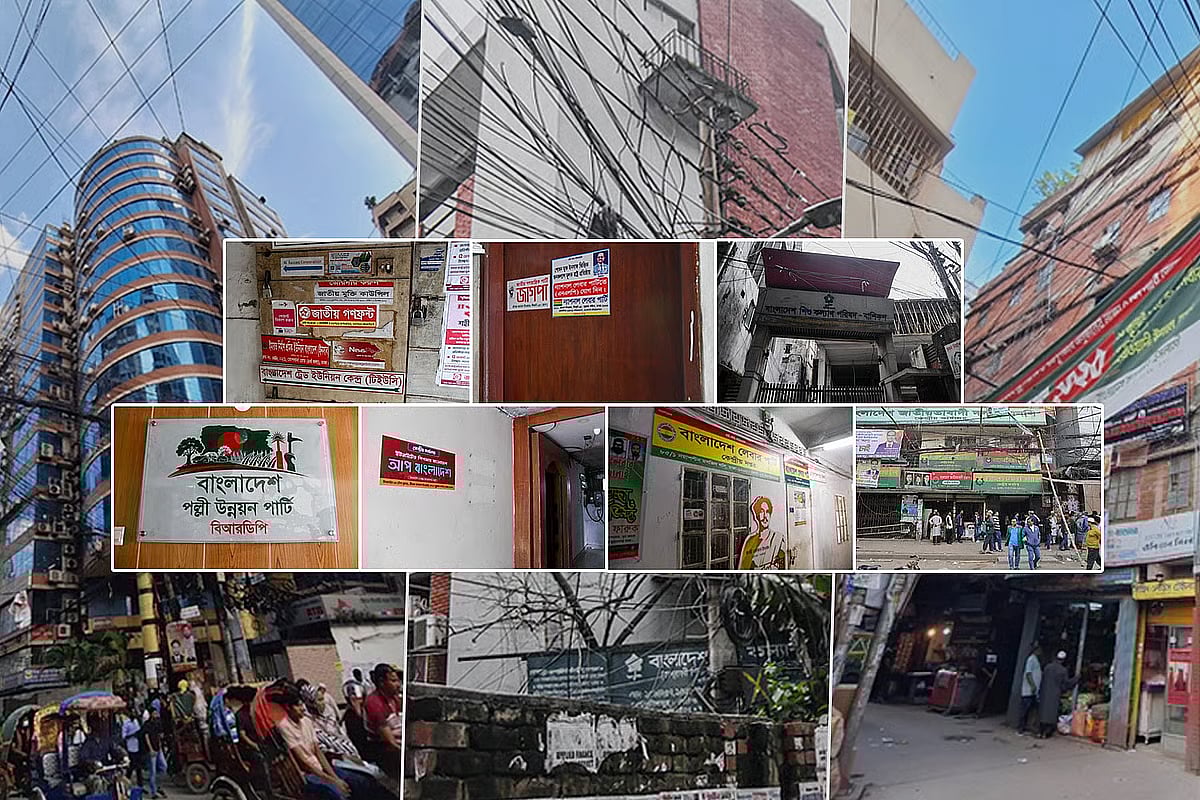
Offices of 15 political parties in just 3 buildings at Paltan
A short walk down Box Culvert Road in Purana Paltan brings one to a 16-storey building named Zaman Tower.
During visits on the building’s rooftop on 11 August and 14 September, three rooms were found to house the central offices of three political parties: the National Labour Party, the People’s Rights Party (PRP), and the Desh Bachao Manush Bachao Andolan.
Apart from those, Jatiya Ganatantrik Party’s (JAGPA) Dhaka city office is also located there. The office of another party, Amjanatar Dal, is on the building’s sixth floor.
Altogether the central offices of 14 political parties and the city office of one more are located at Zaman Tower and in just two other nearby buildings in Paltan.
According to election commission (EC) data, of the 50 parties currently holding valid registration in Bangladesh, 27 have their central offices in Paltan or its neighbouring areas of Topkhana Road, Kakrail, Gulistan, Bijoynagar, Segunbagicha and Motijheel.
A further 16 unregistered parties also have offices in the areas.
Taken together, Paltan could be said to be the “hub” of politics; its peripheries are Topkhana Road, Kakrail, Gulistan, Bijoynagar, Segunbagicha and Motijheel.
Historically, as Dhaka expanded beyond the boundaries of Old Dhaka, Paltan emerged as one of the new residential and commercial areas. Banglapedia records its area as 1.42 square kilometres.
In his book, Dhaka: Smriti Bishmritir Nagari, Professor Muntassir Mamoon writes that the ground once known as Paltan Maidan remained an open field until the 1940s. Over time, Paltan Maidan became renowned as a site for political gatherings, playing a pivotal role in the mass movements of the 1960s.
Mahmudur Rahman Manna, president of Nagorik Oikya, told Prothom Alo that it is this political history that explains why party offices sprang up there.
“When most parties were established, Gulistan was the heart of Dhaka,” he said. “That is why the Awami League’s central office (now its activity is banned) was set up on Bangabandhu Avenue (now Shahid Abrar Fahad Avenue). The BNP too shifted its headquarters to Naya Paltan.”
Rent in Paltan is steep. Classifieds show monthly rates of Tk 80 to Tk 120 per square foot. Zaman Tower, a well-known building in the vicinity, is no exception. Small political parties, unable to afford the high rates, often end up on rooftops.
The building’s owner, Miah Moshiuzzaman, who is also the convener of Amjanatar Dal, told Prothom Alo over the phone, “This is my family property. Political parties rarely find rooms easily, so I have let out a few to encourage political activity.”
7 parties in 1 building
Not far from Paltan stands the Bangladesh Shishu Kalyan Parishad building on Topkhana Road, opposite the National Press Club. This six-storey building houses the central offices of seven parties.
Only two of them are registered, the Bangladesh JASAD and Nagorik Oikya. The rest are Jatiya Gonofront, Bangladesh Palli Unnayan Party, the Songbidhan Bishoyok Janashartho Party–Organisation (CAPP), the Communist Party of Bangladesh (Marxist)–CPB (M), and BASAD (Marxist).
Some 150 metres ahead of Zaman Tower, at 85/1 Naya Paltan Mosque Lane, three more parties maintain offices: Bangladesh Labour Party, Progotishil Jatiyatabadi Dal and Bangladesh Jono-Odhikar Party. All three are allies of the BNP’s simultaneous movement. These parties too are unregistered.
During a visit to the office of the Progoshil Jatiyatabadi Dal on 14 August, its chairman Firoz Mohammad Liton was found chatting with an associate in a small room containing a table and a few chairs.
He told Prothom Alo that his party had rented the office after the July Mass Uprising.
BNP’s headquarters also at Naya Paltan
The Bangladesh Nationalist Party’s (BNP) central office is also at Naya Paltan. Writer-researcher Mohiuddin Ahmad records in his book, BNP: Somoy–Osomoy, that the party’s first headquarters was on Dhanmondi Road 27, before being relocated to Naya Paltan in the early 1980s.
Although Bangladesh Jamaat-e-Islami’s central office is at Moghbazar, its city office is at Purana Paltan.
Several other Islamic parties are also based in and around the Paltan area. Among them, Islami Andolan Bangladesh has its headquarters in Purana Paltan.
Party spokesperson Gazi Ataur Rahman told Prothom Alo, “Many Islamic parties traditionally held programmes in front of Baitul Mukarram, with the National Press Club nearby. Maybe that is why they established their central offices in Paltan.”
Why so many parties?
Bangladesh has seen a proliferation of political parties. In June, 147 applied to the election commission for registration. Most are little more than names.
Asked what drives the launching of so many small parties, writer and researcher Mohiuddin Ahmad said on 7 September over phone, “Everyone wants to engage in politics, but they lack the resources of the big parties. The big parties are like supermarkets, while the small ones are like groceries—‘one-man shows’.”
“What these small parties want is often unclear, even to themselves,” he stated.