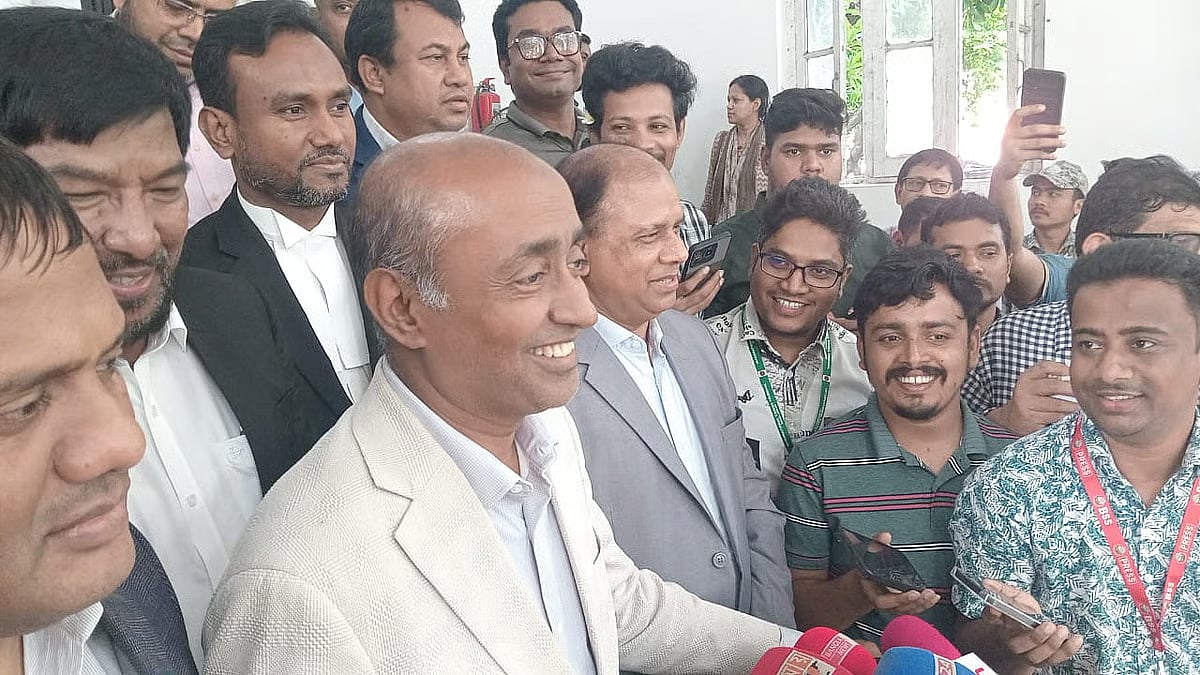
Not appropriate to ‘bargain’ with the chief justice, law minister to journalists
Law, Justice and Parliamentary Affairs Minister Md Asaduzzaman has said it would not be appropriate for him, in his capacity as law minister, to engage in “bargaining or influence” with Chief Justice Zubayer Rahman Chowdhury regarding ensuring unhindered access for journalists to Supreme Court courtrooms during proceedings.
“I hope he (the chief justice) will reconsider the matter using his intellect, wisdom and experience,” he said.
He made the remarks in response to questions from journalists at a briefing held Monday afternoon at the premises of the International Crimes Tribunal.
Asaduzzaman arrived at the tribunal at around 3:00 pm yesterday. After assuming office as law minister, he held his first meeting with the tribunal’s prosecution team. He spoke to journalists following the meeting.
At the briefing, a journalist said, “We have been facing a problem for several months now—we are unable to enter the chief justice’s courtroom. This is hindering our reporting.”
“You may have seen yesterday (Sunday) that we staged a protest. But we have not been able to overcome his rigidity. So, we would humbly request that you speak to the chief justice on the matter. We also ask whether you will take steps to restore our unhindered access to the courtroom as before,” he asked.
In response, the law minister said, “First of all, I do not agree that the chief justice has taken a rigid decision. His decision is an administrative one, not a judicial one. He has taken an administrative decision, and he knows best the reasoning behind it.”
“Secondly, the matter has come to my attention. I believe it has also come to the attention of the honourable chief justice. I hope he will reconsider the decision using his intellect, wisdom and experience. However, I do not think it would be appropriate for me, as the law minister, to enter into bargaining or attempt to influence him on this matter,” he added.
On concerns surrounding the prosecution
Another journalist asked, “You mentioned that you are aware of the issue. Recently, there has been a lot of discussion surrounding this prosecution—such as alleged phone conversations or summoning individuals to rooms, among other matters. You must have come to know about these through various sources. What is your position on this?”
In response, the law minister said, “We have taken steps on all these matters with utmost seriousness. I am not aware of any previous instance where action was taken against someone from the prosecution with such seriousness. But we have taken action, and this will continue.”
‘Mob is a reaction of the people’
At the briefing, another journalist asked, “Under the International Crimes Tribunal Act, crimes against humanity include acts that are widespread and premeditated, such as planned killings. You have granted indemnity up to 5 August. After 5 August, the mobs we have seen were also systematic in nature and widespread. Will those be investigated and tried in the tribunal in the future?”
In response, the law minister said, “A mob is not systematic or widespread. A mob is a reaction of the people, and if it falls under ordinary crime, it will be dealt with under ordinary law. If you attempt to try such matters in that way, many issues will arise. It would mean disrespecting any struggle for independence, any mass uprising, or any revolution.”