Prothom Alo explainer
When police can open fire, what can be the purposes
Following the announcement of the verdict in the crimes against humanity case against Sheikh Hasina, incidents of sabotage occurred in various locations across the country, including Dhaka.
Over the course of a week, more than 40 vehicles were set on fire nationwide and multiple crude bombs were thrown in different areas.
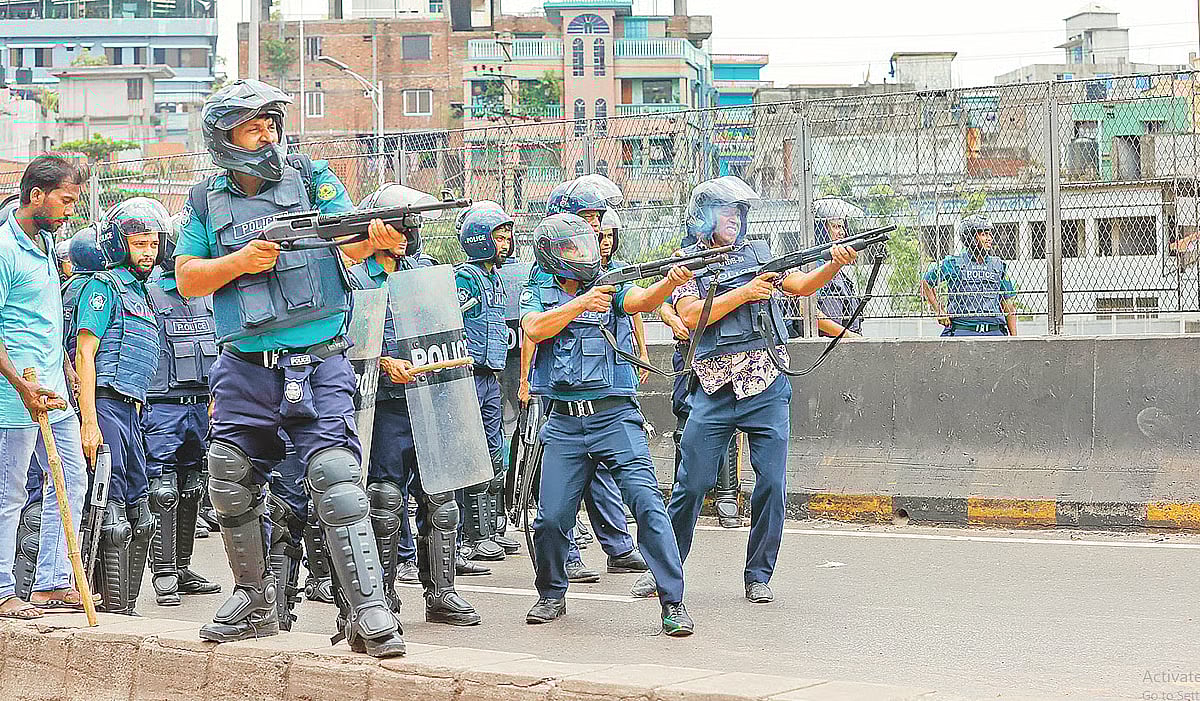
In this context, Dhaka metropolitan police (DMP) commissioner Sheikh Mohammad Sajjat Ali instructed police officers to open fire on individuals who launch crude bomb attacks on civilians or police personnel or who set fire to vehicles.
According to several DMP officials, Sajjat Ali issued this directive via wireless communication on Sunday afternoon.
Speaking to Prothom Alo on condition of anonymity, they stated that the commissioner had directed officers to fire in order to prevent attacks or arson attempts on installations of state importance, including banks and financial institutions.
Five days earlier, the commissioner of Chattogram metropolitan police had issued similar instructions to his officers via wireless communication.
This has raised questions as to whether the police are permitted to open fire in such circumstances.
DMP commissioner Sajjat Ali told Prothom Alo, “The instruction to open fire has been issued lawfully against those who carry out crude bomb attacks on civilians and police officers or who set fire to vehicles.”
His directive has since generated widespread discussion and criticism, with many asking questions, at what circumstances are the police allowed to open fire?
What the police regulations state
According to Section 153 of the Police Regulations, Bengal (PRB), the police may use firearms in three situations: exercising the right to self-defence and protection of property, dispersing unlawful assemblies and carrying out arrests.
Under sections 100 and 103 of the penal code 1860, the police are empowered to cause the death of an assailant in certain circumstances, including attempts to cause death, grievous harm or destruction by arson.
PRB 153 states that the police may use force to protect themselves, the public and government property from attack.
Section 99 of the penal code limits the degree of force that may be used. It stipulates that no more force may be applied than is necessary for self-defence.
Section 102 further states that the right to use force ends as soon as the apprehension of danger ceases.
According to police officials concerned, firearms may be used for purposes such as protecting life and property and effecting arrests. However, the use of firearms does not necessarily imply the intent to kill. The instruction is to achieve the objective with the least possible harm.
Types of police fire and their effects
Police in Bangladesh primarily use shotguns. Shotguns fire two types of ammunition: rubber bullets and lead bullets, also known as pellets. The cartridge contains multiple splinters. In situations involving disorder or violence, police typically begin by using batons, tear gas and sound grenades. If these measures fail to restore order, shotgun rounds are used. These rounds carry a relatively low risk of causing death.
However, the police also possess rifles, pistols and SMG (submachine guns). Ammunition from these weapons is lethal. Bullets fired from rifles and SMG can enter through one side of the body and exit through the other.
Shotgun pellets may also cause death if fired from close range or if they strike sensitive parts of the body, such as the head or chest. Depending on the cartridge type, shotgun pellets fired from within 40 to 50 metres may become lethal.
During the July mass uprising, on 16 July last year, it was observed that the chest and abdomen of Abu Sayed, a student of Begum Rokeya University in Rangpur, were riddled with pellets.
The post-mortem was conducted by physician Rajibul Islam, associate professor and head of the Forensic Medicine Department at Rangpur Medical College.
In September last year, he told Prothom Alo that Abu Sayed died from police shotgun pellets. As he was shot from within 10 metres, some of his internal organs were perforated, resulting in excessive bleeding that caused his death.
There are also various types of lethal bullets. For instance, the effective range of a 9mm pistol round is 50 metres, though depending on circumstances it may be fatal from several hundred metres.
A semi-automatic 7.62mm Chinese rifle round becomes lethal if it strikes a person within 300 metres. Such incidents occurred during the July mass uprising, when gunfire was directed at students and demonstrators.
Stray bullets fatally struck people inside their homes, on rooftops or on balconies. Forensic experts later concluded from the wound characteristics that these injuries were caused by rifle or SMG rounds.
Types of weapons available to police
It has been learned after conversations with police personnel at various levels that shotguns are generally used when a situation requires a higher degree of force. Lethal weapons are used by the police when confronting armed criminals. However, during the July mass uprising, there were instances of misuse of such weapons.
The Bangladesh Police possess firearms of 7.62mm and 9mm calibre, although 9mm pistols are more commonly used. According to internal sources, the police have 7.62mm Chinese rifles, submachine guns (SMG) and light machine guns (LMG). Previously, the police used 0.303 rifles, though these are now almost entirely out of use.
During the July mass uprising, security forces fired indiscriminately at students and the public. Shotguns, pistols and rifles were used most extensively, though SMGs and LMGs were also deployed in certain areas.
Following the events of July, demands emerged for the removal of lethal weapons from police possession. In February, during the deputy commissioners (DC) conference, a recommendation was also made that the police should not be equipped with lethal weapons.
In this context, at the ninth meeting of the Law and Order advisory council committee held on 12 May, the government decided that police officers would no longer be issued weapons such as Chinese rifles, submachine guns and 9mm pistols.
Purpose of police gunfire
Discussions with several retired senior police officers provide insight into the intended purpose of police gunfire. They stated that the police do not generally fire with the objective of causing death.
For maintaining law and order, the police are expected to use weapons that can control disorder while minimising the risk of fatalities.
Police regulations, Section 154, stipulates that gunfire must always be controlled and directed at a designated target. Except in absolutely unavoidable circumstances, no serious harm should be inflicted. Firing must cease immediately once the objective has been achieved.
Additionally, even if an assembly is unlawful, the police regulations require that a warning be issued before firing in order to disperse the crowd.
Various international laws and conventions impose restrictions on the use of lethal weapons. This has contributed to ongoing discussions regarding the police’s firing directives and their intended purpose.
Deputy commissioner Muhammad Talebur Rahman of the media and public relations division of Dhaka Metropolitan Police (DMP) told Prothom Alo that the firing instructions were issued to protect the public from loss of life, damage to property or acts of sabotage.
The intention is not to cause death. He stated that only the level of force necessary under the law to ensure the safety of life and property would be used. However, the police will maintain a strict position in preventing acts of sabotage.