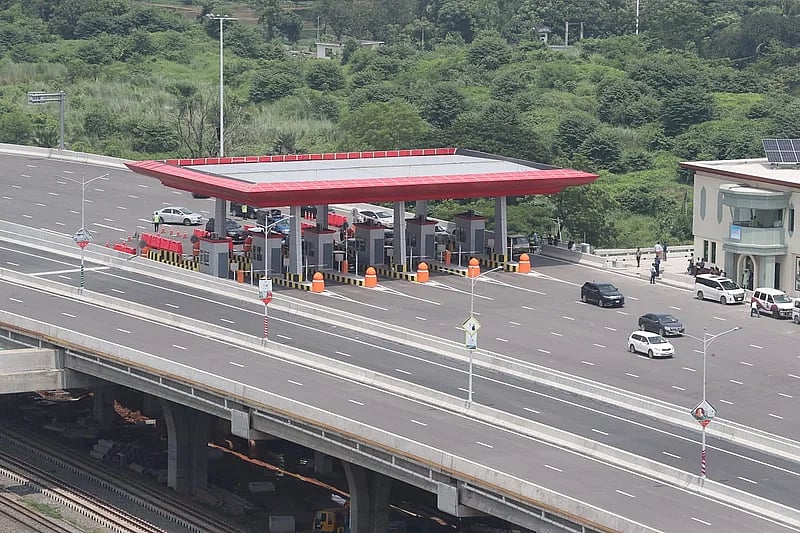
Dhaka Elevated Expressway
Allegations of concealing toll collection information
Allegations have been raised of revenue evasion by concealing the actual information on toll collection on the Dhaka Elevated Expressway. According to the allegations, the foreign investor company is reporting fewer vehicles than the actual number using the elevated expressway.
There are also allegations of assigning toll collection responsibilities to a third party without authorisation, dismissing Bangladeshi employees and demoting them.
Sources concerned said that the Special Branch (SB) of police submitted a report to the Bridge Division on 3 September regarding these allegations, seeking action. Although the Bridge Division has denied the allegations, it said that a separate mechanism would be introduced to monitor toll collection.
The Dhaka Elevated Expressway is a major public-private partnership (PPP) project. According to the agreement, if daily vehicle traffic exceeds 80,000 for 15 consecutive days, the Bangladesh government will receive 25 per cent of the revenue generated from tolls on the additional vehicles.
If daily vehicle traffic falls below 13,500, the operating company will receive a subsidy. Allegations have been raised that although more than 100,000 vehicles currently use the expressway daily, no revenue is being paid to the government.
However, according to information provided by the investor company, 70,000 to 75,000 vehicles currently use it each day.
Project director Golam Mortuza also referred to the same figures for vehicle traffic. He said he had recently joined and was unaware of the allegations of irregularities.
The Dhaka Elevated Expressway PPP project is overseen by the Bangladesh Bridge Authority (BBA). First Dhaka Elevated Expressway Company Limited (FDEE) is responsible for its construction, operation and maintenance.
Initially, Thailand-based Italian-Thai Development held more than half of the shares, but after disputes among partners reached the court, its shareholding dropped to 1 per cent.
Currently, China Shandong International Economic and Technical Cooperation Group holds 80 per cent of the shares, while Sinohydro Corporation holds 19 per cent.
After 25 years, the investors will hand over the elevated expressway to the Bangladesh government. Before that, they will recover their invested money, including interest, through toll collection.
The SB report said that a confidential investigation found that approximately 100,000 vehicles use the expressway daily. However, to show the actual number as below 80,000, toll information for some vehicles is not being entered into the central software or digital system, and tolls are being collected manually.
There are also allegations of collecting tolls during busy hours without issuing online receipts and reusing the same receipt for multiple vehicles.
A spot inspection found that during busy hours, employees stand with tickets in hand in various lanes alongside the toll booths. The registration numbers of vehicles receiving these tickets do not appear on the electronic boards.
Bridge Division Secretary Mohammad Abdur Rouf told Prothom Alo that over the three years since the expressway opened, vehicle traffic had exceeded 80,000 on a total of 21 days, but not consecutively. The government will receive revenue only if the number exceeds that threshold for 15 consecutive days.
He said records were also being maintained for vehicles paying tolls manually or through conventional methods. Saying that he was not calling the SB report “wrong,” he said the report had expressed suspicion. They would look into whether toll collection was being carried out properly.
When contacted, FDEE Administration Manager Siang Shweinan said that since the project authority is the BBA, anyone seeking information on any matter should discuss it with them through the BBA.
Third-party responsibility and employee layoffs
After the expressway opened, incidents of robbery and bodies being dumped there took place. Criminals took advantage of the absence of CCTV cameras in some locations.
Without resolving these problems, last year FDEE engaged another Chinese company named Shandong Hi-Speed International Operation and Maintenance Private Limited in toll collection as well as operation and maintenance work.
Over the following year, Bangladeshis holding various senior positions at FDEE were removed and Chinese nationals were appointed in their place. Demotions and dismissals also took place. Before Eid-ul-Azha last year, nine Bangladeshi employees were dismissed.
Sajib Rahman (30), a dismissed lane assistant, told Prothom Alo that the day before Eid, a driver paid Tk 100 against a toll of Tk 80 and drove away. He did not keep the remaining Tk 20 and threw it into a dustbin.
However, he was dismissed over the allegation of “keeping the money.” Eight others like him were also dismissed on the same allegation.
Employees allege that they were not informed when they were transferred from FDEE to Shandong Hi-Speed. In March last year, the company obtained a trade licence from the government. Later, a Chinese official of the company asked them to provide all toll collection information.
The employees claim that under the PPP agreement, FDEE is responsible for collecting tolls. BBA approval is required to assign this responsibility to another company. However, such approval was not obtained.
A review of BBA correspondence shows that on 13 September, the BBA wrote to FDEE seeking to know the legal status of Shandong Hi-Speed. In its reply on 28 September, FDEE said that although Shandong Hi-Speed had obtained separate registration, it had not been formally assigned responsibility for operation and maintenance.
FDEE alone was carrying out these responsibilities. However, in a letter dated 29 October last year, Shandong Hi-Speed described itself as a contracted operation and maintenance company working with FDEE.
According to the SB report, Shandong Hi-Speed is collecting tolls without proper approval. The company’s office was not found at the North Badda address it had provided to BIDA (currently the Invest Bangladesh Authority). It is operating from FDEE’s address in Kuril. No information about this was found to have been provided to BIDA, nor was any separate agreement with the BBA found.
The report also contains allegations of failure to renew the trade licence, non-compliance with labour laws and the ratio of local and foreign employees, and several foreign nationals not having valid work permits.
Bridge Division Secretary Abdur Rouf said that the investor company could appoint anyone it deemed suitable for toll collection. He expressed hope that once construction up to Kamalapur is completed by June next year, vehicle traffic and government revenue would increase.
Call for effective monitoring
The project, undertaken in 2009, began construction in 2020. The 19.73-kilometre expressway, costing approximately Tk 90 billion, is supposed to extend from Kawla, south of the airport, to Kutubkhali.
According to the agreement, the investor company is bearing 73 per cent of the construction cost of the main structure, while the government is bearing 27 per cent. After several extensions, the latest deadline has been set for December 2028. The section from the airport to Farmgate opened in September 2023.
Adil Muhammad Khan, professor of the Department of Urban and Regional Planning at Jahangirnagar University and executive director of the Institute of Planning and Development, said there had been complaints about the project for a long time.
Bangladesh’s interests had not been adequately protected in the agreement. Although the investor’s financial investment had been accounted for, the monetary value of the land provided by the government and the rehabilitation costs had not been taken into consideration.
He said effective government monitoring was essential regarding how many vehicles were using the expressway and how tolls were being collected.
The SB report should be taken into consideration and action should be taken, and officials who violated the country’s interests in the project should be held accountable. He advised exercising caution in protecting the country’s interests when undertaking PPP projects in the future.