New govt: Large cabinet with veterans and first timers
After two decades out of office, the Bangladesh Nationalist Party (BNP) has returned to state power, embarking on a new chapter in the country’s political journey.
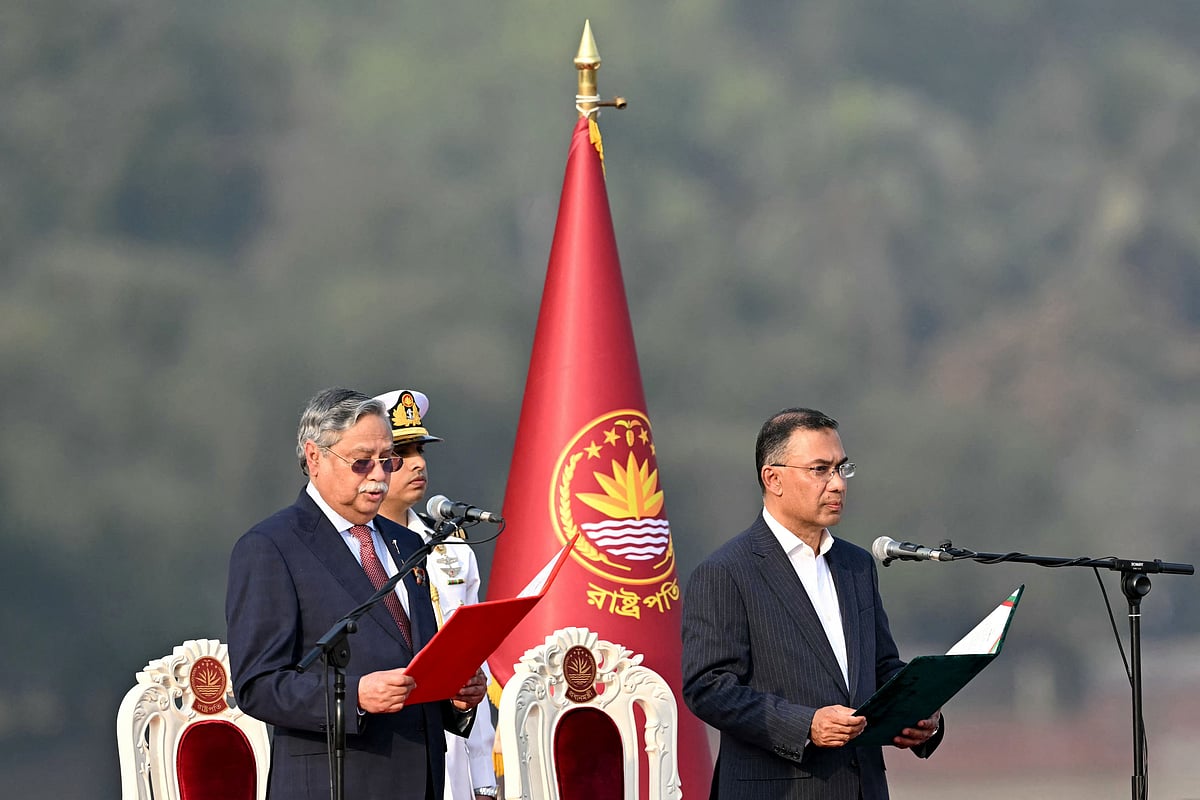
Party chairman Tarique Rahman was sworn in as prime minister and announced a 50-member cabinet that combines senior leadership with a significant number of mid-ranking and younger figures from within the party.
The swearing-in ceremony took place on Tuesday at the South Plaza of the Jatiya Sangsad Bhaban (National parliament building), where president Mohammed Shahabuddin administered the oath of office and secrecy. With this ceremony, the much-anticipated new administration formally began its tenure.
An analysis of the 50-member cabinet reveals a deliberate blend of three generations of leadership. A considerable number of ministers and state ministers have assumed executive office immediately upon being elected members of parliament for the first time. New faces outnumber experienced ones.
Several appointees have been entrusted with weighty responsibilities despite comparatively younger in age or limited political experience, while a handful of inclusions have not been widely viewed as inspiring.
Among the BNP’s senior-most leaders sworn in as members of the cabinet are secretary general Mirza Fakhrul Islam Alamgir and standing committee members Amir Khasru Mahmud Chowdhury, Salahuddin Ahmed, Iqbal Hasan Mahmud (Tuku), and Major (retd.) Hafiz Uddin Ahmed. Their inclusion had been widely anticipated.
However, senior standing committee members Khandaker Mosharraf Hossain and Abdul Moyeen Khan have not been included in the cabinet.
Political circles suggest that Khandaker Mosharraf Hossain may be considered for the presidency, while Abdul Moyeen Khan is being discussed as a potential speaker of the Jatiya Sangsad. Their omission from the cabinet is believed to be linked to these prospective appointments.
10 advisers with ministerial or state ministerial rank
Several other senior figures, including Mirza Abbas, Gayeshwar Chandra Roy, Nazrul Islam Khan, and Selima Rahman, are also absent from the cabinet list. However, 10 individuals have been appointed as advisers with the rank of minister or state minister.
Those granted ministerial rank as advisers include BNP senior joint secretary general Ruhul Kabir Rizvi, former secretary Md Ismail Zabihullah, and Dhaka University professor and economist Rashed Al Mahmud Titumir, in addition to Mirza Abbas and Nazrul Islam Khan.
Appointed as advisers with the rank of state minister are joint secretary general Humayun Kabir, Brigadier General (retd.) Shamsul Islam, Zahed ur Rahman, Mahdi Amin, and Rehan Asif Asad.
Shamsul Islam previously served as the BNP chairman’s chief security officer. Rehan Asif Asad is a technology specialist and son of Asaduzzaman, founder of the Barind Multipurpose Development Project. Mahdi Amin served as political adviser to the BNP chairperson and spokesperson for the party’s election management committee.
A formal gazette notification to this effect was issued by the cabinet division late on Tuesday night.
Notable inclusion
Perhaps the most widely discussed addition to the Cabinet is Khalilur Rahman, who served as national security adviser in the interim government led by professor Muhammad Yunus. Historically, advisers to caretaker or interim administrations have not gone on to assume roles in subsequent elected governments.
Khalilur Rahman has been appointed as a technocrat minister. His earlier appointment as national security adviser had been opposed by the BNP, which even demanded his resignation at the time.
However, following a meeting in London between Tarique Rahman and professor Muhammad Yunus, the chief adviser of the interim government, the political dynamic reportedly shifted. Since then, discussions in political circles have pointed to growing proximity between Khalilur Rahman and the BNP leadership.
For several months, speculation had persisted that he might be retained in a future BNP-led administration. In line with that speculation, he has now been entrusted with the Ministry of Foreign Affairs.
Composition and experience
The cabinet comprises 25 full ministers and 24 state ministers. As of Tuesday night, the official gazette detailing portfolio allocations had yet to be published, although names of ministries have already circulated across various media outlets and social media platforms.
An examination of the cabinet list indicates that nine of the 25 ministers have previously served as ministers and therefore bring prior experience in governance. Nine others have become ministers immediately upon being elected to parliament for the first time. The remaining seven had previously served as MPs but had not held ministerial office.
All 24 state ministers are first-time holders of that office. Of these, 21 have become state ministers immediately upon their first election to parliament. One is a technocrat appointee, while the remaining two had previously served as MPs.
Influx of new faces
Tarique Rahman himself has become prime minister after contesting an election for the first time in his life.
Among the new full ministers are AZM Zahid Hossain, Khalilur Rahman (technocrat), Abdul Awal Mintoo, Mizanur Rahman Minu, Khandaker Abdul Muktadir, Ariful Haque Choudhhury, Zahir Uddin Swapon, Mohammad Amin ur Rashid (technocrat), Afroza Khanam (Rita), Shahid Uddin Chowdhury Anee, Md Asaduzzaman, Zakaria Taher, Dipen Dewan, Fakir Mahbub Anam (Swapan), Sardar Sakhawat Hossain (Bakul), and Sheikh Rabiul Alam.
However, Kazi Shah Mofazzal Houssain Kaikobad and Nitai Roy Chowdhury had served as ministers during the Ershad era, while ANM Ehshanul Hoque Milon and Asadul Habib Dulu had served as state minister and deputy minister respectively during the BNP-led four-party alliance government.
The appointments of AZM Zahid Hossain, Abdul Awal Mintoo, Shahid Uddin Chowdhury Anee, and former attorney general Md Asaduzzaman had been anticipated in political circles.
Zahir Uddin Swapon, who served as convener of the BNP’s media cell, is widely credited with transforming it into a prominent digital campaign platform in a short span of time; many view his cabinet inclusion as recognition of that contribution.
Mohammad Amin ur Rashid, a BNP leader from Cumilla south, had been considered a strong contender for nomination in the sadar constituency but was ultimately not fielded. Although he expressed dissatisfaction at the time, he did not rebel against the party. His appointment as a technocrat minister is widely interpreted as political recompense.
Sardar Sakhawat Hossain was once associated with reformist currents within the BNP and had previously been expelled from the party. His inclusion in the cabinet marks a notable reversal. Sheikh Rabiul Alam, elected from Dhaka-10, has been entrusted with three major and strategically significant ministries — road transport and bridges, railways, and shipping — a concentration of responsibility that has also drawn comment.
State ministers: Political lineage and alliances
Those sworn in as state ministers include M Rashiduzzaman Millat, Anindya Islam Amit, Md Shariful Alam, Shama Obaed Islam, Sultan Salahuddin Tuku, Kaiser Kamal, Farhad Hossain Azad, Aminul Haque (technocrat), Mir Mohammad Helal Uddin, Habibur Rashid, Md Rajib Ahsan, Md Abdul Bari, Mir Shahe Alam, Md Junayed Abdur Rahim Saki (Jonayed Saki), Ishraque Hossain, Farzana Sharmin Putul, Sheikh Faridul Islam, Md Nurul Haque Nur, Yaser Khan Chowdhury, AK Iqbal Hossain, MA Muhit, Ahmed Sohel Manzur, Bobby Hajjaj, and Ali Newaz Mahmud Khaiyam.
Among them, Rashiduzzaman Millat and Ali Newaz Mahmud Khaiyam had previously served as MPs.
Aminul Haque, a former captain of the national football team and currently the BNP’s central sports affairs secretary, has been appointed as a technocrat state minister despite having lost the election in Dhaka-16.
Several appointees come from political families. Anindya Islam Amit is the son of the late BNP leader Tariqul Islam; Ishraque Hossain is the son of former Dhaka mayor Sadeque Hossain Khoka; Shama Obaed Islam is the daughter of the late Obaidur Rahman; Mir Mohammad Helal Uddin is the son of former state minister Mir Mohammad Nasiruddin; Sultan Salahuddin Tuku is the younger brother of former deputy minister Abdus Salam Pintu; and Farzana Sharmin Putul is the daughter of the late state minister Fazlur Rahman (Patal).
In addition, leaders from allied parties in the broader opposition movement have secured places in the cabinet structure. Md Zonayed Abdur Rahim Saki of Ganosamhati Andolon, Md Nurul Haque Nur of Gono Odhikar Parishad, and Bobby Hajjaj of the National Democratic Movement (NDM) are among those included.
Bobby Hajjaj, however, contested the election under the BNP’s ‘sheaf of paddy’ symbol after leaving his own party.
Public expectations
The BNP last held office from 2001 to 2006. Twenty years later, having secured victory in the 13th national parliamentary election, the party has returned to power with a cabinet marked by a substantial number of first-time legislators elevated directly to executive office.
The swearing-in ceremony itself was distinctive. Held in the open at the South Plaza of the Jatiya Sangsad Bhaban, it drew large crowds of onlookers.
Shariful Islam, who travelled from Manikganj to witness the event, told newspersons, “We are very happy today that the BNP government is taking oath. We believe our leader Tarique Rahman will take Bangladesh much further forward.”
Political analysts suggest that the success of this new-old blend within the cabinet will depend less on symbolism and more on the practicalities of portfolio management, policy direction, and implementation at the grassroots level. Whether the fusion of experience and fresh leadership proves effective remains to be seen.