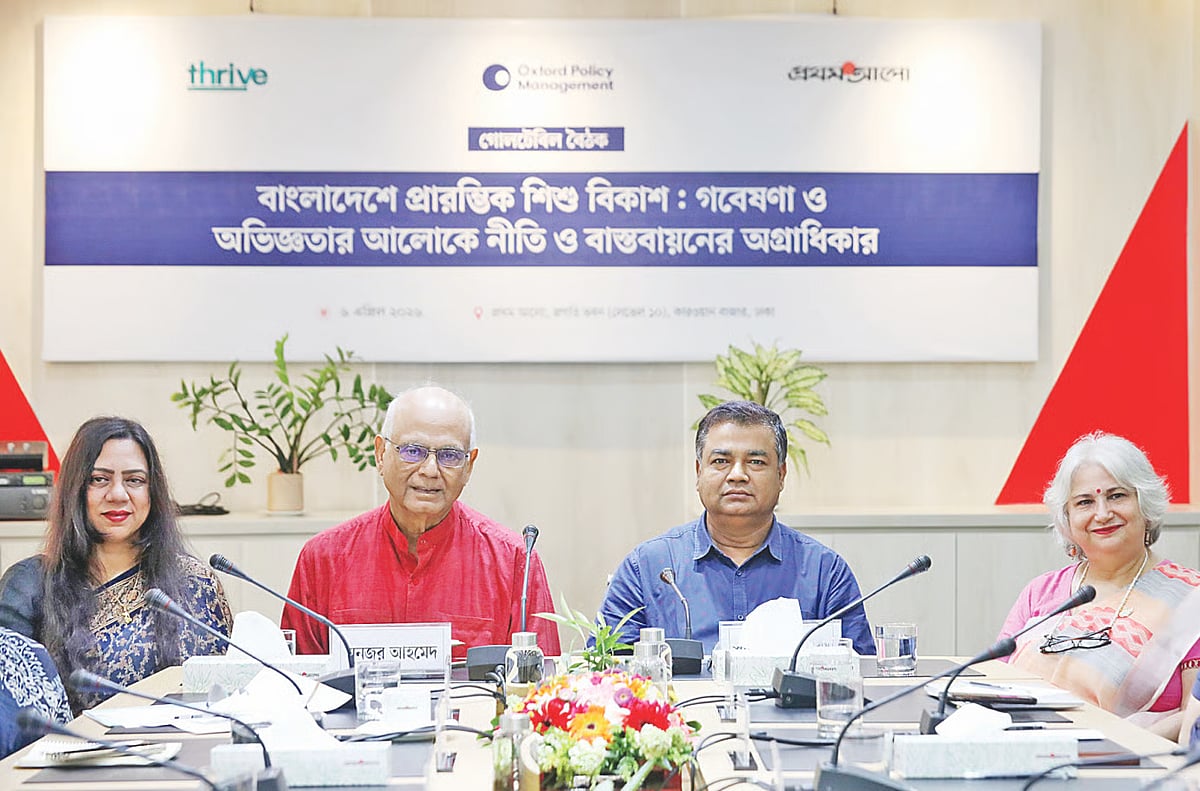
Roundtable
Prioritising early childhood development
Children’s development requires attention to health, nutrition, education, protection, and overall growth. Care for a child must begin from the mother’s pregnancy.
However, the lack of coordination among various ministries, budget constraints, shortages of skilled personnel, poor quality of services, and unequal access to services for all children have hindered the achievement of desired outcomes in Early Childhood Development (ECD).
Speakers highlighted these concerns at a roundtable organised by the Thrive Programme of Oxford Policy Management and Prothom Alo on Monday.
They urged prioritisation of early childhood development and called on the government to transition ECD initiatives from project-based activities into a permanent budgetary framework.
The speakers also recommended establishing a dedicated directorate for Child Affairs to oversee ECD and other child-related matters.
The roundtable, titled “Early childhood development in Bangladesh: Policy and implementation priorities in light of research and experience,” took place at the Prothom Alo office in Karwan Bazar, Dhaka.
The period from pregnancy to the first 1,000 days after birth is called the ‘golden days’. This is because children who receive proper nutrition, education, and protection during this time tend to succeed later in life.Shyamal Kumar Roy, assistant director and head of division (laboratory) at the Institute of Public Health Nutrition
According to the Integrated Early Childhood Care and Development (ECCD) Policy 2013 of Bangladesh, early childhood care and development involve providing all necessary support to ensure every child’s survival, protection, care, development, and education rights—from the fetal stage onwards.
The policy states that 15 ministries will engage in implementing these activities in various capacities.
The ministry of women and children affairs bears responsibility for coordinating efforts among ministries, non-governmental organisations, and international agencies.
In his remarks as the chief guest, Manzoor Ahmed, chairperson of the Bangladesh ECD Network (BEN), stated, “We must work on early childhood development through a permanent budget framework. This initiative must gradually transition from a project-based approach into a national programme. We need to coordinate and plan the budgets allocated for children across different ministries. Local government bodies must also be involved in monitoring activities.”
He added, “Children in the country are dying with symptoms of measles. We must learn from this situation and prioritise children’s issues to prevent such occurrences in the future.”
He emphasised the importance of establishing a directorate for child affairs to give due attention to children’s issues.
Shyamal Kumar Roy, assistant director and head of division (laboratory) at the Institute of Public Health Nutrition said, “The period from pregnancy to the first 1,000 days after birth is called the ‘golden days’. This is because children who receive proper nutrition, education, and protection during this time tend to succeed later in life. The government is giving importance to this issue. During antenatal care (ANC) visits, physicians advise mothers on what to eat for the well-being of the unborn child, what services to receive, and why they should deliver at healthcare facilities.”
Jena Derakhshani Hamadani, emeritus scientist at icddr,b, said, “We must raise awareness about the importance of ECD among parents, families, and society. The media should play a role in disseminating information about the significance of ECD and the factors that negatively affect children.”
Fahmida Tofail, scientist at the Maternal and Child Nutrition Division of icddr,b, stated, “The period when a child is in the womb is the most critical for development. Investment in early childhood development does not yield immediate visible results. It requires sustained, long-term efforts from both government and non-government sectors. Parents must also be made aware of this.”
4 key challenges in implementing ECD
At the meeting, Md Tarek Hossain, country research manager of the Thrive Programme at Oxford Policy Management, presented the keynote paper on early childhood development and the situation in Bangladesh.
The paper stated that the government has a sound policy stance on ECD; however, implementation faces challenges in four main areas. These include coordination and administrative arrangements, human resources and supervision, quality assurance, and financing and planning.
As a result, the expected standard of services has not been achieved. To realise the full benefits of ECD, stakeholders must coordinate ECD activities across ministries and between public and private sectors within existing government allocations and expand these efforts at the national level.
Md Iqbal Hossain, education manager at UNICEF, urged the introduction of a system whereby each ministry submits an annual report detailing progress in ECD activities and evaluating their outcomes.
Esha Husain, country director of Synergos Bangladesh, called for stronger measures to prevent accidental and negligence-related child deaths alongside promoting early childhood development.
Syeda Sazia Zaman, programme head at the BRAC Institute of Educational Development (IED) of BRAC University, called for scaling up pilot projects to the national level.
She stated, “The country has reached this stage after working on early childhood development for many years. There have been achievements. To sustain these gains, we must remove the existing barriers.”
Aneeka Rahman, senior economist (social protection) at the World Bank, emphasised the need to advocate to the government for prioritising ECD initiatives.
She said, “Investment in early childhood development will yield returns at a greater scale. After 20 years, those children will grow into skilled citizens and contribute positively to the country.”
Md Aziz Khan, nutrition and ECD officer at UNICEF stated, “To make ECD services effective, we must repeatedly communicate their importance to mothers. Despite having sound policies, weak accountability and responsibility hinder the effectiveness of ECD programmes.”
Zannatun Nahar, Early Childhood Care and Development manager at Save the Children, observed that wealthier families are more likely to access ECD services, while poorer families lag behind. She emphasised the need to increase funding and improve service quality.
Sahana Begum, senior manager at Phulki, remarked that the number of community-based child day-care centres should be expanded to support children’s development.
Firoz Choudhury, assistant editor of Prothom Alo, moderated the event.