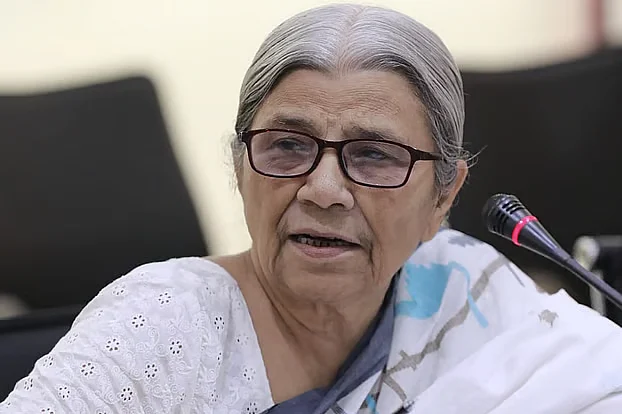
Prothom Alo roundtable
Women's representation in parliament is vital: Fauzia Moslem
She made these remarks on Saturday morning at a roundtable on “Women’s Seats in the National Parliament and Women’s Political Empowerment” held at the Prothom Alo office in Karwan Bazar of the capital. The roundtable was organised by Prothom Alo and moderated by its Associate Editor, Shumana Sharmin. At the outset, Prothom Alo senior correspondent Naznin Akhter presented the concept paper on women’s seats in parliament.
Women's leader Fauzia Moslem said, "It is not possible to have laws drawn up in the interests of women, to create a reality where discrimination against women is eliminated, to create this context, if women are not in the decision-making process."
Fauzia Moslem cited two reasons for having reserved seats for women. First, she said, given the prevailing political culture, it is extremely difficult for women to secure representation. Second, she pointed to the lack of opportunities in society for women to take decisions independently.
Fauzia Moslem said that when a woman contests an election, she has to depend on others. For that reason, reserved seats are necessary.
Criticising the existing political structure, she said political parties bring women’s representation into parliament merely to maintain balance.
Referring to women’s direct participation in national parliamentary elections, the Mahila Parishad president said that the extent of hostility towards women in society is now becoming evident. “In this situation, we must continue to exert pressure, and we are doing so,” she said.
She proposed increasing the number of parliamentary seats to 400, with 150 of them reserved for women. At the same time, she demanded that opportunities be created for women’s direct participation in elections.
The roundtable was moderated by Shumana Sharmin, Associate Editor of Prothom Alo.
The participants included Shireen Parveen Huq, head of the Commission on Reforms on Women’s Issues; Badiul Alam Majumdar, head of the Electoral System Reform Commission; Rasheda K. Choudhury, Executive Director of the Campaign for Popular Education and former adviser to the caretaker government; Fauzia Moslem, president of the Bangladesh Mahila Parishad; Shaheen Anam, Executive Director of the Manusher Jonno Foundation; Khondaker Golam Moazzem, Research Director of the Centre for Policy Dialogue (CPD); Khushi Kabir, coordinator of Nijera Kori; Gita Das, chairperson of Naripokkho; Taslima Akhter, president of Garment Workers’ Solidarity; Ilira Dewan, member of the Local Government Reform Commission; and Nazifa Jannat, a key organiser of the July Movement and a student.