Roundtable
Climate crisis: Women in haor region at most risk
The lives of millions of women in Bangladesh’s haor wetlands revolve indeed around the haor. The challenges they face must be identified and solutions must be found. To do so, there is no alternative to a coordinated government and non-government initiative.
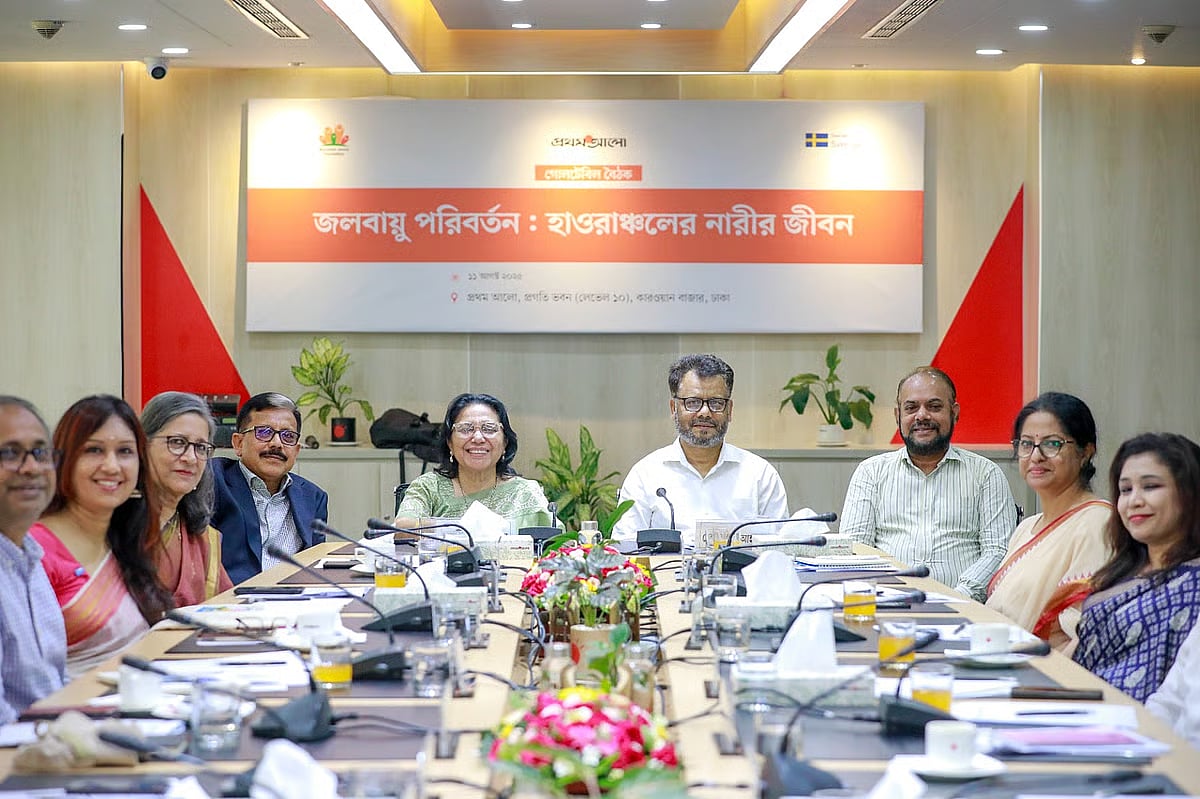
Speakers made these remarks Monday, during a roundtable titled ‘Climate Change: Life of Women in Haor Region’ held at Prothom Alo office in Dhaka. The event was organised by Manusher Jonno Foundation and Prothom Alo with support from the Swedish government.
Participating in the roundtable, Sheikh Farid Ahmed, joint secretary at the Ministry of Disaster Management and Relief, said that around 600,000 to 700,000 (6 to 7 lakh) people in the haor region are directly dependent on the wetlands for their livelihoods. Of them, 200,000 to 300,000 (2 to 3 lakh) are women, whose lives and livelihoods are revolving around the haor.
Stressing the need to identify the challenges faced by these women and find solutions, Sheikh Farid Ahmed said that the government so far has only been calculating how much paddy is produced and how many fish are caught in the haor. Now it’s time to look at women’s crises.
He remarked, “Today’s roundtable highlights the types of crises women face due to the impact of climate change in the haor. The government will identify these issues and seek solutions.”
He also emphasised the importance of coordination among ministries and agencies in tackling challenges in the haor. He added that the suggestions and recommendations coming from the roundtable would be passed on to the government, and they would be considered in policymaking.
Opening the discussion, Shaheen Anam, executive director of Manusher Jonno Foundation said, “Although climate change poses an existential threat for us, we do not see sufficient initiatives towards tackling it. While men and children are also affected by disasters, the impact of that on women is twice as severe.”
“We must commit to bringing qualitative change to the lives of the poor and women. With the election approaching, we should ensure that the political parties make commitments on climate crisis and women affairs in their manifestos,” she added.
Md Ziaul Haque, director (air quality and management) at the Department of Environment, said the Ministry of Women and Children Affairs must be included in policymaking to point out women’s vulnerabilities to climate change. He noted that representatives from this ministry are absent in climate discussions and stressed the need for inter-ministerial and inter-agency coordination.
Farah Kabir, country director of ActionAid Bangladesh said, “Women affected by the climate crisis do not want to remain victims. Given the environment and opportunities, they want to exercise agency. We have many policies, but no policy action. Nor do we see coordination among government bodies.”
Dilruba Haider, representative of UN Women emphasised the need for more in-depth research on women’s challenges in the haor, “Life is very hard for women in the haor. Frequent floods have intensified their hardships even further.”
“We have become so complacent about our activities on climate change issues that we haven’t done much research on these issues. We need research on what can be done to improve women’s lives,” she added.
Munjurul Hannan Khan, former additional secretary and executive director of Nature Conservation Management (NACOM), criticising current development indicators said that a multi-sectoral approach is needed to address the problems faced in the haor. It is not there now but the space for that must be created, he said advising on involving politicians in such discussions.
Gawher Nayeem Wahra, founding member-secretary of the Foundation for Disaster Forum, said the sources from where the water in the haor is being polluted during flash floods must be identified.
Snigdha Rezwana, associate professor at the Department of Anthropology of Jahangirnagar University said, “There is a tendency to treat women living in haor region as a separate group. We must consider their challenges as part of our mainstream challenges.”
Golam Rabbani, head of the Climate Bridge Fund Secretariat at BRAC said, “In the past eight years, there has been no research on the impact of climate change in the haor. Our policies contain self-contradictions, and these need to be removed.”
Md Shamsuddoha, chief executive of the Centre for Participatory Research and Development (CPRD), stressed the construction of embankments and cyclone shelters to address the impacts of climate change, adding “We must develop the capacity to assess the additional damage caused by climate change.”
Md Ahsanul Wahed, programme manager at Manusher Jonno Foundation, presented a research titled ‘Climate Change: Women’s Struggles in the haor Ecosystem’ at the roundtable.
Among others Professor Md Moniruzzaman Khan, director of the Institute of Disaster Management and Vulnerability Studies at the University of Dhaka; Nishat Sultana, director (influencing, campaign and communication) at Plan International Bangladesh; Banshree Mitra Neogi, director (rights and governance) at Manusher Jonno Foundation; and Sohanur Rahman, executive coordinator at YouthNet Global also participated in the discussion.
The roundtable was moderated by Firoz Choudhury, assistant editor at Prothom Alo.