Proposed budget burdens low-income individuals with higher taxes: CPD
The proposed personal income tax structure for the 2026-27 fiscal year is ‘highly discriminatory,’ says the Centre for Policy Dialogue (CPD), noting that the new framework disproportionately increases the burden on lower-income individuals.
In contrast, the think tank argued that the increase in tax liability for high-income individuals earning above Tk 3 million annually is significantly lower.
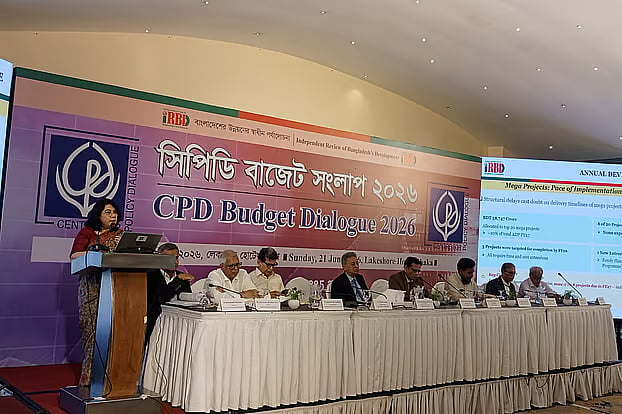
CPD presented its analysis during a budget review dialogue held this Sunday (21 June), at the Lakeshore Hotel in Gulshan, Dhaka. Finance and Planning Minister Amir Khasru Mahmud Chowdhury attended the event as chief guest. CPD Executive Director Fahmida Khatun presented the keynote paper.
The dialogue, chaired by CPD Distinguished Fellow Mustafizur Rahman, also featured State Minister for Planning Zonayed Saki as a special guest and National Citizen Party (NCP) MP Akhtar Hossain as an honored guest.
The discussion also featured presentations from economists and business leaders, including Hossain Zillur Rahman, Executive Chairman of the Power and Participation Research Centre (PPRC); MA Razzaq, Chairman of Research and Policy Integration for Development (RAPID); Anwar-ul-Alam Chowdhury Pervez, President of the Bangladesh Chamber of Industries (BCI); Enamul Haque Khan, Senior Vice President of the BGMEA and Montu Ghosh, President of the Garment Workers’ Trade Union Centre.
Disparity in tax burden
CPD Executive Director Fahmida Khatun stated at the event that an analysis of the tax burden relative to income growth reveals a significant disparity. Under the new budget, individuals with an annual taxable income between Tk 600,000 and Tk 1.5 million (6 to 15 lakh) will see their tax liability increase by 12.5 to 16.7 per cent. In contrast, those earning over Tk 3 million (30 lakh) will see an increase of only 7.6 per cent. She noted that this is contrary to social equality and justice.
Lack of clarity on employment
Fahmida Khatun remarked that the proposed budget does not clearly reflect the government’s election manifesto promise to create 10 million new jobs within 18 months. She pointed out that budget allocations for the four relevant ministries—Labour, Expatriates' Welfare, Industries and Commerce are either decreasing or stagnant relative to total expenditure.
Furthermore, major employment-oriented projects, such as the Patuakhali EPZ and Jamdani Village, have remained stalled for years.
She warned that without a specific national employment program and necessary reforms, the goal of creating such massive employment risks remaining merely a ‘political aspiration.’
The government has set a target in the budget proposal to bring inflation down to 7.5 per cent. However, the CPD Executive Director noted that the average inflation rate was 8.63 per cent until May of the outgoing fiscal year. She stated that achieving this target is impossible without ensuring food and fuel supplies and maintaining a prudent monetary policy.
Fahmida Khatun added that while the Finance Minister's goal for economic recovery in the new government’s first budget is commendable, the macroeconomic indicators are ‘overly optimistic.’ While she viewed the increased allocations for human resource development sectors such as education and health as a positive step, she expressed serious concern regarding the effective implementation of these allocations.