Unhealthy competition and violence between parties and alliances increasing in elections: TIB
Although signs of relatively healthy competition were visible at the start of the election campaign, conflicts, internal feuds, unhealthy competition and violence among different parties and alliances are gradually increasing, said Iftekharuzzaman, executive director of Transparency International Bangladesh (TIB).
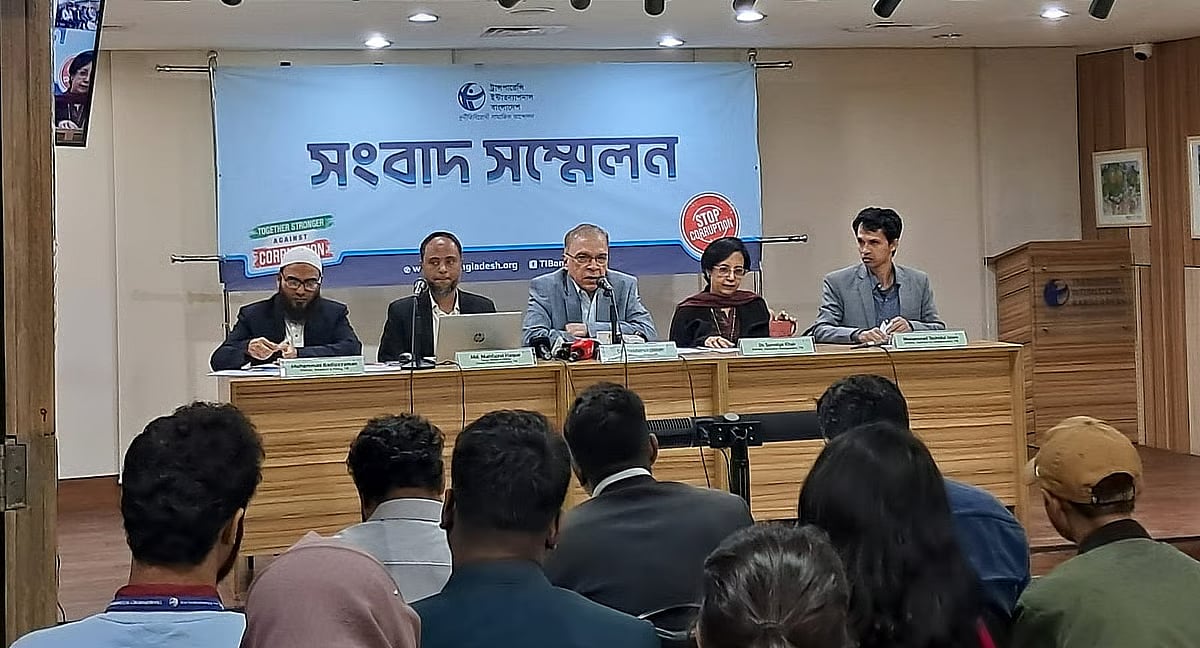
Iftekharuzzaman made the remarks at a press conference held at TIB’s office in Dhanmondi, Dhaka today, Sunday afternoon. The press conference was organised to release a report titled, ‘Pre-election and referendum situation: TIB’s observation’.
Speaking about the parliamentary election and the referendum, the TIB executive director said both polls would be conducted properly if everyone behaves adhering to the rules. In this regard, political parties and candidates have the biggest role to play. A free and fair election is possible, if they want.
At the press conference, TIB’s senior research officer, Md Mahfuzul Haque presented the organisation’s report on the pre-election and referendum situation. This was followed by an overall assessment from TIB Executive Director Iftekharuzzaman, who later answered different questions from journalists.
Although parties were required to nominate at least five per cent women candidates in this election, none of them complied.
Responding to a question on the issue, Iftekharuzzaman said, “By not nominating even a single woman, Jamaat-e-Islami has set a disgraceful example. We did not expect Jamaat to do so. But, what about those parties from whom we did expect better? Only 2.7 per cent of candidates from the largest active party are women, why?”
He also questioned the position of the Communist Party of Bangladesh (CPB) regarding the nomination of women candidates.
Iftekharuzzaman identified five factors- money, religion, muscle power, patriarchy and majoritarianism- as Bangladesh’s “core political capital”.
Responding to another question, he said ensuring the security of all voters, including minorities and women, is the responsibility of the Election Commission and the relevant forces. However, the primary responsibility lies with the political parties.
In response to another question, Iftekharuzzamn said corruption has continued even under the current government. Although there was an opportunity to reform the Anti-Corruption Commission (ACC) under this government, it was not done.
The failure to disclose asset statements of the advisers in the interim government would set a bad precedent for the future. The interim government has failed to demonstrate transparency, he added.
In his opening remarks at the press conference, Iftekharuzzaman protested the incident in which journalists were picked up from the office of a media outlet called Bangladesh Times on Saturday night.
He said, “Picking up journalists from a media office is unacceptable. Whatever the justification, taking journalists away without specific allegations, is a medieval example of violence against free journalism.”
“If there are objections to any report, there are proper procedures to address them. Even though the journalists were later released, this incident has sent a strong message of intimidation to the entire media. We want the army and all other institutions to refrain from such actions,” he added.
Seven observations on the elections
In its overall pre-election assessment, TIB highlighted seven key observations:
1. Although there were initial signs of relatively healthy competition, political parties and candidates have gradually reverted to old practices of violent electoral activities. As a result, conflicts between parties and alliances, intra-party feuds, unhealthy competition for power and violence are increasing.
2. Alongside electoral violence, there is a risk of instability due to anti-election activities announced by ousted authoritarian forces.
3. Political parties and candidates have not only continued but significantly increased the use of money and religion, along with muscle power, patriarchy and majoritarianism, in the election.
4. Growing deficiencies are evident among the Election Commission and other stakeholders in creating a free, impartial, transparent and level playing field as well as in organising a peaceful election. In particular, effective exercise of the commission’s authority to prevent political conflict, violations of the code of conduct, irregularities and unhealthy competition is not visible.
5. Despite widespread violations of the election code of conduct and various irregularities at almost every stage of the election—both online and offline—the commission appears to be avoiding or ignoring many of these issues, largely due to its inability to act. This poses a serious risk to ensuring a level playing field for all parties and candidates as well as to ensuring a healthy, impartial electoral environment for voters of all classes.
6. Failures, irregularities and inaction to ensure a neutral and influence-free environment have been observed among government officials involved in organising the election, especially within a section of the administration and the law enforcement agencies.
7. Political parties and candidates have also shown a lack of cooperation with the Election Commission in complying with the electoral code of conduct. Conduct opposing to the principles of ensuring a level playing field is becoming increasingly evident among many political parties and candidates.
Eleven observations on the referendum
TIB in its observations outlined 11 points regarding the referendum campaign:
1. Due to opposing positions taken by influential political parties, the government’s indecision on the referendum and its attempt to appease both sides through an ordinance created confusion, misunderstanding and controversy over the referendum issue and question from the outset.
2. Even if the decisions of holding the election and referendum on the same day as well as making the upper house mandatory in parliament is considered means of achieving that appeasement, the issue has nevertheless become even more complex.
3. It remains unclear whether any constructive consultation or coordination took place between the government and the Election Commission during the process of drafting the ordinance and deciding on the referendum as well as the government’s stance in favour of a ‘Yes’ vote.
4. The Election Commission’s directive, issued 18 days after the government started campaign, on government employees campaigning in favour of the referendum (stating that campaigning in favour of ‘Yes’ vote was unlawful), has created further controversy over how well-considered, lawful or constructive it was.
5. The Election Commission’s directive treated the elections and the referendum as equivalent, which is questionable. For, according to Section 2(7) of the Representation of the People Order, 1972, ‘election’ means election to a seat of a member held under this Order. A referendum cannot be considered equivalent to election, as voters in the referendum, do not vote for or against any seat or member.
6. Had the Election Commission consulted the government, as the drafter of the referendum ordinance, before issuing the gazette, its independent role would not have been questioned, rather unnecessary confusion could have been avoided.
7. Overall, ill-considered actions by both the government and the Election Commission have created unnecessary controversy surrounding the government’s direct involvement in the referendum.
8. In line with the mandate of the July mass uprising, it was the government’s responsibility to play the necessary role in securing a ‘Yes’ vote in the referendum for the July Charter, the main catalyst for state reform. There was no legal or logical basis for the Election Commission to oppose this role.
9. However, in carrying out this responsibility, the government has called its own conduct into question by imposing decisions, from the outset, not only on public servants but also unnecessarily on various stakeholders, including NGOs and banks. This has been compounded by questions over transparency and accountability in the financing and expenditure of the referendum.
10. Especially after the announcement of the election schedule, when government employees legally fall under the authority of the Election Commission, the government interfered unnecessarily in the commission’s jurisdiction by issuing instructions without the commission’s consent, even though campaigning for a ‘Yes’ vote was justifiable.
11. Whether due to this interference or other considerations, the Election Commission took unnecessary and controversial steps based on a misinterpretation of the law. Both the government and the Election Commission have failed to perform their expected roles properly and effectively in organising a historic referendum, rendering it controversial.
The press conference was moderated by TIB’s outreach and communication director, Mohammad Touhidul Islam. TIB’s adviser (executive management), Sumaiya Khayer and TIB’s research director, Mohammad Badiuzzaman were also present at the time.