The Ministry of Housing and Public Works has initiated a project to provide free residential flats to the families of martyrs from the July Uprising. The preliminary cost for constructing a total of 804 flats has been estimated at Tk 7.62 billion, which will be fully funded by the government.
The project will be implemented by the National Housing Authority (NHA), which plans to build the flats on government land in Mirpur's Section 14 of the capital. Under the proposed plan, six 14-storey and ten 10-storey buildings will be constructed.
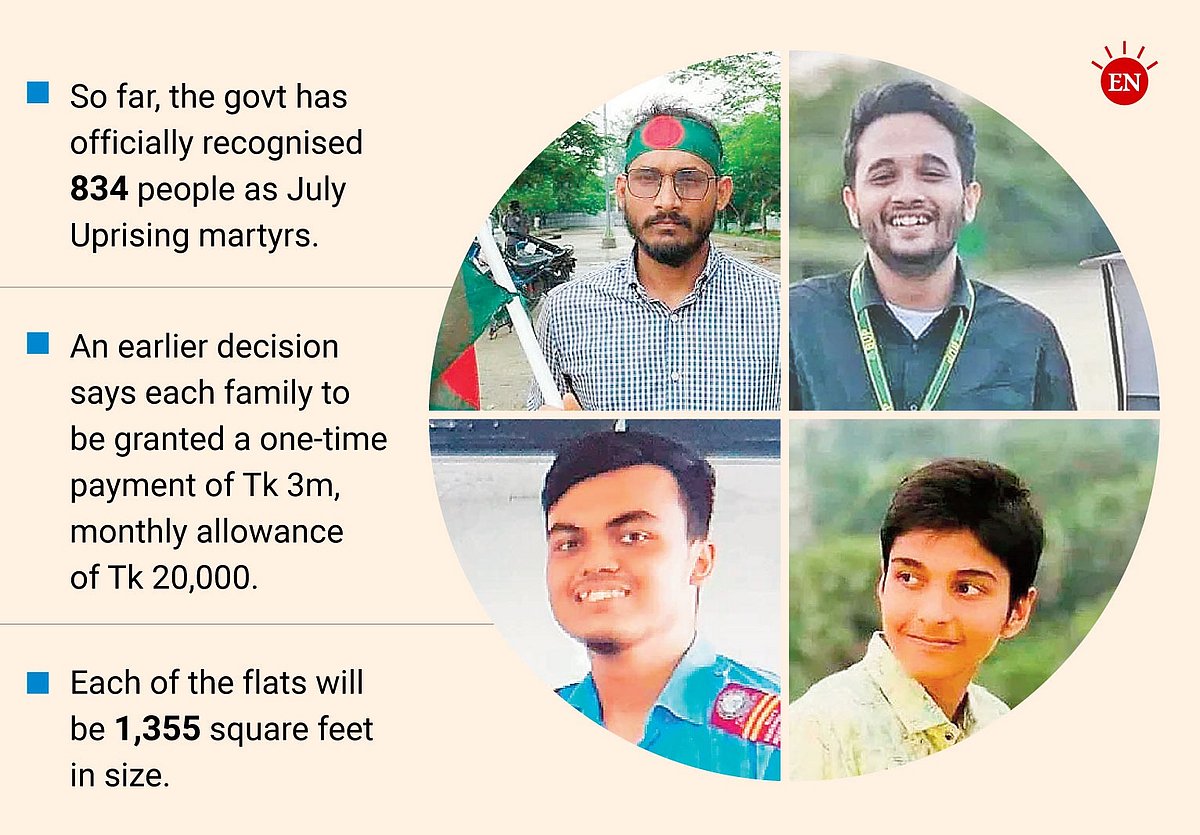
Each of the 804 flats will be 1,355 square feet in size, consisting of two bedrooms, a drawing room, a living room, a dining room, a kitchen, and three bathrooms.
The official name of the project is: ‘Construction of residential flats on the National Housing Authority’s own land acquired by the National Housing Authority (‘36 July’) to provide permanent housing to the families of martyrs in the anti-discrimination student movement’.
According to NHA sources, the project is awaiting presentation at an upcoming meeting of the Executive Committee of the National Economic Council (ECNEC). Construction work will begin following ECNEC approval, with completion targeted by June 2029.
So far, the government has officially recognised 834 people as martyrs of the July Uprising. The state is currently offering various forms of assistance to their families. Each family is being granted a one-time payment of Tk 3 million, in addition to a monthly allowance of Tk 20,000. The initiative to provide new flats is part of the broader support programme.
Several potential complications were discussed, particularly surrounding inheritance rights. Officials raised the question of who should legally inherit the flats—parents, siblings, or spouses and children.
Though the Mirpur site will house 804 flats, officials say the number may be slightly reduced. Those not accommodated there may be allotted flats under a separate housing project for those injured in the July events, especially those who have lost the ability to work.
Finance adviser Salehuddin Ahmed has proposed an allocation of Tk 4.05 billion in the 2025–26 fiscal year budget for the welfare of martyr families and the injured. This fund will cover one-time grants, monthly honoraria, medical allowances, housing, and employment generation.
A Project Evaluation Committee (PEC) meeting on this housing initiative was held at the Planning Commission on 16 June. Several potential complications were discussed, particularly surrounding inheritance rights. Officials raised the question of who should legally inherit the flats—parents, siblings, or spouses and children.
A senior official present at the meeting told Prothom Alo on condition of anonymity that while the issue of inheritance was acknowledged, no solution was reached.
The Tk 3 million one-time grant is being provided in the form of government savings certificates. Of this amount, Tk 1 million is being disbursed in the current (2024–25) fiscal year, while the remaining Tk 2 million will be given in the next fiscal year (2025–26).
According to the Ministry of Liberation War Affairs, 671 martyr families have so far received savings certificates. However, 163 families are still awaiting disbursement. In at least 134 of these cases, disputes over inheritance have delayed the process. A key point of contention is whether, in cases where the martyr was married, the rightful heirs are the parents or the spouse and children. Many families have not applied due to unresolved disagreements.
There will be no opportunity to sell the flats outright. Anyone wishing to sell will need approval from the top echelons of the government.Syed Nurul Basir, chairman, National Housing Authority
On 1 June, Hazrat Ali, elder brother of martyr Humayun Kabir of Nandail Upazila in Mymensingh, visited the July Mass Uprising Branch at the Ministry of Liberation War Affairs.
He alleged that his brother’s wife had submitted an application for the savings certificate without including information about the heirs. Upon review, officials confirmed that the application lacked necessary heir documentation.
The National Housing Authority has said that a clear policy on inheritance will be established during the construction phase. This will define who within the martyr’s family will legally own the flat.
Since most martyr families live in various districts outside Dhaka and are rooted in their local livelihoods, the PEC meeting also discussed whether these families would choose to move to the capital. Questions were raised about whether they would be allowed to rent or sell the flats if they chose not to live in them. However, no final decision was made on these matters.
Sources from the Ministry of Public Works added that the land earmarked for the project in Mirpur currently contains several old buildings, which are being rented out to different families. Evicting them could lead to legal complications, which the ministry is taking into consideration.
For now, the NHA says its immediate focus is on infrastructure development. Officials believe that by the time construction is completed, decisions on legal and logistical issues will be resolved.
Speaking to Prothom Alo on 17 June, NHA chairman Syed Nurul Basir said, “No family will be forcibly brought to Dhaka. They will come only if they choose to.”
He acknowledged the unresolved issues but said they would ultimately be settled by the highest levels of government.
“There will be no opportunity to sell the flats outright,” he added. “Anyone wishing to sell will need approval from the top echelons of the government.”
Who will pay the registration fee?
Sources in the National Housing Authority have said that the registration fee for each flat—due at the time of handover—could be around Tk 1 million. However, it has not yet been decided who will bear this cost.
Meanwhile, an inter-ministerial meeting on the project was held on 4 May in the conference room of the Ministry of Housing and Public Works at the Secretariat. The meeting was chaired by Housing and Public Works Secretary Nazrul Islam. It was decided that under this project, the National Housing Authority will be responsible solely for constructing the buildings. The respective utility services—gas, electricity, and water—will be arranged by the concerned ministries, while Dhaka North City Corporation will handle the construction of internal roads.
Yunus Sardar, father of Mohammad Ifti Abdullah, who was martyred in the July Uprising, told Prothom Alo, “If my son were alive, he would have taken good care of us. But he is gone, and nothing will bring him back.”
Now living in a rented house, he added, “If the government gives us a flat, it will be a great help for our family.”