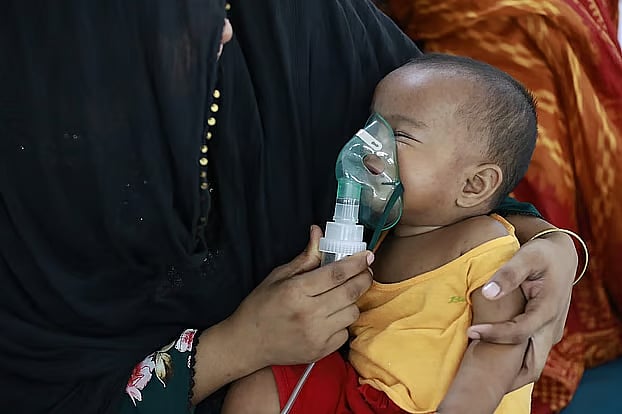
Over 50 die of measles per week
The spread of measles and measles-related deaths in the country shows no sign of declining. Analysis of data from the World Health Organization (WHO) and the Directorate General of Health Services (DGHS) indicates that the outbreak is still at a high level, and deaths are not decreasing.
According to DGHS, from 15 March until yesterday, Friday, 575 children have died from measles and its symptoms. This means an average of over 57 children are dying every week.
The outbreak began in January this year. Since 15 March, the health authorities have been regularly providing updates to the media on the measles situation. Data analysis shows that in the most recent week (18–24 May), 59 children died.
According to the latest update on Bangladesh’s measles situation published by WHO on 26 May, confirmed infections have decreased slightly, but hospital admissions due to symptoms remain alarmingly high. At the same time, deaths from measles and related complications continue to rise. DGHS reported that 732 patients were admitted to hospitals across the country in the last 24 hours.
However, during holidays, hospital visits usually decline, making it difficult to fully assess the situation. The official Eid holiday began on 25 May and will continue until 31 May.
Experts say that to understand the true scale of any disease outbreak, not only the number of detected cases but also the trend in deaths is an important indicator. This is because the reported number of infections can often be lower due to limited testing, weak surveillance, or gaps in reporting.
Assistant Professor of Epidemiology and public health expert Nazmul Haider from Keale University, UK, told Prothom Alo that in any outbreak, the trend in deaths is generally a more reliable indicator of how the infection is progressing. Based on the current data available in Bangladesh, there is still no clear evidence that the situation is stabilising.
Experts believe that several factors, including delays in measles vaccination during 2025 under the interim government, malnutrition among children, and the absence of vitamin A capsule distribution campaigns, have contributed to the outbreak.
Infections and deaths
According to WHO, the 14th week of measles transmission in the country was from 29 March to 4 April. During that time, there were 1,836 reported cases of measles and measles-like symptoms. Within one week, this rose sharply to 7,992 cases.
In the following weeks, infection levels remained high. In the 16th week (12–18 April), the number of cases was 8,793. In two consecutive weeks, the number of cases exceeded 9,000. In the 19th week (3–9 May), cases rose to 10,190. The following week it was 9,864, and in the 21st week (17–23 May), the number of infected people was 9,723.
Alongside infections, the death trend is also alarming. In the 14th week, there were 9 deaths. The following week, this rose to 53. By the 21st week, total deaths had increased to 512.
Disease management also needed
After the outbreak began, vaccination was started in 30 of the most affected upazilas on 5 April. Nationwide vaccination began on April 20. However, according to WHO report dated 26 May, measles has now spread across all districts of the country.
Public health expert Mushtuq Husain told Prothom Alo that vaccinations were initially administered at fixed centers, rather than through the traditional door-to-door approach. More importantly, vaccination alone is not enough. Proper disease management is also essential. But that aspect has not been adequately addressed. As a result, hospital admissions remain at peak levels, and deaths continue to rise.
Lack of awareness campaigns on hygiene
Measles is one of the most dangerous viral infections affecting children. While adults may have partial immunity, young children do not. Meanwhile, during the Eid holidays, a large number of people left Dhaka for different parts of the country. Experts fear this could further spread measles, as healthy children may become infected in high-risk areas.
In such a situation, public awareness about hygiene practices is crucial, say public health experts.
Former Director of the Institute of Epidemiology, Disease Control and Research (IEDCR), Mahmudur Rahman, told Prothom Alo, “During such outbreaks, it is essential to promote hygiene practices. But surprisingly, I have not seen any awareness campaign. It feels as if nothing is happening. This culture of neglect could make the situation even more vulnerable.”