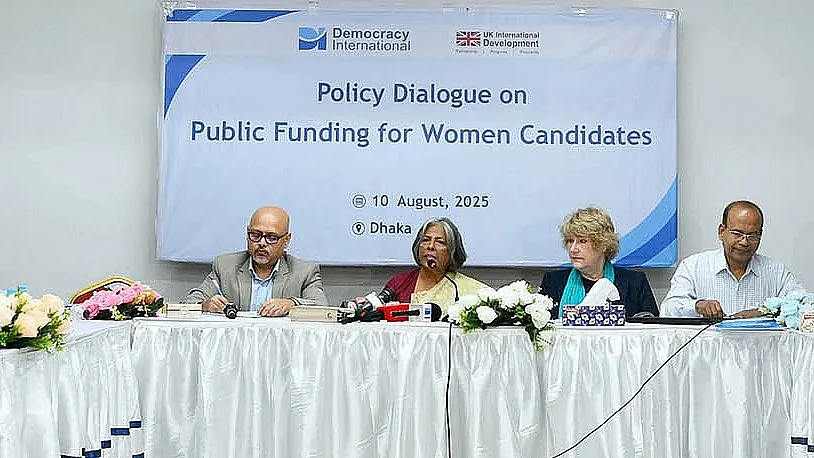
A commission without female deciding women-related issues: Sharmeen Murshid
Parties should nominate more female candidates and a system of direct voting in reserved women seats should be introduced to increase women empowerment in politics.
The national consensus commission should start discussion with women for this.
Speakers at a discussion titled ‘Policy Dialogue on Funding for Women Candidates’ said this.
They also criticised the consensus commission and the political parties for taking decisions on women-related matters excluding women.
Private agency Democracy International organised the event at the Krishibid Institution Bangladesh (KIB) auditorium in the city on Sunday.
The draft of the ‘Election Campaign Expenditure (Women Candidates) Ordinance, 2025’ was presented at the dialogue to increase women’s participation in the national parliamentary elections. Speakers stressed the need to create a public fund to support eligible women candidates in the elections.
Representatives from various women rights organisations and civic society gave harsh reactions over the decisions regarding reserved women seats and nomination of female candidates that came up in the discussion between political parties and the national consensus commission.
The demands of increasing the number of reserved women seats in the parliament and direct voting in these constituencies have not been met. The political parties have reached a consensus of fielding at least 5 per cent female candidates in constituencies outside the reserved women seats. They have agreed to gradually increase it to 33 per cent in the upcoming elections.
Besides, the existing system of 50 reserved seats for women and direct voting in the remaining constituencies remains in place. These decisions were finalised in discussions excluding women.
In her speech as the chief guest of the event, adviser to the Ministry of Women and Children Affairs and the Ministry of Social Welfare, Sharmeen Murshid said, “A commission without females is taking decisions on women-related issues. It’s quite uncomfortable for me. There was not equal participation of women in terms of decision making here.”
Regarding the discussions between political parties and the National Consensus Commission, she further said that women have been shortchanged when the calculations were made. He called for the resumption of discussions by the Consensus Commission to increase women’s participation in elections.
The adviser said women must be made more active and empowered in politics and brought into the election process as more capable candidates.
Md Abdul Alim, principal director of Democracy International, presented the draft ordinance on forming a public fund for female candidates at the dialogue.
The draft proposal stated that a public fund would be created for female candidates, both party-affiliated and independent. To form this fund, the government would allocate the required amount each year as per the Election Commission’s demand, and it would be considered part of the national budget. The commission would have the authority to cancel the allocated fund, in full or in part, if a candidate violated its conditions, refrained from contesting, or boycotted the election.
Speaking regarding this, the adviser said, “Elections in this country are never completely free of corruption. The ceiling for electoral expenditure has never been complied. The initiative to form a public fund might curb the corruption rate. Many eligible candidates cannot come to the fore due to financial constraints. The public fund may play a significant role in bringing forward women in this regard.”
Election Commissioner Brigadier General (retd) Abul Fazl Md Sanaullah said that according to the Representation of the People Order (RPO), political parties registered with the Election Commission were supposed to ensure 33 per cent female representation at all levels of their committees by 2020. As the parties failed to meet the target, the deadline was extended to 2030. It seems that even by 2030, the target will not be met.
He said that although the female population in the country is higher, the number of female voters is lower. The commission has taken steps to reduce this gap. As of the draft voter list on 2 January this year, there were three million fewer female voters than male voters. A total of 4.4 million voters were found to be missing, many of whom had lost faith in voting. In the past few months, the gap in the number of female voters has been reduced to 1.8 million.
Discontent over women’s seats and nominations
Addressing the dialogue, National Consensus Committee member, Badiul Alam Majumdar said, “Every one demanded for increasing women seats and direct voting in these constituencies this time. Nominations for reserved seats are considered a favour, as there is no accountability to the public. Unfortunately, direct elections to reserved seats have now become merely a slogan for women’s and rights organisations as well as civil society. Politicians have also used this slogan. In its 2001 election manifesto, the BNP pledged to directly nominate candidates for reserved seats.”
BNP national standing committee member Nazrul Islam Khan said, “The government can, if it wishes, increase the number of nominations for women. There should be no problem in speaking about the matter from anyone’s position. It is the political parties that have to implement the decision, and it is not so simple. Women themselves also need to be proactive in contesting elections. It must be seen how many women seek nominations, as parties will need to find female candidates who can compete against rivals from other parties and win. The issue of accountability and implementing decisions arise only if a political party wins in the election.”
He welcomed the proposal to create a public fund for female candidates.
Another BNP standing committee member, Selima Rahman, said there had been debates over women’s seats and nominations. In this regard, the Consensus Commission had failed to provide any solution. A member from the Women’s Affairs Reform Commission should have been included in the discussion, she said. Many grassroots women are campaigning at the ground level to secure nominations, and this needs to be addressed.
Former BNP MP Nilofar Chowdhury (Moni) said that if 5 per cent of nominations are given to women in this election, the party contesting in 300 seats will nominate 15 women. She questioned whether this number is enough for women to become self-reliant in politics. She believes there is a need for a public fund to support women in elections.
Central BNP self-reliance affairs secretary Shirin Sultana said she was disappointed with how the consensus commission’s talks with political parties ended. She said women’s candidacy was limited. Expressing hope that more nominations will be arranged for women, she added there is still time for discussion.
Shahin Anam, executive director of Manusher Jonno Foundation, said, "The consensus commission made decisions about women without consulting any women’s organisations. We reject this decision. Now in 2025, only 5 per cent nomination in general seats is being shown as a gesture. There are possibilities that parties will nominate women in weaker constituencies."
National Citizen Party (NCP) Senior Joint General Secretary Tasnim Zara said, "Women took the lead from the front in the July uprising. Yet, no changes were made regarding nominations for reserved seats and general seats. This is a failure. There appears to be no process within the consensus commission to capture the voice of women."
At the event, the opening speech was delivered by Democracy International’s chief of party, Katherine Cecil. The closing speech was given by the organisation’s deputy chief of party, Aminul Ehsan. The programme was conducted by the organisation’s senior director, Lipika Biswas.
Among the others who addressed the dialogue are - Saiful Haq, general secretary of Bipolobi Workers Party; Saiful Alam Khan of Jamaat-e Islami; Sumaiya Islam, member of the Women’s Reform Commission; Bobby Hajjaj, founder and chairman of Nationalist Democratic Movement (NDM); Humaira Nur, joint secretary of NCP; July warrior Shahjadi Phanna; among others.