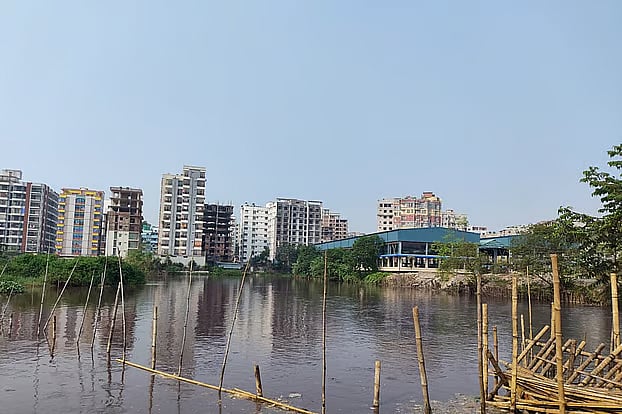
Dhaka district admin moves to acquire part of reservoir for the police lines
The government wants to acquire part of a reservoir to construct a police line for the Special Security and Protection Battalion (SPBN).
The matter has been challenged in the High Court, which has issued a rule and a three-month stay order.
The reservoir is located in Katasur Mouza, Mohammadpur, Dhaka. In the acquisition proposal, one part of the reservoir is referred to as a ‘bore’ and the other as a ‘doba’. Land surveyors explain that ‘bore’ refers to low-lying land used for Boro rice cultivation.
According to a mid-20th century survey by the Land Survey Division (RS), the area is officially marked as a reservoir. Bangladesh has at least three laws aimed at protecting reservoirs, water bodies, and water retention areas. To fill in or encroach upon a water body for national interest, clearance from the Department of Environment is required. Although a No Objection Certificate (NOC) was obtained at the time of the acquisition proposal, as of the writing of this report, the police have not applied for the site-specific clearance.
According to the City, Divisional, and District Municipal Areas’ Playgrounds, Open Spaces, Parks, and Natural Reservoirs Preservation Act, 2000, the classification of areas identified as playgrounds, open spaces, parks, or natural reservoirs cannot be changed. Such areas cannot be used for any other purpose, nor can they be leased, rented, or transferred in any way.
According to the Bangladesh Environment Conservation Act, areas identified as reservoirs cannot be filled in or reclassified for other uses. However, this restriction may be relaxed if a clearance is obtained from the Department of Environment in cases of essential national interest.
The land acquisition is nearly complete. The High Court has issued a stay order on two plots here. Once that is resolved, we will hand over the entire area to the police.Litus Lawrence Chiran, Additional Deputy Commissioner of Dhaka District Administration
The SPBN (Special Security and Protection Battalion) is a specialised unit of the Bangladesh Police. This unit provides security and protection for the Prime Minister and President of the country, including their residences and offices. They also ensure the safety of government-designated VIPs, both domestic and foreign.
For the implementation of the SPBN Police Line project, 4.22 acres of land across 25 plots in Katasur Mouza, Mohammadpur are being acquired. According to land records, the total area of the reservoir is 3.5 acres, and the acquisition proposal covers about 1.5 acres of this reservoir. In October 2022, the Dhaka District Administration issued a notice under the Immovable Property Acquisition and Occupation Act, 2017.
When asked, Litus Lawrence Chiran, Additional Deputy Commissioner of the Land Acquisition Branch of Dhaka District Administration, told Prothom Alo: “The land acquisition is nearly complete. The High Court has issued a stay order on two plots here. Once that is resolved, we will hand over the entire area to the police.”
Regarding how the reservoir was classified as Boro land in the acquisition proposal, Litus Lawrence said, “In the records, its classification is listed as Boro. When we acquire land, there is guidance on adjusting the classification based on the actual conditions.”
Asked whether a realistic reclassification has been done in this case, he replied, “This is a previous issue; I would need to review the file to answer.”
The proposed acquisition site is located just before the RAB-2 office, moving along the Basila-facing road from the Mohammadpur Bus Stand in Dhaka.
Last Saturday, a site visit revealed that the area is surrounded by a security wall. Moving slightly along the wall, there is an alley to the right, and at the end of the alley lies the reservoir, with bamboo posts installed and fish being cultivated.
Several local residents, speaking to Prothom Alo on condition of anonymity, said that part of the reservoir has already been filled in and a shed constructed. They have heard that a police line will be built here, which is why part of the reservoir will be filled.
For land acquisition purposes, the police obtained a No Objection Certificate (NOC) from the Department of Environment in advance, following the rules. In the NOC issued on 26 December 2021, the department stated that under no circumstances should the natural reservoir (RS plot numbers 805 and 810) be filled. The existing natural reservoir within the project area must be properly preserved, and compliance with the Environment Conservation Act is mandatory. Any proven violation would result in legal action.
On 9 September, local resident Rokeya Begum filed a writ petition in the High Court to protect the reservoir. Her lawyer, Ishit Manjul Sohini, told Prothom Alo: “RS plot numbers 805 and 810 are clearly marked as reservoirs, but this was concealed in the acquisition notice, which classified them as Boro land. We have sought the High Court’s intervention on this matter.”
Proposing to classify reservoirs as Boro (cultivable) land for acquisition is a crime. Similar practices are being carried out nationwide with rivers, canals, and floodplains.Professor Akhtar Mahmud of the Department of Urban and Regional Planning at Jahangirnagar University
Lawyer Ishit Manjul Sohini stated that the High Court has issued a three-month stay order on the acquisition of the reservoir. He added that the court has also issued a rule directing the authorities concerned to explain why the inclusion of part of the reservoir in this acquisition should not be declared illegal.
A 2024 study by the Bangladesh Institute of Planners (BIP), the organisation of urban planners, found that about three decades ago wetlands covered more than 20 per cent of Dhaka’s total area. Over time that has fallen to below 3 per cent—a net loss of 17 percentage points of wetlands in thirty years.
Professor Akhtar Mahmud of the Department of Urban and Regional Planning at Jahangirnagar University told Prothom Alo that proposing to classify reservoirs as Boro (cultivable) land for acquisition is a crime. He said similar practices are being carried out nationwide with rivers, canals, and floodplains.
Urban planner Akhtar Mahmud warned that Dhaka’s livability has reached rock bottom. He explained that Dhaka suffers from waterlogging, and to reduce that problem the city needs waterbodies—reservoirs, wetlands, and ponds—which are essential for a healthy urban environment. If these are filled in and repurposed, the city will lose its livability. While Dhaka has not yet regained livability, he added, by destroying the potential for it now we are erasing any chance that the city could become livable in the future.