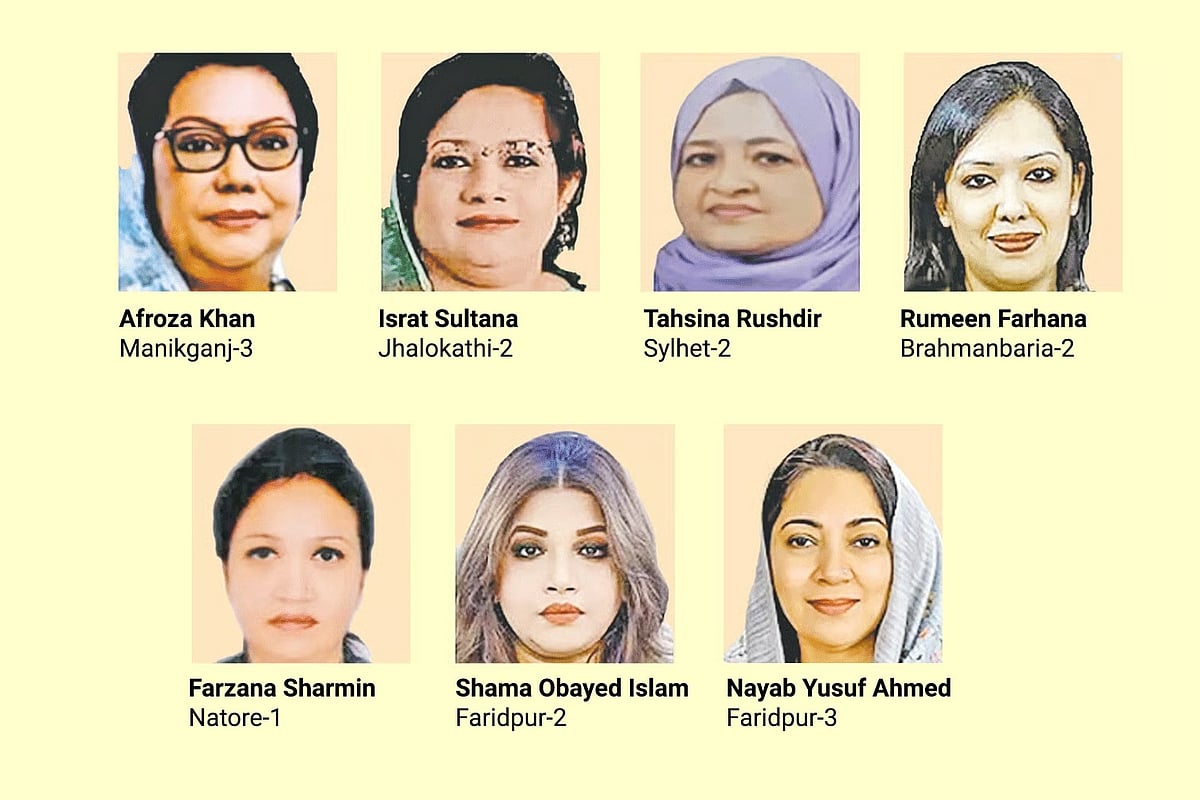
The 13th parliamentary election was held last Thursday, 12 February. This time, seven women were elected. The same number of women had been elected in the 8th parliamentary election held in 2001.
Women who participated in the election believe that misogynist campaigns and discriminatory treatment of women during the election influenced the votes for female candidates.
Regarding the lower number of nominations for women in this election, party tendencies were similar to before. Around the July movement, women’s rights activists had expected a higher rate of nominations for women.
However, despite strong objections from women’s rights activists, political parties agreed with the National Consensus Commission to allocate 5 per cent nominations to women. Even then, the parties did not fulfil that commitment.
Of the seven women elected this time, six are from BNP and one is an independent. They are Afroza Khan (Manikganj-3), Israt Sultana Elen Bhutto ( Jhalokathi-2), Tahsina Rushdir (Sylhet-2), Farzana Sharmin (Natore-1), Shama Obayed Islam (Faridpur-2), Nayab Yusuf Ahmed (Faridpur-3), and Rumeen Farhana (independent, Brahmanbaria-2).
Rumeen Farhana was a ‘rebel’ candidate from BNP. This time, BNP had nominated a total of 10 women candidates.
There are 50 reserved women’s seats in this parliament. Accordingly, the total number of women MPs will be 57. This means women will have 16 per cent representation in parliament. Among 299 constituencies, there were 86 women candidates.
Impact of misogynist campaigns
Nayab Yusuf Ahmed of BNP won in Faridpur-3. She told Prothom Alo, “Women are seen through a lens of discrimination in society. Many also considered me weak. At every stage of my political life, I have proven them wrong. Some parts of society still may not accept me. I will prove to them that I can work harder than men.”
Gender discrimination and negative campaigns prevented more women from winning. Some groups and parties want women to remain in the shadows, she added.
In Dhaka-12, Taslima Akhtar of Ganosamhati Andolon contested but Jamaat-e-Islami candidate Saiful Alam Khan (Milon) won.
Regarding lower votes for women candidates, Taslima Akhtar told Prothom Alo that there was significant misogynist campaigning even before the election. A certain party campaigned that their leader could never be a woman.
She added that giving more nominations to women, raising awareness against misogynist campaigns, and establishing women’s dignity as citizens would increase the rate of women being elected.
Number of women in each parliament
According to the Election Commission, Khan Foundation’s research report tilted Empowering Women Thru Reserved Seat in Parliament: Fight or Flight Response?, Democracy International newsletters, and Prothom Alo’s own reporting:
First Parliament (1973–1975): 15 representatives from reserved seats were women.
Second Parliament (1979–1982): 2 directly elected women plus 30 reserved seats, totalling 32 women MPs.
Fourth Parliament (1988–1990): No reserved seats; 4 directly elected women.
Fifth Parliament (1991–1995): 5 directly elected women plus reserved seats, totalling 35 women MPs.
Sixth Parliament (February 1996, BNP-led): 3 women directly elected; 30 reserved seats. The election was later annulled.
Seventh Parliament (June 1996): 8 directly elected women; total 38 women MPs.
Eighth National Election: 7 directly elected women plus 45 reserved seats, total 52 women MPs.
Ninth National Parliament: 21 directly elected women; reserved seats later increased to 50, totaling 70 women MPs.
During Awami League’s tenure, the elections of 2014, 2018, and 2024 were one-sided and controversial, with 18, 23, and 19 women elected respectively.
Number of women candidates always low
Mir Nadia Nivin, a member of the Election Reform Commission formed by the interim government and a governance and institutional reform specialist, presented data at an event on 28 January, stating that compared to the 2024 12th parliamentary election, the number of women candidates this time was lower. In 2024, there were 101 women candidates, more than 5 per cent of all candidates.
This time, men received 22 times more nominations than women. More than 8 per cent of women candidates won relative to nominations, while men won 15 per cent relative to their nominations.
Mir Nadia Nivin told Prothom Alo that male candidates received far more nominations than women, and 15 per cent of them were elected in comparison. So there is no scope to say that women performed poorly. If more nominations had been given and women had been prepared for elections over a long period, more women would have been elected.
She said that the experience of this election has created a major opportunity to bring forward women’s leadership from the grassroots, introduce them in their constituencies in advance, and focus on preparing women as candidates for the next election.