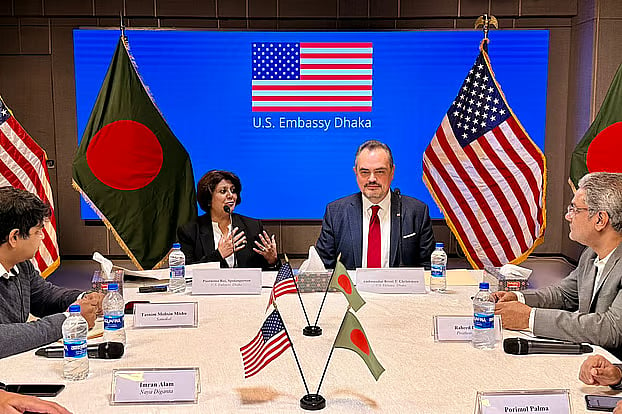
We will clearly highlight risks of engagement with China in certain cases: Brent Christensen
In the US Senate hearing on ambassadorial appointments last October, Brent Christensen stated that he would clearly present the risks associated with engagements with China to Bangladesh.
After joining as the new ambassador in Dhaka, he reiterated this point when facing journalists for the first time.
Brent Christensen mentioned his intention to clearly communicate the specific risks related to engagements with China to the interim government or the newly elected government.
On Wednesday afternoon, Christensen discussed various aspects of the relationship between the two countries with several media representatives at the EMK Centre in the capital.
During this exchange, he addressed a question regarding the geopolitical competition between the US and China.
During the Senate hearing last October, Christensen expressed his concerns about China's influence in South Asia and highlighted the potential for closer military engagement between Bangladesh and the United States as an alternative.
In today's meeting, when asked about defence cooperation, to avoid placing Dhaka amid the competition of major powers, Brent Christensen commented, ''You know, security issues are a topic you know of great interest to me given the prior role that I had as a senior official back in Washington and also my long experience here in Bangladesh. You know, the United States and Bangladesh have strong military to military cooperation. It's been growing stronger."
Brent Christensen noted, "We have partnerships across all branches of Bangladesh defense forces, working with the Navy on maritime security, with the army and with the air force on operational and emergency response readiness, you know, through a host of training and exercises."
The US ambassador stated, "Yeah, over the last year we conducted several important exercises, things like, you know, tiger shark, working with the Navy on operational readiness, tiger lightning with the army on peacekeeping, counter-terrorism, and medical issues, you know, and a host of other engagements."
Brent Christensen said, "As we look to to deepen those ties and that interoperability as as you suggested, you know, we also provide about a $1.5 million dollars a year in professional military education for the Bangladeshi military. I myself am a proud alumnus of our National War College where I had a Bangladeshi Brigadier General as one of my classmates."
Brent Christensen, "We are, you know, working with the Bangladeshi military in support of its plans for modernisation and developing its capabilities. A specialist that looks to expand what it can do in peacekeeping, but also what it can do here for your own domestic security needs. We're, you know, working to help facilitate the number of military purchases, and trying to see what could be the best fit for the Bangladeshi military."
The US ambassador noted that while the budget realities of Bangladesh are important, the ability to integrate new capabilities is also being considered.
Brent Christensen said, "You know, given as you said, Bangladesh's budget, but also, you know, it's ability to absorb certain new capabilities. You know, as I said in my hearing. I am concerned about broader Chinese influence in South Asia. I think, the United States government's been very clear about that."
"And as I committed my hearing, you know, I will always engage, you know, with our friends, in the government, be it the interim government or the new elected government, to clearly articulate the risks of involvement with the Chinese in certain areas, should the Bangladesh government choose to go down that path. As I also said in my hearing, we have a host of options available to try to help our partner militaries meet their capability needs. This can include US systems," he added.
Brent Christensen said, "This sometimes includes us helping identify a good good system from one of our allies and partners that might be better suited to what the Bangladeshi military needs or might be more affordable. You know, if the United States doesn't have the appropriate system, you know, we do often work with our partners and our our allies to also help meet those needs."