Nearly Tk 3000 cr spent in 14 years, discussions to cancel BRT underway
• An additional Tk 3500 crore required to purchase and operate the buses.
• Infrastructure for 15 of the 25 stations constructed, but not put to use.
• The stations' escalators are deteriorating, protective barriers damaged
When the BRT project was launched, it was said that once implemented, nearly 25,000 passengers a day would be able to travel on the special buses. The buses would not be delayed by traffic jams, road signals, or any other obstacles. However, after nearly Tk 3000 crore (Tk 30 billion) has been spent over 14 years, it has become clear that these objectives are unlikely to be achieved. In fact, traffic congestion and public inconvenience could increase further. As a result, discussions have begun about canceling the project entirely.
After reviewing reports prepared by two committees of the Ministry of Road Transport and Bridges during the tenure of the interim government, an expert team from Bangladesh University of Engineering and Technology (BUET) reached this conclusion regarding the project. The four-member expert team was led by Shamsul Hoque, a professor in the university's Department of Civil Engineering. They submitted their report to the Ministry of Road Transport last month.
According to the BUET experts, the BRT project is an example of a “systemic failure” in the country's infrastructure planning and implementation. They said the situation arose due to the lack of proper technical evaluation, skilled personnel, and accountability. The report noted that the project suffered from planning flaws, design weaknesses, poor coordination, and a lack of accountability during implementation. The expert team recommended that the BRT operation be completely abandoned and that the existing infrastructure be repurposed as an upgraded highway.
When asked about the matter, Sheikh Robiul Alam, Adviser to the Ministry of Road Transport, Railways, and Shipping, told Prothom Alo on Sunday that there is strong support for canceling the project. However, there is also a view that, instead of abandoning it, spending some additional funds could still yield at least partial benefits.
He said that within the next few days, the Ministry of Road Transport will hold a meeting with all stakeholders to decide whether the project should end here or whether new investment should be made. After that, the final decision, either to cancel the project or proceed with additional investment, will be presented to the cabinet for approval.
Infrastructure built with loan funds now in disrepair
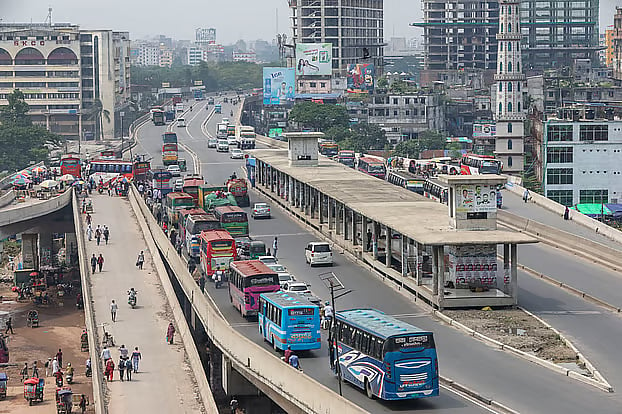
During a visit to the project area from the airport to Gazipur on 25 May, it was observed that 15 station structures had been built in the median of the road under the BRT project. However, none of them has been completed. Some stations are at ground level, while others are located on elevated sections. To allow passengers to access the stations from both sides of the road once the dedicated buses begin operating, modern pedestrian crossings have been constructed. These include escalators, and some stations also have lifts.
One escalator in Uttara was briefly put into operation, but it is now out of service. The machinery of escalators at other stations are rusting and deteriorating, some structures already falling into disrepair.
Md. Sohel, a covered-van driver who transports goods along the Dhaka–Mymensingh highway, told Prothom Alo that on a rainy day in 2022, it took him 10 hours to travel from the airport area to Gazipur. He said the suffering caused by the BRT project is unforgettable.
According to him, all vehicles are now being allowed to use the BRT lane. Traffic congestion occurs frequently. There are inadequate signs and signals; some sections are elevated while others are at ground level; certain stretches are fenced off; and parts of the road are narrow. As a result, drivers often become confused and take the wrong route.
A visit to the area revealed that, in some parts of Uttara, iron fences have been erected in the middle of the road to separate the BRT lane. In several places, however, the fences have been broken, allowing people to cross the road through the gaps. Garment factories line both sides of the entire 20 km corridor. In front of these factories, security guards carrying red flags were seen stopping vehicles to help workers cross the road safely.
Along the entire 20 km route from the airport area to Gazipur, the BRT lane has been separated from the rest of the roadway by concrete barriers nearly one foot high. If the project is canceled and normal traffic flow is to be restored for all types of vehicles, those barriers will have to be removed.
14-year project
The concept of Bus Rapid Transit (BRT) involves creating two dedicated lanes in the middle of a roadway exclusively for special buses. Dhaka''s first BRT project was undertaken along the route from Hazrat Shahjalal International Airport to Shibbari in Gazipur, covering nearly 20 kilometers. Of this distance, 15.07 kilometers consists of roadway at ground level, while the remainder is elevated. The project was launched in 2012.
Over the past 14 years, the project has caused severe hardship not only for residents of Uttara, Tongi, and Gazipur, but also for travelers commuting to and from the greater Mymensingh region, northern Bangladesh, and Tangail. In addition, seven people lost their lives in crane accidents and other construction-related incidents during the project's implementation.
The Bangladesh Institute of Planners (BIP), however, believes that it would not be appropriate to cancel the project when only about 3 per cent of the infrastructure work remains unfinished
Initially, the BRT project's budget was estimated at approximately Tk 20.4 billion (2,040 crore). Construction was supposed to be completed in 2016, with automated-door buses beginning operations in 2017. However, the project proposal was revised three times. Deadlines were extended, and the projected cost increased to Tk 42.68 billion (4,268 crore). Despite this, the work remained unfinished and the modern buses never entered service. So far, Tk 28.11 billion (2,811 crore) has been spent.
In 2025, the Road Transport and Highways Division proposed a fourth revision of the project. Under the new proposal, the estimated cost rose to Tk 65.98 billion (6,598 crore), with the completion deadline extended to 2029.
Project review
However, during the tenure of the interim government, the Executive Committee of the National Economic Council (ECNEC) did not approve the fourth revised proposal. Instead, it instructed authorities to reassess possible alternatives to the project. It also directed that the individuals or institutions responsible for the project's design flaws be identified and recommendations be made regarding appropriate actions.
Following this directive, a meeting was held on 31 August 2025, chaired by the Senior Secretary of the Road Transport and Highways Division. Two separate committees were formed, and both subsequently submitted reports.
At a meeting on 9 October 2025, chaired by Muhammad Fouzul Kabir Khan, then Adviser to the Ministry of Road Transport and Bridges, it was decided that the reports of the two committees would be reviewed by Professor Shamsul Hoque of the Department of Civil Engineering at BUET. He was formally assigned responsibility for conducting the review.
Sources within the Ministry of Road Transport say that the interim government's policy position was that it would not move forward with the BRT project. However, the current BNP-led government has not yet reached a clear decision on whether the project should continue. Some have even suggested seeking the opinion of the parliament before making a final decision.
During construction it was found that there was no proper drainage system in the project area, causing waterlogging. There was also no prior plan for how to relocate utility service lines
The Bangladesh Institute of Planners (BIP), however, believes that it would not be appropriate to cancel the project when only about 3 per cent of the infrastructure work remains unfinished. According to the institute, dismantling the project would itself be costly, as removing the stations, ramps, and escalators, along with compensating contractors, could require more than Tk 10 billion (1,000 crore).
This position was presented at a press conference titled “Transit-Oriented City: The Future of the Dhaka–Gazipur BRT”, held on 18 May at the BIP Conference Hall in the capital.
A senior official of the Ministry of Road Transport, speaking to Prothom Alo on condition of anonymity, said that if the project is abandoned now, a large portion of the money borrowed and spent on it will effectively be wasted. Moreover, if the corridor is to be fully reopened for all types of vehicles, several hundred crore taka more will have to be spent to dismantle the existing infrastructure.
On the other hand, there is also a risk of failure if the government decides to proceed by spending an additional Tk 35 billion (3,500 crore) to purchase and operate the buses. As a result, the project has become a major dilemma for policymakers.
The BRT project was largely designed around foreign financing. In addition to the Asian Development Bank (ADB), funding has also been provided by the French Development Agency (AFD) and the Global Environment Facility (GEF).
To purchase and operate the buses for the BRT system, the Dhaka Bus Rapid Transit Company Limited (DBRTCL) was established in 2013. The company currently has 18 employees, including a managing director. Most of them have been transferred or deputed from other government agencies. Since no buses have been purchased, they have had very little actual work to perform.
Design flaws and mismanagement
According to information from a website called Global BRT Data, BRT systems are operating in 191 cities around the world. These systems collectively carry about 32.5 million passengers every day. In neighboring India, BRT systems operate in 13 cities, with a combined network length of 228 kilometers, serving around 500,000 passengers daily. In China, about 4.4 million passengers use BRT systems, while in Taiwan the number is around 1.35 million.
In 2005, the government adopted the Strategic Transport Plan (STP) for Dhaka. The plan recommended introducing BRT in Dhaka alongside metro rail, flyovers, and bus route franchising. However, the Airport–Gazipur route was not included in the STP. In 2011, the ADB, through its appointed consultants, proposed this route as suitable for a BRT system.
Relevant sources say that the project was undertaken before a full feasibility study and detailed design had been completed. As a result, several problems emerged during implementation. For example, during construction it was found that there was no proper drainage system in the project area, causing waterlogging. There was also no prior plan for how to relocate utility service lines. In addition, no alternative arrangements were made to maintain normal traffic flow during construction on this busy road.
A 2019 survey conducted under the BRT project found that between Tongi College Gate and Bhogra Bypass, an average of 24,754 vehicles pass daily. A 2022 survey by the Dhaka Metropolitan Police reported that around 40,000 vehicles pass through Abdullahpur every day.
BUET has also raised serious allegations against the design consultant firms. The report states that the road becomes narrower near BRT station areas. In many places, the access ramps from pedestrian overbridges encroach on sidewalks. In important locations such as Abdullahpur, Bhogra, and Gazipur intersection, the design is such that no future transport infrastructure can be developed there.
Chaotic project
The BRT project is being implemented by three government agencies, and officials say coordination among them has become a major challenge. The Roads and Highways Department (RHD), the Bridge Division, and the Local Government Engineering Department (LGED) are responsible for the main construction work. A state-owned company, the Dhaka Bus Rapid Transit Company Limited (DBRTCL), was formed to operate the system. Project coordination is overseen by a committee under the Dhaka Transport Coordination Authority (DTCA). In addition, four consultancy firms were engaged to supervise the work.
The RHD was responsible for upgrading and widening 16 kilometers of road, constructing the BRT lanes, six small flyovers, and 25 BRT stations. The Bridge Division was assigned to build a 4.5 km elevated corridor, including BRT lanes and stations, as well as a new 10-lane bridge replacing the existing Tongi Bridge. The LGED was responsible for service roads, building a bus depot in Gazipur, and installing traffic management equipment and street lighting.
According to project-related documents, three Chinese companies are responsible for constructing the elevated sections and roads. A local company has been assigned to build the depot in Gazipur.
Experts say that in most countries where BRT projects are implemented, they are built on roads with 12 to 14 lanes. However, the Gazipur road has four lanes, while the airport section has six lanes. Separating two dedicated lanes in the middle of such a road is difficult. In addition, the concept of having BRT lanes partly on elevated sections and partly at ground level is also considered flawed. On such a corridor, the entire BRT system should have been built as an elevated route.
Who is responsible?
The BUET report does not name any individual as directly responsible. However, it states that those among the key contributors to the project’s failure include the consultants who prepared the feasibility study, the design consultants, and the government officials involved in planning and implementation. It says they must be held accountable. In addition, the financing agencies, the project steering committee, the government’s Implementation Monitoring and Evaluation Division (IMED), and the Planning Commission have also been held responsible.
The BUET report contains 17 recommendations. These include emphasising commuter rail, quickly completing unfinished pedestrian overpasses, and constructing new overpasses based on the needs of workers and pedestrians. It also proposes relocating escalators and elevators from BRT stations to other government facilities or selling them at auction.
The head of the BUET expert team, Professor Shamsul Hoque, told Prothom Alo that the BRT was an imposed project. He said there were flaws in the design and the feasibility study was not properly conducted, but none of these irregularities were identified by the implementing agencies, consultants, or even the Planning Commission. “It is a very poor example,” he said.
The professor further said that this type of project is the first of its kind in Bangladesh, so a lack of experience was possible. However, experienced professionals existed globally and could have been brought in. This immature and imposed project has caused public suffering for over a decade. Money has been spent, but none of the promised benefits have reached the public. He added that this should serve as a lesson for the future so that the same mistakes are not repeated.