Nehreen Khan Memorial Lecture
Caretaker govt system a ‘purely’ bureaucratic mis-administration: Farashuddin
The former governor of the Bangladesh Bank and economist, Professor Mohammed Farashuddin, has characterised the caretaker government system as a “purely” bureaucratic maladministration.
He remarked that by relying on this system, politicians are effectively demonstrating a lack of confidence in themselves, which he noted is by no means a positive indicator.
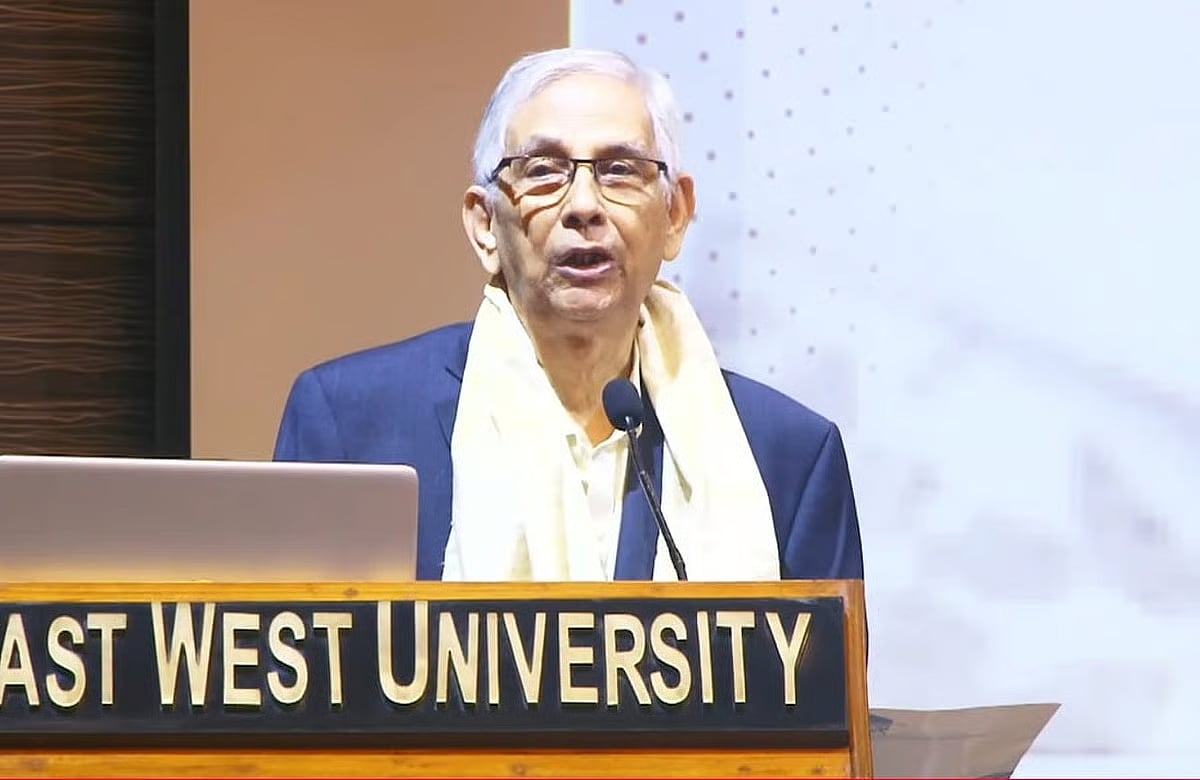
Mohammed Farashuddin made these observations whilst delivering his address as the distinguished speaker at the 'Nehreen Khan Memorial Lecture and Award Ceremony 2026', held at the private East West University in the capital on Sunday.
Speaking at the event, which was organised for the eighth time, he presented a written paper titled 'Constitutional Reform and Democratic Governance: The Bangladesh Perspective'.
In his address, he outlined a comprehensive suite of proposals aimed at parliamentary and constitutional reform in Bangladesh.
Mohammed Farashuddin believes that substantial improvements can be achieved if electoral reforms are implemented alongside a mechanism for power-sharing between the Prime Minister and the President.
He pointed out that the election of the President is currently solely dependent on the volition of members of parliament (MPs).
To address this, he proposed the formation of a broad 'Electoral College' for presidential elections. This body would comprise not only MPs but also representatives from the Dhaka city authority, mayors and commissioners of city corporations, and elected representatives from district and upazila councils.
In his view, this arrangement would enhance both the prestige and the balancing power of the presidency.
Furthermore, Mohammed Farashuddin stated that the authority to appoint individuals to all constitutional posts should vest in the President. However, he stipulated that such appointments must be preceded by consultations with both the Prime Minister and the Leader of the Opposition.
Upper house
In his written text, Mohammed Farashuddin cited the examples of the elections held in 1991, 1996, 2001, 2006, 2014, 2018, and 2024. He argued that due to the ‘winner-takes-all’ principle, even a marginal difference in the popular vote translates into a disproportionately vast disparity in parliamentary seats.
To mitigate this, he proposed the creation of a 100-member Upper House. Under his proposal, members of the Upper House would be elected in proportion to the votes received by respective political parties.
This Upper House would possess the authority to review constitutional amendments and crucial legislative bills.
Proposal to amend article 70
Mohammed Farashuddin proposed an amendment to article 70 of the Constitution. He noted that whilst this provision was originally introduced to prevent frequent 'floor-crossing', it has now effectively transformed into an instrument of coercion against MPs.
His proposal suggests that MPs should retain the right to vote against the party whip (directives) on all matters, with the exception of three specific areas: constitutional amendments, motions of no-confidence, and finance bills.
Additionally, if two-thirds of the members of a parliamentary party wish to form a separate bloc, it should be permissible, he proposed. However, utilising the name and symbol of the parent party would require the explicit consent of the party leadership.
Women's empowerment
Mohammed Farashuddin proposed the introduction of a provision whereby the registration of any political party would be cancelled unless at least one-third of its nominated candidates in national parliamentary elections are women.
He further suggested that this ratio should be progressively increased to 50 per cent.
To curb electoral expenditure, he recommended reducing the security deposit amount and funding a portion of election expenses from the state exchequer.
He also advocated for ensuring accountability in electoral spending through rigorous auditing.
Administrative reform
In the second part of his address, Mohammed Farashuddin spoke on administrative reforms. He noted that approximately 500,000 public sector positions currently remain vacant. If these vacancies are filled in an objective and impartial manner, it would significantly reduce the unemployment rate.
He proposed the establishment of a high-powered, independent commission to reform the bureaucracy. Alongside this, he suggested sending inefficient officials into retirement by offering them 'golden handshakes'.
Non-performing loans (NPLs)
Speaking regarding the banking sector, Mohammed Farashuddin recalled that in the late 1990s, a 10 per cent upfront cash deposit was mandatory for loan rescheduling. This requirement has now been slashed to a mere 1 per cent.
He also highlighted that the number of bank directors permitted from a single family has been increased from two to four, whilst their tenure has been extended from four to 12 years.
According to his estimates, defaulted loans in the country stood at roughly Tk 90 billion (9,000 crore) in 1990. This figure has skyrocketed to the current Tk 6 trillion (600,000 crore), accounting for nearly 36 per cent of total disbursed loans.
To tackle this crisis, he advised segregating the interest on non-performing loans into a separate account.
A trillion-dollar economy
Mohammed Farashuddin noted that Bangladesh's GDP stood at US$10 billion in 1972, which has now grown to $460 billion. If this momentum is sustained, he expressed optimism that the country could transition into a trillion-dollar economy by 2036.
He identified weaknesses in revenue collection as the country's most formidable challenge. Given this scenario, he stressed the urgent need to bring the tax administration under complete automation.
Debates 'uncalled for'
Mohammed Farashuddin described the ongoing controversies surrounding the Father of the Nation and the Proclamation of Independence as 'uncalled for'.
He asserted that the resolution to this issue lies within the speech delivered by the martyred President Ziaur Rahman on 27 March 1971, from the Shadhin Bangla Betar Kendra in Kalurghat. In that broadcast, Ziaur Rahman explicitly stated that he was proclaiming independence on behalf of Sheikh Mujibur Rahman. Furthermore, his respect for Bangabandhu remained unswervingly genuine throughout.
Emphasis on inclusivity
Speaking on the question of reform, Mohammed Farashuddin emphasised the necessity of inclusive politics.
He warned that any plan to marginalise or exclude a major segment of the population from the political mainstream is bound to fail. The political process must be universal, as sustainable reform cannot be achieved by leaving anyone behind.
The event was attended by the Vice-Chancellor of East West University, Shams Rahman, as the guest of honour. Other speakers included Fakrul Alam, retired professor of the Department of English at Dhaka University; poet and journalist Sohrab Hassan; and Air Commodore (retd) Ishfaq Ilahi Choudhury, Treasurer of East West University and Chairperson of the Board of Trustees of the Nehreen Khan Memorial Fund.
Nehreen Khan was the only child of the late Akbar Ali Khan—former advisor to the caretaker government and Cabinet Secretary—and the late Hamim Khan, a teacher at Sunbeams School.
After studying in the United States, she returned to Bangladesh, enrolled at East West University, and completed her MA in English Literature. She passed away in 2016 at the age of 39 after battling a terminal illness.
East West University administers literary awards and student scholarships under the 'Nehreen Khan Memorial Fund'.