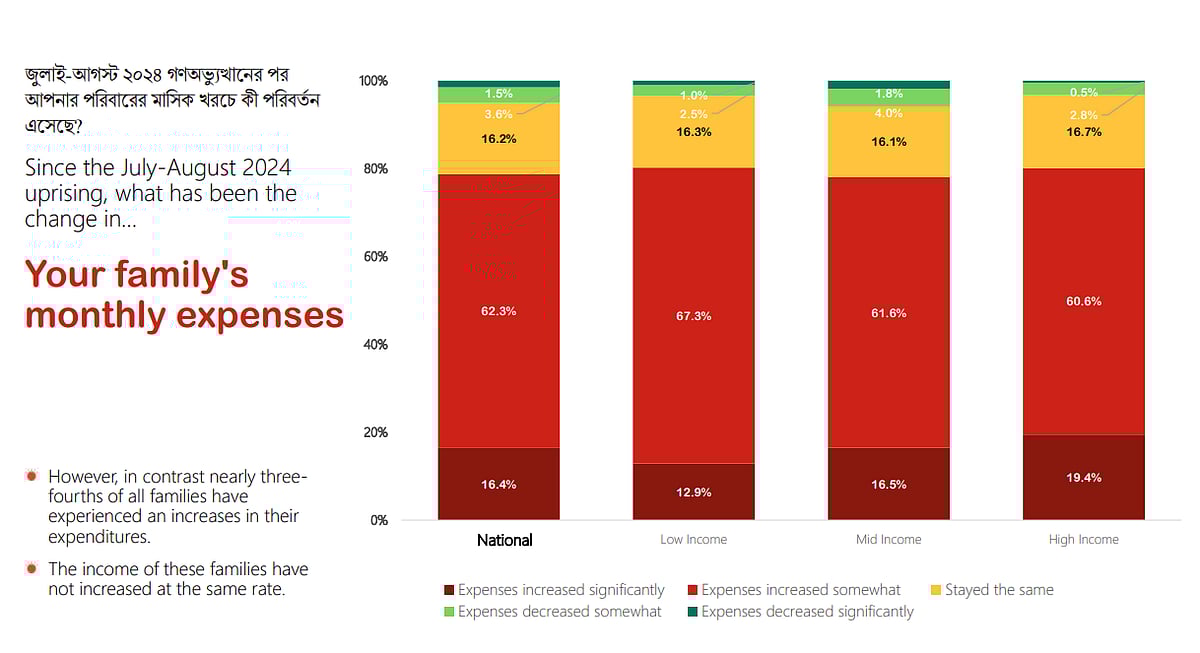
In the one year following the July mass uprising, the incomes of only a small number of people have increased, while expenses have risen for the majority. Most people are dissatisfied with the government’s efforts to secure livelihoods for ordinary citizens and to control commodity prices.
These views emerged in the “National Public Opinion Survey on Key Socio-Political Issues–2025” conducted on the initiative of Prothom Alo. The survey was carried out for Prothom Alo by the private research organisation Keymakers Consulting Limited.
The survey included five questions on income, household expenditure, and price control. One question asked: how satisfied are you with the work done by the post–July mass-uprising interim government in ensuring people’s income opportunities and controlling commodity prices?
In response, about 51 per cent of respondents said they were dissatisfied. Around 28 per cent said they were satisfied. The rest were neither satisfied nor dissatisfied. The rates of satisfaction and dissatisfaction were similar across the three income groups—low, middle, and high.
Due to falling global commodity prices and other factors, inflation has dropped sharply in countries including India, Sri Lanka, and Pakistan. In Bangladesh, however, it remains high.
Under the initiative of Prothom Alo, opinions were collected from 1,342 adults (aged 18–55) from five urban areas and five rural or semi-urban areas of the country. Participants came from different income levels, social classes, and professions. Data were collected between 21 and 28 October.
The survey organisation stated that this was an opinion poll. It is nationally representative but does not specifically represent any particular electoral constituency. The sample reflects people who can read online or print newspapers and are likely to vote in the next election. The confidence level of the survey results is 99 per cent.
Income increased for only 12pc of people
Another survey question asked: what change has occurred in your family’s monthly income since the July mass uprising? Only about 12 per cent of respondents said their income had increased. Forty-two per cent said their income had decreased, while 46 per cent said it had remained the same.
There is some variation across low, middle, and high income groups in terms of income increases or decreases. A large portion of wealthier people reported a decline in income, but wealthier respondents were also more represented among those whose income increased. Income declines were more common among low- and middle-income groups.
Similar patterns emerged regarding expenditure. Five per cent of respondents said their expenses had slightly decreased. However, about 79 per cent believed their expenses had increased, while the remaining 16 per cent said their expenses had neither increased nor decreased. The proportion reporting increased expenditure was almost the same across low, middle, and high-income groups.
How much money is needed to run a household?
The survey asked how much monthly income a four-member family needs to live decently. Based on respondents’ answers, the average figure stands at Tk 35,505.
People in Dhaka’s urban areas cited the highest required income—Tk 42,505 per month. The lowest figure was reported by respondents from rural areas of Faridpur—Tk 26,783.
Prices have increased
The survey also asked what change respondents had noticed in the prices of daily necessities since the July mass uprising. More than 82 per cent said prices had gone up. About 9 per cent believed prices had remained unchanged, and the remaining roughly 9 per cent said prices had fallen. People from lower-income groups more frequently reported price increases; among others, the rates were similar.
Following the July mass uprising, the interim government led by Professor Muhammad Yunus assumed office three days after the fall of the Awami League government on 5 August last year. In August of that year, the country’s inflation rate was 10.49 per cent. By last October, it stood at 8.17 per cent—meaning goods and services that cost Tk 100 a year earlier now cost more than Tk 108.
Due to falling global commodity prices and other factors, inflation has dropped sharply in countries including India, Sri Lanka, and Pakistan. In Bangladesh, however, it remains high.