Liberation War Museum of Bangladesh Police
A glorious history illuminated by the spirit of resistance
At 11:30 pm on 25 March 1971, Shahjahan Miah, a wireless operator, transmitted an emergency message across the country from the then central wireless base station of the police at Rajarbagh in Dhaka, informing all stations of the attack by the Pakistani army.
In that message, he stated, “All base stations of the East Pakistan Police are being alerted that the Pakistani army has attacked us. Ensure your own safety.”
That same night, members of the police at Rajarbagh Police Lines mounted the first resistance against the Pakistani forces.
Shahjahan Miah took position on the rooftop of the Police Headquarters building and actively participated in the resistance.
When his ammunition ran out towards dawn, Pakistani forces captured him and subjected him to torture. He was released two days later, on 28 March, and subsequently joined the Liberation War.
The wireless device used by Shahjahan Miah to send that message was of the ‘Helicopter Badge’ model.
This historic device is now preserved at the Liberation War Museum of Bangladesh Police. The message itself is displayed on the museum walls in both Bangla and English.
On the night of 25 March 1971, just before the Pakistani forces launched their attack, Abdul Ali, the bodyguard of the then inspector general of police, rang the ‘Pagla Ghanta’ (alarm bell) to gather police personnel scattered across the area. He urged them to organise resistance against the Pakistani forces.
Hearing the alarm, police members stationed at Rajarbagh assembled there.
They then collected arms and ammunition from the armoury, raised the flag of independence with a ceremonial guard, and prepared for resistance. That very alarm bell is also preserved in the museum.
From the first resistance to the broader contributions of the police during the Liberation War, the museum has numerous artefacts and relics. It also presents brief historical accounts of these items.
The ‘Liberation War Museum of Bangladesh Police’ stands as a testament to the proud history of the police force’s role in the Liberation War.
The museum is located at Rajarbagh Police Lines in Dhaka, adjacent to the Police Smrity Stambha. Its architectural design reflects the form of the memorial itself. Authorities inaugurated the museum on 23 January 2017.
Earlier, on 24 March 2013, they had inaugurated the first version of the museum at the Telecom Building within Rajarbagh Police Lines.
During a recent visit, Sub-Inspector (SI) Ahsan Habib, who is in charge of the museum, welcomed this correspondent.
He guided the visit throughout the museum and provided detailed information about the weapons used by police personnel during the Liberation War that are preserved there.
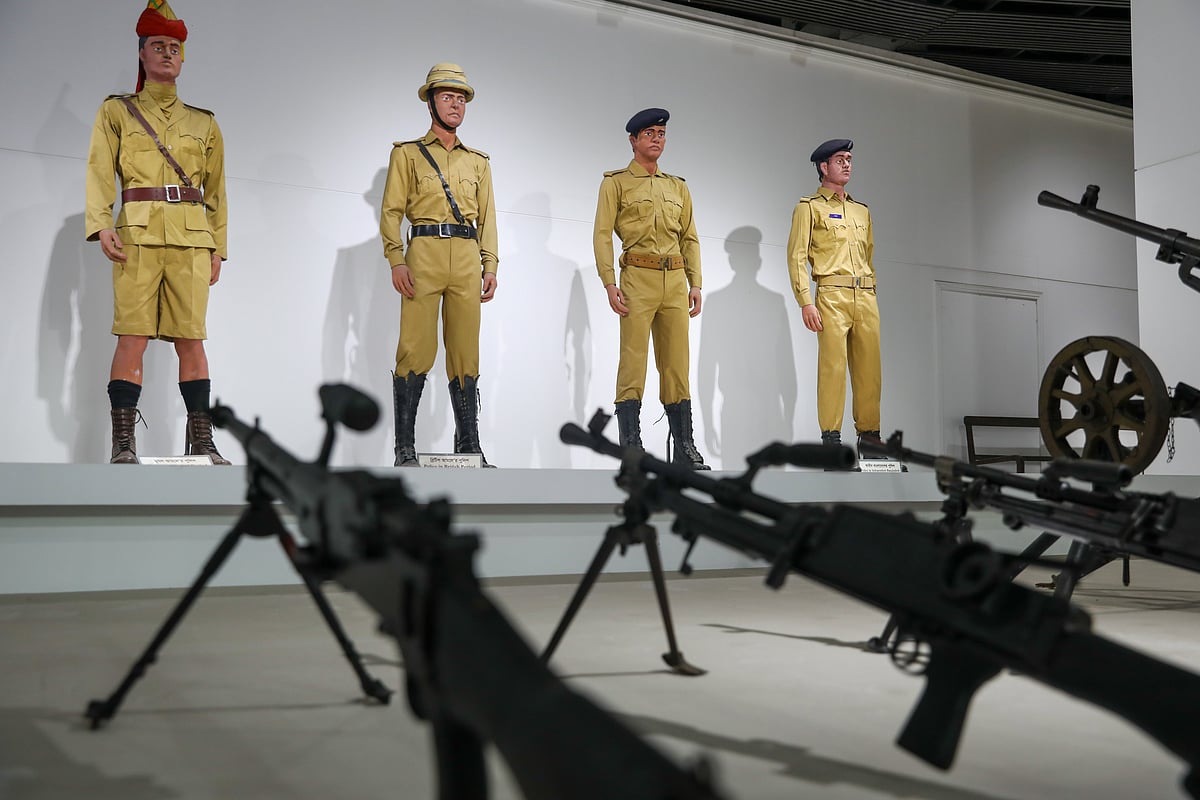
Ahsan Habib told Prothom Alo that the museum preserves a wide range of weapons used by police during the Liberation War, including SMGs, LMGs, machine guns, rifles, revolvers, guns, shotguns, axes, and bayonets.
He added that the museum also displays various artefacts representing the contributions of the police during the war, alongside weapons and equipment used by the police during the British colonial period.
SI Ahsan Habib said, “Visitors to the Bangladesh Police Liberation War Museum can learn about the role of the police in the great Liberation War and explore numerous historical artefacts. The museum was established to introduce the new generation to this history and to preserve the diverse relics of the Liberation War.”
Artefacts of martyred police personnel
The Liberation War Museum of Bangladesh Police preserves numerous artefacts used by police personnel who were martyred during the liberation war.
Among these are the blazer and trousers used by Police Superintendent Shah Abdul Majid. The museum also holds the uniform belt and baton of Deputy Inspector General (DIG) Mamun Mahmud.
The walls display wartime diaries, handwritten messages, photographs, and posters of valiant freedom fighter police members.
In addition, the museum has collected and preserved uniforms, clothing, belts, spectacles, batons, and various personal belongings of many other martyred police personnel.
The museum preserves not only personal items used by martyred police members but also important documents and artefacts related to the Liberation War.
During the war, Abdul Khaleq was appointed Inspector General of Police (IGP). He also served as the first Home Secretary of the Government of Bangladesh.
After the outbreak of the Liberation War, approximately 14,000 police personnel stationed in the then East Pakistan left their posts and joined the war. Alongside direct participation in combat, they also trained, organised and mobilised freedom fighters.
Subsequently, the Pakistan government ordered the police personnel who had joined the Liberation War to return to their workplaces.
At that time, IGP Abdul Khaleq, through a letter, called upon them to continue the Liberation War and not to rejoin their posts until the country achieved independence. That historic letter is also preserved in the museum.
History of atrocities by Pakistani forces on display
During a visit to the Liberation War Museum of Bangladesh Police, a wall-mounted text draws attention. It presents the history of the first armed resistance during the Liberation War. The heading of the text reads, “First Resistance: Rajarbagh Police Lines, 25 March 1971”.
It states that, on the night of 25 March, Pakistani forces attacked Rajarbagh Police Lines in accordance with the plan of ‘Operation Searchlight’.
Bengali police members stationed at the police lines broke open the armoury and took positions to resist the Pakistani army.
The Pakistani forces planned their attack on Rajarbagh Police Lines from three directions—Shantinagar, Malibagh and Fakirapul. At around 11:30 pm, a convoy reached Shantinagar.
As the soldiers disembarked, the first bullet fired by the police from the roof of Don School (now Eastern Plus Shopping Mall) struck a Pakistani soldier, who immediately collapsed to the ground.
That bullet, fired from Don School, marked the first shot of the armed resistance for independence.
Towards the end of the night, when police ammunition ran out, Pakistani forces took control of Rajarbagh. Mortar shell attacks destroyed the tin-shed barracks of the police lines, which were subsequently burned.
Pakistani forces carried out widespread looting in the police lines and subjected women to severe abuse. They brutally killed trapped-police personnel and disposed of their bodies in the Buriganga River.
This account appears on the museum wall, drawn from a report by the United Kingdom’s The Daily Telegraph.
It notes that although the exact number of police personnel martyred at Rajarbagh on the night of 25 March is not specified, very few survived.
The museum walls also document the attacks and atrocities carried out by Pakistani forces at Ramna Police Station, Bangshal Police Station, Babupura Police Outpost, and Kotwali Police Station. One particular text on the wall draws attention, titled “Indiscriminate Killing of Police”.
It states that on 25 March 1971, sweepers collected two truckloads of bodies from the morgue of Mitford Hospital in Old Dhaka, most of which were mutilated corpses of government employees, police, Ansar members, and power workers dressed in khaki uniforms. Many of the decomposed, swollen, and bullet-ridden bodies were clad in police khaki shirts.
Visitor information
The Liberation War Museum of Bangladesh Police remains open to visitors every day except Wednesday from 10:00 am.
It stays open until 6:00 pm from March to September and until 5:00 pm from October to February. The museum closes for one hour at 1:00 pm each day.